
Marketing that produces booked, paying patients — not just impressions.
We help cash-pay medical practices fix the message, pick the right channels, and build the conversion systems that turn ad spend into revenue.
What is medical practice marketing?
Medical practice marketing is the complete system a clinic uses to attract, convert, and retain patients: the message and offer, the channels that put it in front of the right people, and the front-desk and follow-up process that turns interest into booked appointments. For a cash-pay practice, awareness alone isn't enough — the marketing has to generate patients who choose to pay out of pocket. That makes message clarity, proof, conversion, and strong patient acquisition systems every bit as important as traffic.
The fix is to get the fundamentals in the right order: message, then market, then media, then the system that converts.
Why cash-pay marketing is different
An insurance practice competes on being in-network. A cash-pay practice has to earn the wallet directly. That changes everything.
Competes on being in-network
- Patient picks from a list of covered providers
- Decision is logistical, not emotional
- Marketing optimizes for visibility & convenience
- KPI: cost per lead
Competes on outcome, trust & experience
- Patient is choosing to spend money out of pocket
- Decision turns on message clarity & visible proof
- Speed-to-lead & conversion system make or break ROI
- KPI: cost per booked, paying patient
It also changes the math. A recurring hormone membership patient or a high-ticket regenerative case is worth far more than a one-off visit, so the marketing should be built around acquiring and keeping high-LTV patients. We go deep on that in which marketing channel brings the highest-LTV patient.
Start with message, not media
The most expensive mistake clinics make is opening an ad account first. The order that compounds is the opposite.
Message
Decide the single result you deliver and the exact patient you serve. Sharp, specific, defensible.
Market
Find where those patients already are — by demographic, condition, and awareness stage.
Media
Only now do you pick the platform — and only the one that fits the message and the market.
Get this backwards and you pay to put a muddy message in front of the wrong people. Two clinics can spend the same and get wildly different results: the one with a sharp message, a specific patient avatar, and a compelling offer converts; the one running generic "we treat everything" ads burns cash. See why you start with message before choosing a channel and how to define your ideal patient avatar.
Match the channel to the treatment
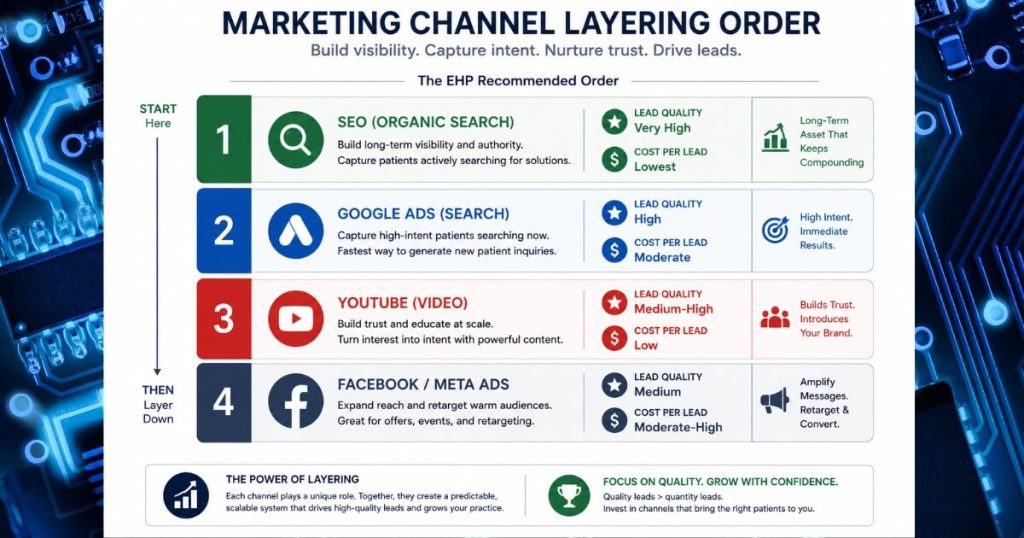
There is no universally best channel — only the right channel for a specific treatment, awareness stage, and cash ticket.
SEO + Google
Patients searching by name: TRT, GLP-1, hormones, peptides.
TikTok + Meta
Discovery-driven offers — aesthetics, weight loss, pain.
YouTube Ads
Earlier-stage research — building trust before the search happens.
Radio + Events
Specific demographics — high-ticket pain, regenerative, longevity.
The skill is picking one lead channel that fits, maximizing it, then stacking a second to fill the gap — depth before width. Paid ads are powerful, but they're not always the first move. A practice without a brand, an offer, and a conversion system often shouldn't scale ads yet. We cover the decision in when paid ads actually work for a cash-pay practice and the buyer psychology in the 5 stages of customer awareness. Most clinics start with SEO first because it produces the highest-LTV patients at the lowest acquisition cost. For treatment-specific growth, we also build dedicated strategies for med spa marketing, pain management practice marketing, stem cell clinic marketing, men’s hormone & TRT clinic marketing, GLP-1 & weight loss clinic marketing, regenerative medicine marketing, peptide therapy clinic marketing, and functional medicine & longevity clinic marketing.
The conversion system makes or breaks every channel
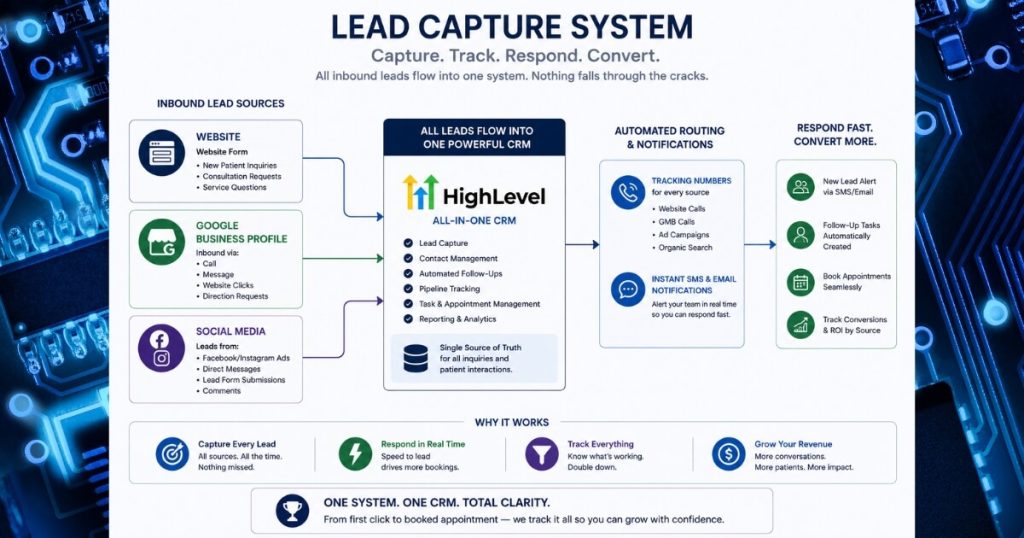
Marketing fills the pipeline. The conversion system turns it into money. Without it, even great marketing leaks.
The clinics that win respond to every new lead within minutes, give the front desk a script and a written FAQ so no question stalls a booking, and run a structured follow-up sequence for the patients who don't book on the first touch. Without that, leads sit, cool off, and book the clinic across town instead.
- Speed-to-lead under 5 minutes. Every minute of delay halves conversion. Notifications fire instantly to phone and email.
- Trained, scripted intake. The front desk has a 90-second script and a written clinical FAQ — no question stalls a booking.
- 8-touch follow-up sequence. SMS, voicemail, email. Designed to outlast the "I'll think about it" plateau.
- CRM, not Gmail. Every lead tracked end-to-end. No lead lost to an inbox, no patient touched twice by accident.
This is the most common reason a clinic concludes "marketing doesn't work" when the real issue is operational. If your leads aren't converting, start with the system, not the spend.
What this looks like when it works
Different verticals, different channels, same fundamentals. We helped Eternity Health Partners grow from $1M to $4M a year, added $6.7M in a single year across 3,727 new patients for NuLevel Wellness, and generated $309,590 in cash-pay revenue in 10 months from SEO alone, at a 79.4% conversion rate for Orthobiologics Associates — no ad spend at all. Another cash-pay growth example produced $1.44 million collected across nine tracked months at a cash-pay regenerative practice.
Eternity Health Partners
Grew from $1M to $4M a year over 4 years. SEO alone now drives $1.7M/yr in recurring memberships — zero ad spend.
Read the case study →NuLevel Wellness
Added $6.7M and 3,727 new patients in a single year via a diversified multi-channel paid strategy.
Read the case study →Orthobiologics Associates
$309,590 in cash-pay revenue over 10 months from SEO alone, at a 79.4% lead-to-patient conversion rate.
Read the case study →FAQ's About Medical Practice Marketing
What is medical practice marketing?
It's the system a clinic uses to attract, convert, and retain patients — its message and offer, the channels it runs (SEO, Google, paid social, events, referrals), and the front-desk and follow-up process that turns leads into booked, paying patients. For cash-pay practices it has to produce patients who pay out of pocket, so message and conversion matter as much as traffic.
How is marketing a cash-pay practice different from an insurance-based one?
A cash-pay practice has to convince patients to pay out of pocket, so it competes on outcome, trust, and experience rather than on being in-network. That makes message clarity, a strong offer, proof, and fast lead follow-up far more important — and the metric that matters is cost per booked patient, not cost per lead.
Which marketing channel is best for a medical practice?
There's no single best channel — it depends on the treatment, the patient's awareness stage, and the cash ticket. SEO and Google capture patients searching by name; TikTok and Facebook drive discovery for aesthetics and pain; events and radio reach specific demographics. Pick one lead channel that fits, maximize it, then stack a second.
Why isn't my medical practice marketing producing patients?
Usually the leads are fine and the conversion system is the problem. If leads wait hours for a callback, the front desk can't answer questions, or there's no follow-up sequence, marketing gets blamed for an operations failure. Fix speed-to-lead, scripts, and follow-up before adding ad spend.
How do I choose a medical practice marketing agency?
Choose one that understands cash-pay economics and patient acquisition, not just running ads. Ask for case studies with real revenue and patient numbers in your vertical, confirm they work on message and conversion, and make sure they measure cost per booked patient. Specialization in cash-pay practices matters more than agency size.
Let's build your marketing system
If your cash-pay practice is spending on marketing without the patient volume to show for it, the fix is rarely "spend more." It's sharpening the message, matching the channel to your treatments, and closing the gaps in your conversion system. On a free strategy call, our medical practice marketing consultants will map exactly where your leverage is.