
The 5 Stages of Customer Awareness — How They Determine Which Ad Platform Works for Your Cash-Pay Medical Practice
Most cash-pay clinics don’t have an ad platform problem — they have an awareness-stage problem. Eugene Schwartz’s 5 Stages of Awareness explains why your TikTok ads bombed, why Google killed it, and why your competitor’s SEO is printing money. Across 40 of the fastest-growing cash-pay clinics in the country, the pattern is the same: when the platform matches where the patient already is, the ad works. When it doesn’t, no amount of creative testing will save it. This FAQ maps your services to the right stage — and the right platform.
What Are the 5 Stages of Customer Awareness, and Why Do They Matter for a Cash-Pay Medical Practice?
The 5 stages of customer awareness are Eugene Schwartz’s framework for where a prospect is on the journey from “doesn’t know they have a problem” to “ready to buy from you right now.”
They matter because each stage needs a different platform, offer, and message to convert.
Schwartz’s five stages are:
- Unaware — Prospects don’t know they have a problem. Marketing introduces the problem gently.
- Problem Aware — Prospects realize they have a problem but don’t know solutions exist. Messaging validates the problem.
- Solution Aware — Prospects know solutions exist but don’t know YOUR product. Marketing introduces the category.
- Product Aware — Prospects know your product exists and are comparing it to alternatives. Messaging is features, benefits, differentiation.
- Most Aware — Prospects are ready to buy. They need urgency, pricing clarity, or a CTA.
Importantly, people buy when they are “Most Aware.”
Your job is to help them get there.
However, if you push a Most Aware offer onto an Unaware TikTok scroller, you waste money.
Likewise, if you spend SEO dollars educating Unaware patients about a problem they don’t know they have, you waste years.
In most cases, the mismatch — not the platform — kills cash-pay growth.
Which Ad Platforms Work for Unaware and Problem Aware Patients?
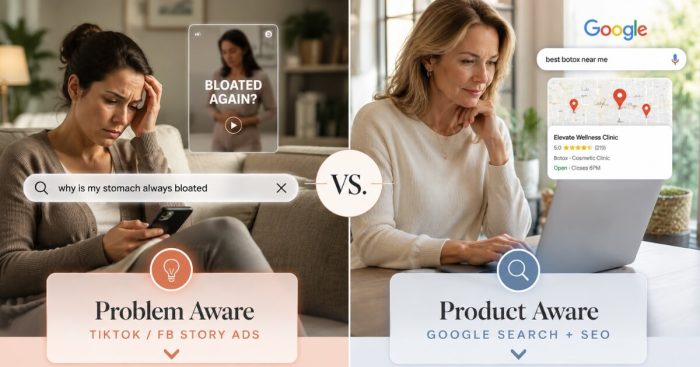
Interruption platforms — TikTok and Facebook/Instagram — are the only place Unaware and Problem Aware patients can be reached.
That’s because those patients aren’t searching for anything yet.
Anton’s named example is gut health.
These patients are Problem Aware. They know they have a problem, imagine solutions exist, but don’t know where to start.
As a result, they aren’t typing “functional medicine protocol near me” into Google — they’re scrolling TikTok wondering why they’re bloated every afternoon.
Therefore, the platform has to put your story in front of them before they go looking.
What works at this stage:
- TikTok ads for high-LTV services with a female-skewing audience — body contouring, hormone, GLP-1.
- Testimonial and real patient-story creative outperform polished ads.
- Historically, these campaigns produce lower CPL and CAC than other platforms.
- Facebook/Instagram ads for any vertical where front-end cash collected is over $3,000 — joint pain, neuropathy, body contouring.
- Audience callout in the copy is non-negotiable.
The funnel also can’t ask for too much commitment.
Anton’s order ascends in quality and descends in volume:
- lead form (most volume),
- landing page,
- scheduling page with credit-card-hold (most quality).
For Problem Aware traffic, lean toward volume and qualify on the back end.
Which Ad Platforms Work for Solution Aware Patients (Like Patients Searching “GLP-1” or “HRT” by Name)?
Solution Aware patients are searching by name.
As a result, Google, YouTube, and on-page SEO that ranks for those searches are where you win them.
When a patient types “GLP-1 weight loss” or “HRT clinic near me” into Google, they’ve already done the awareness work. They know a solution exists and have progressed through several of the 5 stages of customer awareness before beginning their search.
They know a solution exists; they just don’t know your practice.
Therefore, the platforms with intrinsic intent matching — Google search, YouTube via Performance Max, and on-page SEO — are the only ones that meet that intent.
Anton’s Google playbook:
- start with tight phrase match on terms he knows people search for,
- get conversions,
- then switch to Performance Max with assets to maximize on YouTube.
For video, see what people are typing first, then build creative from that.
Optimize on cost per lead.
Generally, lead quality is already good, so the sales process can be fixed if CPL is right.
The default Google funnel looks like this:
- ad,
- landing page,
- quiz,
- scheduling page with credit-card-hold.
For really high intent, use call-only ads (which is what LSAs are).
Meanwhile, for telehealth, ZocDoc is the Solution Aware gateway drug for primary care concierge, ADHD, and weight loss.
Which Ad Platforms Work for Product Aware and Most Aware Patients (Botox, Filler, TRT)?
Product Aware and Most Aware patients are choosing who to buy from.
Because of that, on-page SEO, GMB, Google reviews, branded search, and your organic social brand are the platforms that close them.
Anton’s named examples:
“Botox and filler: people are Product Aware. They know the product, they’re just choosing who to buy from.”
And:
“GLP-1 and TRT: have moved into Product Aware. Population knows about them, choosing who is best.”
Categories that were Solution Aware in 2022 are Product Aware in 2026 — and the platform that wins them has changed.
The channels that perform best include:
- on-page SEO for “best [treatment] in [city]”
- GMB, which ranks on relevance, engagement, posts, reviews, descriptions, and services listed
- reviews that mention the services you want to be found for
- organic social brand
- branded search at near-zero CPC
Anton specifically wouldn’t run FB/IG/TikTok ads without an established brand first.
The proof:
An HRT clinic we grew from $1M to $4M in 4 years with $1.7M/year in memberships from SEO alone is this pattern exactly.
Their patients were Product Aware — they knew HRT was the answer, they were choosing the practice — and SEO + GMB + reviews captured them at the highest intent.
Results included:
- SEO traffic growing from 80 → 1,000+ visits/month
- 60 inbound calls/month
- 250 members at $1,000/month
However, none of that works on Problem Aware gut-health patients who aren’t searching yet.
How Do I Map My Cash-Pay Medical Practice’s Services to the Right Awareness Stage?
First, write down every service you offer.
Then, write the awareness stage next to it.
Finally, assign each service its own platform mix based on that stage.
A working map for the verticals Anton works in most:
- Botox, filler, CO2 / fractional lasers
- Product Aware
- Google + SEO + GMB + brand
- GLP-1 weight loss
- Product Aware
- Google + SEO primary, TikTok/Meta secondary for volume
- TRT / Low-T / hormone
- Product Aware
- Google + SEO + conservative talk radio + brand
- HRT
- Product Aware (educated) / Solution Aware (broader)
- SEO + Google primary
- Gut health / functional medicine
- Problem Aware
- TikTok and FB/IG story creative + quiz funnel
- Joint pain, neuropathy, body contouring
- FB/IG (any vertical over $3,000 front-end cash works), supported by Google
- Neuropathy and knee pain at scale
- Over $20K LTV can run long-form TV infomercials
- The older audience is the right demographic
- Primary care concierge, ADHD, weight-loss telehealth
- ZocDoc as the gateway drug, then cross-sell
Most clinics have never done this exercise.
As a result, many run TikTok ads for Product Aware services and Google ads for Problem Aware services, which is exactly backwards.
What’s the Most Common Awareness-Stage Mismatch That Wastes Ad Spend at Cash-Pay Clinics?
The most common mismatch is running interruption-platform ads (TikTok, Meta) for Product Aware services — botox, filler, established TRT — instead of letting SEO and Google capture those patients at the moment of intent.
For example, a medspa runs a $5,000/month TikTok campaign for botox.
The creative is beautiful, and the targeting is dialed in.
However, it still underperforms because the Product Aware botox patient isn’t discovering your practice on TikTok.
Instead, she already knows she wants botox; she’s typing “best botox [city]” into Google.
Those dollars belonged on SEO, GMB, and reviews.
The reverse is just as expensive.
For example, a functional medicine clinic spends $4,000/month on Google ads for “leaky gut treatment” and gets crickets.
Why?
Because the Problem Aware gut-health patient isn’t searching for the solution category yet.
Those dollars belonged on Meta and TikTok with story creative.
Anton’s rule is simple:
depth before width
Pick 1–2 channels and maximize them for the stage your patient is actually in.
How Does the Awareness Stage Change My Offer, My Creative, and My Landing Page?
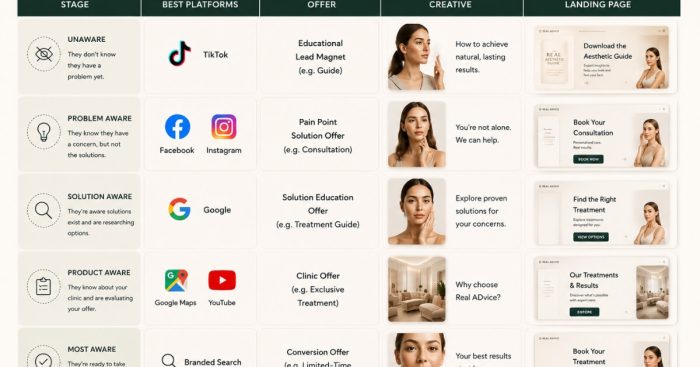
The awareness stage changes everything downstream of the ad.
As patients get closer to Most Aware:
- the offer becomes more concrete,
- the creative becomes less story-based and more proof-based,
- and the landing page asks for more commitment.
Offer by stage:
- Problem Aware — soft offer (free guide, “is this you?” quiz)
- Solution Aware — category offer (“$99 GLP-1 consult,” “free HRT lab panel”)
- Product Aware / Most Aware — practice offer (“book Friday, $50 off first syringe, credit card to reserve”)
Creative by stage:
Problem Aware
- testimonials,
- patient stories,
- audience callouts
Anton’s TikTok best practice is real patient-experience video including the offer or footage of the procedure.
- Solution Aware
- comparison and education built from real search queries
- Product Aware / Most Aware
- social proof,
- reviews,
- before/afters,
- your brand
The better your brand is on social, the better everything else converts.
Landing page by stage (Anton’s escalating-quality funnel):
- Problem Aware → lead form
- Solution Aware → landing page → quiz
- Product Aware / Most Aware → scheduling page with credit-card-hold
When the offer, creative, and landing page all match the stage, the platform works.
However, when one element is off-stage, the campaign underperforms.
What’s the Next Step?
If you’re running ads to the wrong awareness stage, you don’t have an ad problem — you have a strategy problem, and more spend won’t fix it.
The fastest unlock is auditing every service against the 5 Stages and rebuilding the media mix around where patients actually are.