
How Do I Define an Ideal Patient Avatar for My Cash-Pay Medical Practice?
The clinic that builds every offer, ad, lead magnet, and nurture sequence around one specific patient avatar grows 2–4x faster than the clinic trying to be everything to everyone. Here’s the 4-part framework — pains, desires, mission, demographic — used by every Real ADvice client we’ve taken past $1M/year.
If you cannot describe your ideal patient in one paragraph that includes their specific pains, their specific desires, their underlying mission, and their demographic and earnings profile, your marketing is generic and your conversion math is paying the price. Below is the avatar framework we work through with every cash-pay HRT, functional medicine, regenerative, longevity, and concierge practice we onboard, with a worked HRT/functional-medicine example, the interviews you should be running to discover your real avatar, and the most common mistakes cash-pay owners make trying to do this from their desk.
Why does an “ideal patient avatar” matter more for a cash-pay clinic than for an insurance-based one?
Because at a cash-pay clinic:
- every patient is opting in voluntarily
- every patient is paying out of pocket
…which means the patient must recognize themselves in:
- your content
- your offer
- the language your NPC uses on the consult call
An insurance-based primary care practice:
- gets foot traffic regardless of how generic its marketing is
A cash-pay practice:
- gets nothing unless the patient says, “this clinic seems to be talking to me specifically.”
A clearly defined avatar is what turns:
- a $30 lead into a $4,000 booked program
An undefined avatar is what makes:
- the same $30 lead disappear
The downstream impact compounds.
Your ideal avatar also tends to:
- have the highest LTV
- stay longer
- refer more
- complain less
…because everything you do is built for them.
Every clinic in our portfolio that broke past $1M/year had a specific avatar.
Every clinic that plateaued under $500K/year was still trying to serve:
- “everyone who walks in the door.”
What are the four components of a useful patient avatar (pains, desires, mission, demographic)?
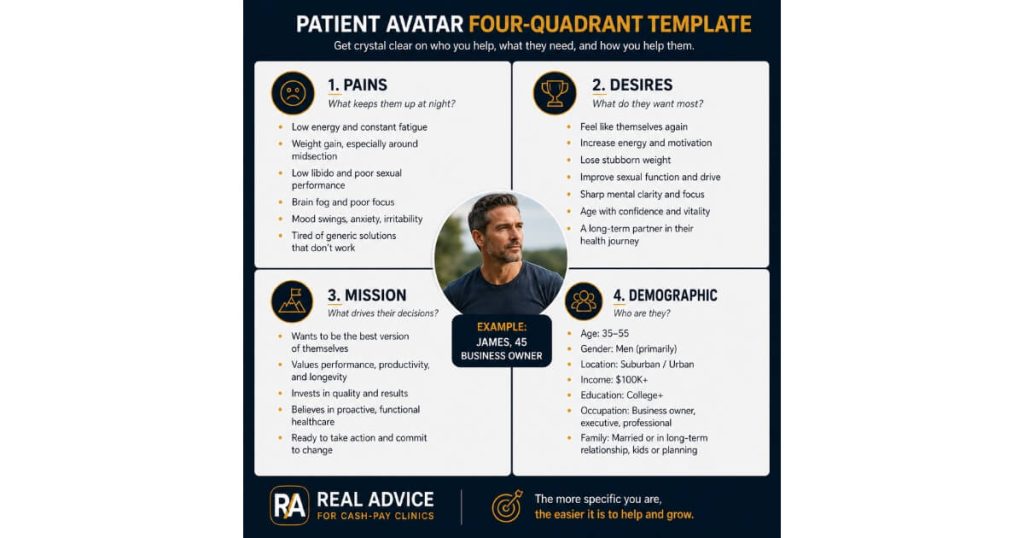
A useful avatar has four parts:
1. Pains
The specific symptoms, frustrations, and limitations the patient is living with right now:
- brain fog
- fatigue
- weight gain that won’t move
- mood swings
- decreased libido
- joint pain that wakes them up
2. Desires
The specific outcomes they want and the words they’d use to describe them:
- “I want my energy back”
- “I want to lose 20 pounds and keep it off”
- “I want my labs to actually mean something this time”
3. Mission
The why underneath the desires, often a relationship or a role they want to inhabit better:
- be a present dad
- be a competitive athlete again
- be the partner my spouse fell in love with
4. Demographic
The specific identifiable characteristics that make targeting and channel selection possible:
- age 35–55
- $100K+ household income
- suburban professional
- business owner
- athlete
The biggest mistake is to do one of the four and skip the others.
- Demographic alone (age, income, zip code) gives you targeting but no copy.
- Pain alone gives you copy but no targeting.
You need all four — and you need them written down where the marketing team can reference them every time they write an ad or build a landing page.
What does an ideal HRT or functional medicine patient avatar look like in practice?
A worked example for a cash-pay HRT or functional medicine clinic:
Typically:
- men or women 30–60
- financially established ($100K+/year earners)
- often business owners or working professionals or athletes
Pains
- brain fog
- inconsistent energy that crashes by 2 PM
- physical fatigue they’re not used to
- higher body fat than they want
- decreased libido or sexual performance
- mood swings they don’t recognize in themselves
Desires
- mental acuity restored
- body fat reduced
- libido and confidence returned
- energy that’s consistent without three cups of coffee
- physical stamina to work out longer and harder
- emotional stability
- muscle mass regained
Mission
- to take care of their family and have the energy to spend real time with their loved ones while excelling in their career
- to commit time to hobbies and passions
- to regain physical and mental confidence to be a better partner and lover
That paragraph is decision-forcing.
It tells:
- the marketing team to write ads that lead with brain fog and the 2 PM crash
- the NPC to ask discovery questions about energy through the day and how it affects the patient’s relationships
- the content team to film provider videos titled:
- “What does optimized testosterone feel like at 45?”
- “Why does my energy crash at 2 PM after I eat lunch?”
Every clinic in our portfolio that wrote out this avatar saw:
- close rate improve
- CPL improve
…within 60 days because the copy started mirroring the patient’s own language.
How do I figure out my real patient avatar — instead of who I wish was my patient?
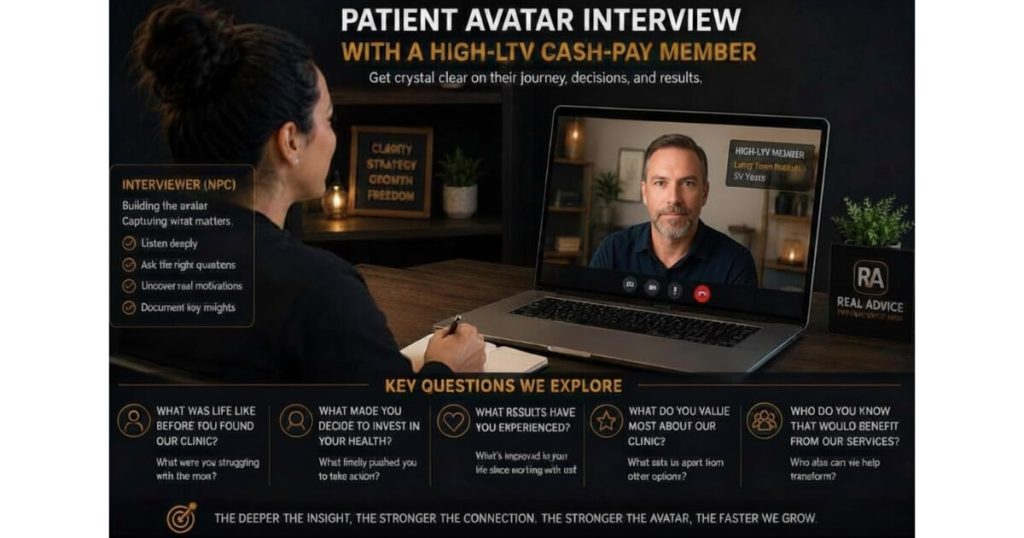
Interview your top 10 highest-LTV members and read your last 50 5-star Google reviews.
Stop guessing.
The clinics in our portfolio that nailed their avatar did it by setting up 15-minute calls with their:
- highest-tenure members
- highest-spend members
…and asking five questions:
- “What was going on in your life that made you finally book with us?”
- “What did you try before this that didn’t work?”
- “What changed for you in the first 90 days?”
- “Who in your life noticed first?”
- “What would you tell a friend who was on the fence?”
The patient’s own words are:
- your next ad campaign
- your next landing page
- your next NPC discovery script
…all at once.
Read your 5-star Google reviews with a highlighter.
The phrases that repeat:
- “I was at my wit’s end”
- “no one had taken the time to listen”
- “I finally feel like myself again”
…are your real avatar’s language.
Stop writing marketing copy from your desk and start writing it from the highlighted lines of your own patients’ words.
How does the avatar definition change my offers, content, and ad targeting?
The avatar changes everything downstream.
Offers
Offers become specific to that avatar.
Instead of:
- a generic “free consult”
The HRT clinic with a male-professional avatar offers:
- “Free 7-Question Low T Self-Assessment + 15-Minute Recovery Call.”
The functional medicine clinic with an autoimmune-woman avatar offers:
- “Autoimmune Reversal Roadmap Discovery Call.”
Content
Content becomes:
- the questions your avatar is typing into Google, ChatGPT, and YouTube
…and the videos answer them in your provider’s voice.
Ad targeting
Ad targeting becomes precise:
- interest stacks on Meta and TikTok built around the avatar’s known behaviors
- SEO keywords built around the symptoms they’re already searching
Examples:
- CrossFit
- Tim Ferriss
- biohacker podcasts
- specific supplement brands
The HRT clinic we scaled from $1M to $4M in four years runs almost entirely on this principle:
- one avatar
- one set of pains
- one offer
- one set of channels
The compounding shows up because every piece of marketing reinforces every other piece.
The pain management practice we added $2.095M in revenue to in 10 months did the same on the regenerative side:
- one avatar (active 45–65-year-old who wants to avoid surgery)
- one offer stack
- one set of channels
How often should I revisit and update my patient avatar?
Revisit the avatar quarterly and rewrite it once a year.
Patient avatars drift as:
- your clinic matures
- your offer evolves
- your provider mix changes
- the broader market shifts
Examples:
- GLP-1s
- peptide trends
- regulatory changes
- regional demographics
Quarterly check-in
- pull your last quarter’s new memberships
- scan their intake forms and review patterns
- confirm the avatar still matches reality
Annual rewrite
- do the 10 interviews again
- re-read the latest 50 reviews
- rewrite the four sections from scratch
The cost of skipping this is invisible until it isn’t.
The clinic that nailed its avatar in 2023 and never updated it is:
- paying premium CPLs in 2026
…because the avatar’s pains and desires have evolved.
Examples:
- GLP-1 changed everything about weight loss patients
- peptides changed everything about longevity patients
- post-pandemic stress changed everything about hormone and functional medicine patients
Annual rewrites keep your marketing speaking:
- the patient’s current language
…not their 2023 language.
What are the most common mistakes cash-pay clinic owners make defining their patient avatar?
Three mistakes appear in nearly every owner-written avatar we review.
First
Defining the avatar from the desk instead of from member interviews.
The avatar ends up describing:
- the patient the owner wishes they had
…not:
- the patient who actually buys
Second
Making the avatar too broad:
- “women 30–60 who want to feel better”
…because the owner is afraid of leaving money on the table.
In practice:
- broad avatars produce generic marketing that converts no one
Third
Defining the avatar once and never updating it.
The avatar gets:
- pinned to the wall in 2023
…and:
- the market has moved on by 2026
The fix for all three:
- schedule the member interviews on the calendar
- define the avatar specifically enough that you can name three actual current members who fit it
- put a quarterly avatar review on the leadership scoreboard
The clinics that do this:
- iterate their way to a clearer, more profitable avatar over 2–3 quarters
The ones that don’t:
- repeat the same generic marketing for years
- wonder why CPL keeps climbing