
Why Aren’t My TikTok Leads Converting Into Booked Patients? (2 Bookings From 32 Leads Isn’t a Lead Problem)
A med spa running women’s HRT campaigns on TikTok came to a monthly review with an uncomfortable number: roughly 32 leads, 2 booked appointments. The instinct in that moment is always the same — “TikTok leads are junk.” Except the ad side was demonstrably improving: cost per lead in their best state had dropped from $30 to $14 in a week. The leads were real. What was broken was everything that happened after the form. Here’s the FAQ, straight from that call.
Why aren’t my TikTok leads converting into booked patients?
Usually because of what happens after the form is submitted—not because of the platform or the leads.
During this review, three leaks became immediately obvious.
First, weekend and late-night leads sat untouched. As the clinic admitted, “if they come in Saturday night at 10pm, I don’t think anyone’s reaching out until sometime Monday or Tuesday.”
Second, prospects who did receive a call had to choose a vague two-to-three-hour callback window. Consequently, many lost interest before anyone reached them.
Third, the funnel’s self-scheduling page was being skipped entirely, sending people straight to the thank-you page instead.
Meanwhile, the advertising kept improving.
The clinic’s strongest market reduced cost per lead from $30 to $14 in only one week.
When acquisition costs are falling but only two appointments are booked, the issue isn’t med spa marketing on TikTok.
Instead, the breakdown occurs between the lead form and the calendar.
What’s a good lead-to-booking rate for cold TikTok leads at a cash-pay clinic?
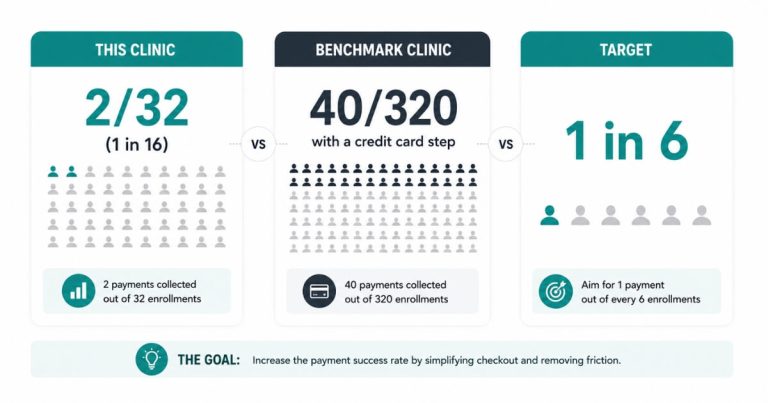
Aim for roughly one booking from every six to eight leads.
By comparison, two bookings from 32 leads—about one in sixteen—is only around half of where the funnel should perform.
The benchmark discussed during the call came from another clinic using the same campaign structure.
That practice generates approximately 320 leads every month and books around 40 appointments.
Notably, patients must enter a credit card before booking, and nobody from the clinic has to call them first.
That equals roughly one booking for every eight leads despite additional friction.
Therefore, the target for this clinic, which didn’t require a credit card, was even stronger.
Five bookings from 30 leads—roughly one in six—was considered a realistic objective.
Benchmarks matter because they eliminate the wrong conclusion.
Without one, two bookings from 32 leads feels like proof that TikTok doesn’t work.
With one, the picture changes.
The platform is producing qualified leads.
The follow-up process is failing to convert them.
Why do callback windows kill TikTok leads?
Because asking someone to wait two or three hours for a call feels like waiting for the cable company.
The comparison from the meeting captured the problem perfectly.
“It’s like when AT&T says, we’ll be there from noon to 6—you just sit and wait.”
Then, as we joked during the call, they usually arrive at 6:15.
TikTok leads don’t have that kind of patience.
Unlike Google searchers, they raised their hand while scrolling.
As a result, their intent fades quickly.
Asking someone to reserve half their afternoon for an uncertain callback dramatically reduces answer rates.
The clinic couldn’t even verify whether those calls actually occurred during the promised windows.
The team reached an important realization.
Patients respond much better when they feel they’re scheduling the appointment themselves.
A confirmed 2:30 appointment belongs to the patient.
A vague noon-to-three callback belongs to the clinic.
That psychological difference has a major impact on conversion.
Should TikTok leads self-schedule, or should my staff call them back?
Whenever possible, let patients schedule their own appointment.
If your current staffing can’t support that immediately, reduce callback windows to one hour while building the scheduling system.
The rollout discussed during the meeting followed a straightforward sequence.
First, shorten callback windows from two or three hours down to one.
Next, embed a live scheduling calendar directly inside the funnel so patients choose an exact appointment time.
Whether you use GoHighLevel, Calendly, or another scheduling platform matters far less than the experience itself.
Patients should see a specific appointment time—such as 2:30 p.m.—instead of a broad availability window.
In addition, appointment confirmations, text reminders, and email reminders should trigger automatically without requiring staff intervention.
Self-scheduling also solves the weekend problem.
Someone who submits a form on Saturday night can schedule an appointment for Sunday morning while motivation remains high.
That approach is especially valuable when treatment coordinators are balancing phone calls with in-office responsibilities.
How fast do I need to follow up with TikTok leads?
The same hour whenever possible.
A lead submitted Saturday night and left untouched until Monday or Tuesday is usually gone.
Unlike Google searchers, cold social-media leads weren’t actively researching providers.
Instead, they raised their hand while scrolling.
Because of that, intent fades rapidly.
It rarely survives an entire weekend.
On this clinic’s funnel, two treatment coordinators handled leads first, while two call-center representatives served as backup.
Although that structure looked reasonable on paper, it failed to match the hours when TikTok generated most inquiries.
Automation closes that gap.
An immediate text acknowledgment, a self-scheduling link, and automated reminders allow the clinic to respond at 10 p.m. without paying someone to sit beside the phone.
Among all improvements you can make to patient acquisition, speed to lead consistently delivers one of the highest returns because it’s the only variable that loses value every hour you wait.
What kind of TikTok ad actually converts for HRT and med spa services?
A staged mini-consultation combined with pain-driven messaging consistently outperformed the alternatives.
The highest-performing creative for this clinic featured a mock consultation about hormone pellets.
It felt like a short video sales letter rather than a traditional advertisement.
Its thumbnail focused on women over 40 reigniting their sex drive.
The team tested three primary themes:
- Antidepressants
- Blood work
- Hormone pellets
The pellet campaign won decisively.
Even more interesting, the messaging centered on escaping pain rather than achieving hope.
As the data accumulated, it became clear that moving away from discomfort motivated viewers more effectively than promising an ideal future.
One unexpected finding also stood out.
The clinic’s best-performing women’s HRT advertisement featured a man who wasn’t even a provider.
Sometimes the structure of the message matters more than the spokesperson delivering it.
The scaling strategy from the call was equally clear.
Dedicate roughly 80% of creative effort to variations of the proven winner.
For every five new videos, produce four that build on the successful concept and only one that explores a completely new direction.
Once the data identifies a winning message, keep improving it instead of constantly starting over.
FAQ’s About Converting TikTok Leads at a Cash-Pay Clinic
Are TikTok leads lower quality than Google leads?
Not necessarily.
TikTok leads are generally colder because they come from an interrupted browsing session rather than an active search.
However, the evidence from this review didn’t point to lead quality.
A comparable clinic using the same funnel consistently books around 40 patients each month.
Before judging TikTok, make sure your follow-up process operates at TikTok speed.
What’s a good cost per lead for TikTok HRT campaigns?
During this campaign, the strongest state averaged about $30 per lead across the month and improved to approximately $14 per lead after the winning creative gained traction.
States producing significantly higher acquisition costs received targeting adjustments rather than immediate shutdowns.
However, persistent underperformers should eventually lose budget to stronger markets.
What’s the fastest fix if I can’t build self-scheduling this week?
Reduce callback windows from two or three hours to one hour.
At the same time, make sure someone owns evenings and weekend leads.
Then build an embedded scheduling calendar.
The specific scheduling platform matters far less than allowing patients to choose a precise appointment time.
How many staff do I need to work TikTok leads?
This clinic operated with two treatment coordinators supported by two call-center representatives.
Even so, leads still slipped through because staff availability didn’t match lead timing.
Self-scheduling combined with automated reminders reduces staffing pressure far more effectively than simply hiring another coordinator.
How do I scale a winning TikTok ad without burning it out?
Create four variations of your top-performing ad for every one completely new concept.
Keep the successful structure.
Test new hooks, angles, and messaging around the proven topic.
For this clinic, that meant continuing to build around hormone pellets, pain-first messaging, and the mock-consultation format instead of repeatedly reinventing the campaign.
What’s the next step?
If your TikTok leads are piling up while bookings remain flat, don’t assume the campaign is the problem.
Instead, audit everything that happens during the first eight hours after someone submits the form.
Book a strategy call.
In 60 minutes we’ll trace one week of your leads from submission through scheduling, identify exactly where they’re falling out of the funnel, and map the speed-to-lead and self-scheduling improvements that can turn a one-in-sixteen booking rate into one closer to one-in-six.