
Why Do Systems Matter More Than Sales Skills in Growing a Cash-Pay Practice? (Stop Relying on Talent)
Every cash-pay practice owner has felt it: the frustration that providers won’t upsell, the front desk won’t push, and nobody on the team “can sell.” Here’s the uncomfortable reframe — if your growth depends on how naturally persuasive your people are, you haven’t built a growth engine. You’ve bought a lottery ticket on talent. The practices that grow predictably replace talent with systems: tools, structures, and scripts that produce the sales outcome even on an average day, with an average team. Here’s the FAQ.
Why do systems matter more than sales skills in a cash-pay medical practice?
Because talent doesn’t scale, doesn’t transfer, and eventually walks out the door.
A well-designed system does none of those things.
A gifted closer at the front desk is wonderful until she’s on vacation, promoted, or hired away.
Then the number she carried often leaves with her.
By contrast, a written system performs the same way on Tuesday as it does on Friday.
It defines what gets asked during every visit, what happens to every lead within five minutes, and what gets said when a caller asks about pricing.
As a result, the next hire learns the role in days instead of years.
Meanwhile, the system improves every month because you can measure it, refine it, and train it.
You can’t improve charisma with documentation.
The practices that grow year after year aren’t staffed by unicorns.
Instead, they’re ordinary teams running extraordinary patient acquisition and retention systems.
Why is relying on provider talent to upsell a mistake?
Because you’re frustrated with providers for not doing a job you never gave them the tools to perform.
This comes directly from our consulting work.
Owners often complain that providers don’t upsell, cross-sell, or resell during follow-up visits.
However, nothing inside those visits is structured to support that outcome.
There’s no tool.
There’s no written process.
There’s only an unspoken hope that the provider will naturally “bring it up.”
Most providers didn’t choose medicine because they wanted to sell.
As a result, they feel uncomfortable doing it and quietly skip the conversation.
That’s not a character flaw.
It’s a missing system.
The solution isn’t sending your NPs to another sales seminar.
Instead, restructure the visit so selling becomes the natural result of delivering excellent care.
That’s exactly what a well-designed follow-up visit accomplishes.
What does a sales system look like at a follow-up visit?
Four questions, asked in the right order, allow the patient to upsell, resell, or cross-sell themselves.
At every follow-up visit with an established patient, structure the conversation around four simple questions:
- What was your initial goal?
- What progress have you made toward that goal?
- Where else have you noticed progress?
- What else would you like to learn about?
Those four questions create a predictable sequence.
First, the patient restates their original goal, recommitting to it out loud.
Next, they explain the progress they’ve already experienced, reinforcing the value of treatment in their own words.
Then they recognize unexpected improvements, expanding what they believe your clinic has helped them achieve.
Finally, they tell you what they’re curious about next.
That last answer often becomes a natural cross-sell opportunity without the provider making a sales pitch.
The provider never has to “sell.”
Instead, the system guides the conversation.
Because it’s built into the visit rather than someone’s personality, it works across virtually every cash-pay specialty.
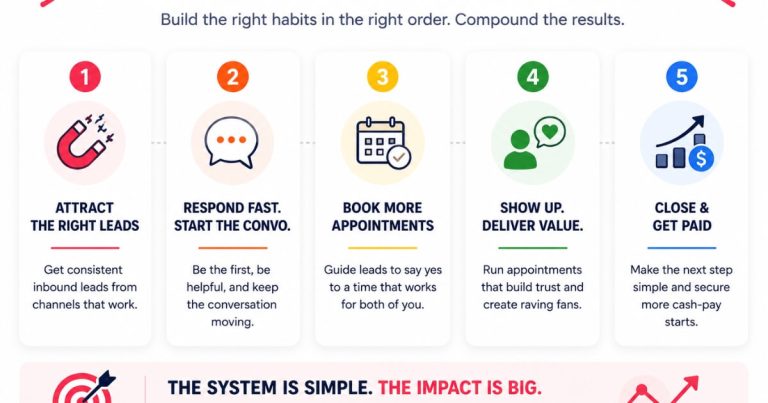
Which other sales systems should a cash-pay clinic install?
The same visit structure applies anywhere revenue currently depends on improvisation.
For example, inbound calls should follow a written conversation flow with a direct path to booking.
That way, the outcome doesn’t depend on which team member answers the phone.
Likewise, every new lead should trigger an automatic speed-to-lead standard and a documented multi-touch follow-up cadence.
Follow-up should never rely on someone’s memory.
Price conversations deserve the same consistency.
Create one standard process for presenting programs and responding to, “I need to think about it.”
Finally, build a defined process for requesting reviews and referrals after visits instead of asking only when it “feels right.”
None of these systems require hiring elite salespeople.
Instead, they help ordinary team members deliver consistently strong results.
That kind of system-driven growth helped a practice that went from roughly $80,000 a month to about $148,000 a month average.
A pain practice we work with added $2,095,039 in revenue in 10 months because structured conversion systems handled the leads—not because they found a once-in-a-generation closer.
Install the system first.
Then allow ordinary people to run it with extraordinary consistency.
Don’t sales systems make the patient experience feel scripted and pushy?
Quite the opposite.
A well-designed system feels like unusually attentive care because it’s built around thoughtful clinical questions.
Look back at the four follow-up questions.
Every one of them is appropriate during a medical visit.
You’re asking about the patient’s original goal.
You’re reviewing their progress.
You’re exploring additional improvements.
Then you’re discovering what they want to accomplish next.
Patients experience that conversation as genuine interest.
Meanwhile, the “sales” happens naturally because they hear themselves describe the value they’re already receiving.
That carries far more weight than anything a provider could say.
The same principle applies throughout the practice.
Structure the conversation your best employee has on their best day.
Write it down.
Teach it.
Repeat it.
Scripted isn’t the opposite of authentic.
Instead, it’s authenticity made reliable.
How do I start replacing sales talent with sales systems at my clinic?
Begin with the one revenue moment that varies the most from person to person.
Then systematize that first.
Audit one week of visits and phone calls.
Identify where outcomes change dramatically depending on who handled the interaction.
That variation is your improvisation tax.
For most clinics, the biggest opportunities are follow-up visits without an upsell structure, inbound pricing calls, or new-lead follow-up.
Once you’ve identified the highest-impact moment, document the process.
Next, spend one week practicing it through role-play.
Afterward, measure the single metric that process should improve, whether that’s rebooking rate, booking rate, or show rate.
Then repeat the process with the next revenue moment.
One system every month compounds surprisingly fast.
Within a year, the machine—not the mood—produces the revenue.
An HRT clinic we work with built exactly that kind of system and grew from $1M to $4M a year with 250 active members paying $1,000 a month.
Membership revenue at that level isn’t driven by individual talent.
It’s the result of disciplined systems compounding over time.
FAQ’s About Sales Systems vs. Sales Skills
Why won’t my providers upsell or cross-sell?
Because they don’t have a tool or system that supports those conversations.
Most providers weren’t trained to sell, and most aren’t comfortable trying.
Instead, restructure the follow-up visit around four questions: the patient’s original goal, the progress they’ve made, other improvements they’ve noticed, and what they’d like to learn about next.
As a result, the patient naturally sells themselves without the provider making a pitch.
What are the four follow-up visit questions that get patients to upsell themselves?
Ask these questions in order:
- What was your initial goal?
- What progress have you made toward it?
- Where else have you noticed progress?
- What else would you like to learn about?
Together, these questions help patients recommit to their goals, recognize the value they’ve already received, expand that value, and request the next service themselves.
Do I need to hire salespeople for my cash-pay clinic?
Usually not.
First, install written systems for follow-up visits, phone conversations, lead follow-up, and price presentations.
Then measure the results.
Over time, ordinary teams running documented systems consistently outperform talented improvisers.
If you eventually hire dedicated salespeople, they’ll perform even better inside an established system.
Won’t scripts make my clinic sound robotic?
No.
A good script is simply your best conversation written down so it happens every time.
Patients experience structured questions about their goals and progress as attentive care rather than sales.
Reading word-for-word sounds robotic.
Internalizing the structure sounds professional and natural.
Where should I build my first sales system?
Start wherever revenue varies the most depending on the individual team member.
For most clinics, that’s follow-up visits, inbound pricing calls, or new-lead follow-up.
Systematize one revenue moment.
Measure the single metric it’s designed to improve.
Then move on to the next.
One completed system every month consistently outperforms a practice-wide overhaul that never gets finished.
What’s the next step?
If you’re frustrated because your team “can’t sell,” stop searching for naturally gifted salespeople and start installing systems.
Visit structures, conversation frameworks, and follow-up cadences allow average days to produce above-average revenue.
Book a strategy call.
In 60 minutes we’ll identify the revenue moments in your practice that currently depend on improvisation and map the first system that will make those outcomes predictable.