
Why Scaling Your Practice Doesn’t Always Create More Freedom (You Might Just Be Building a Higher-Paid Job)
Most people don’t get into business because they want a job. Most people get into business because they DON’T want a job. Then they grow a practice and discover the punchline: in the process of growing and scaling a business, you have a very highly paid job for a period of time — and if you scale without changing the structure, you just end up with an even higher-paid one. Here’s why that happens, and what actually converts revenue into freedom.
I started my practice to escape having a job — why does it feel like one anyway?
Because in the growth phase, that’s exactly what it is: ownership plus every unfilled role equals a very high-paid job.
Nobody opens a cash-pay clinic dreaming of being an employee. The whole point was autonomy — clinical, financial, and personal.
But the early and middle stages of building a practice put the owner in every seat that doesn’t have a hire yet. You’re the lead provider, head of sales, marketing director, HR, complaint department, and the person who notices the supply closet is empty.
That’s not failure. It’s a phase.
You have a very high-paid job for a period of time. Knowing it’s a phase is what keeps it from becoming an identity.
The real trap comes when that phase quietly becomes permanent. The practice’s operating model hardens around the owner’s personal output. Meanwhile, the owner keeps buying growth with more of their own hours because it works.
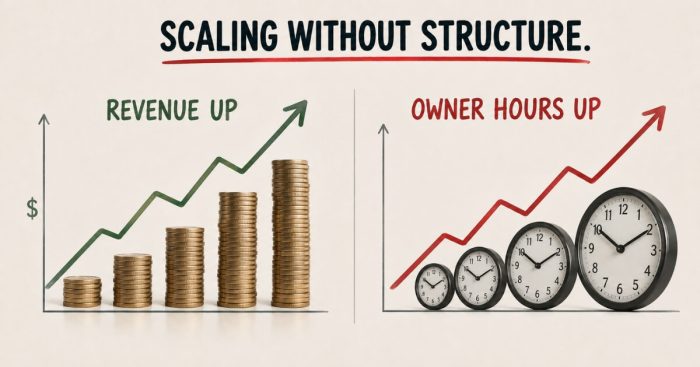
Revenue climbs. The calendar dies.
And the business that was supposed to buy freedom starts collecting it as rent.
Why does scaling sometimes make the freedom problem worse?
Because more revenue built on the same owner-dependent structure just scales the job — even as you grow, you can end up with an even higher-paid job.
Here’s the uncomfortable math.
If the owner personally touches every consult, every close, and every operational decision, doubling revenue roughly doubles those touches.
The practice at $2M becomes busier than it was at $1M. At the same time, the owner becomes more essential, harder to replace, and further from a week off than ever.
Scaling amplified exactly what was already there: dependence.
You can see it in how the owner’s week changes — it doesn’t.
Same 60 hours, higher stakes, better car.
The income statement says business owner. The calendar says highest-paid employee.
This is why “we grew 40% last year” and “I haven’t taken a real vacation in three years” so often come from the same person.
Growth was real. Freedom went backwards.
More marketing, more patients, and more revenue cannot fix this. The constraint was never demand. The problem is that the machine only runs when the owner is standing in it.
What actually converts a scaled practice into freedom?
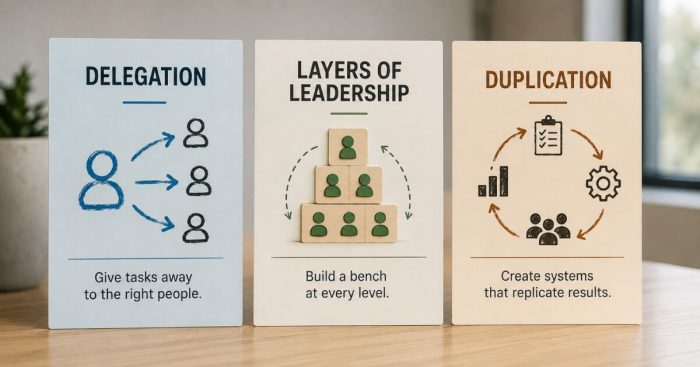
Three mechanics: delegation, layers of leadership, and duplication. Freedom arrives only when you can step away from day-to-day fulfillment.
It’s only when you’re able to step away from the day-to-day fulfillment of the business that freedom starts to appear. That requires real delegation, layers of leadership, and duplication.
Each mechanic removes a different dependency.
Delegation moves tasks off the owner’s plate with real authority attached, not just work assigned.
Layers of leadership mean someone other than the owner manages the people doing those tasks. Problems get solved a level down instead of automatically routing to the top.
Duplication is the deepest layer. You need documented processes and trained people who can produce the same outcome the owner would. That applies whether they’re running a consult, handling a complaint, or closing a program sale.
Most clinics attempt only delegation and then wonder why the owner is still trapped.
Tasks moved, but every exception, decision, and standard still lives in one person’s head.
Dr. Joy Kong hired four additional doctors, built the practice’s authority around the team and the science rather than herself, and scaled out of the daily schedule entirely — duplication applied to the hardest thing to duplicate, the founder herself.
How do I know if my practice is a business or a high-paid job?
One test: can you step away and choose when you come in? If absence breaks the practice, it’s a job with your name on the lease.
The honest diagnostic is a calendar experiment, not a P&L review.
Take a full week off, genuinely unreachable, and watch what happens. Bookings may stall. Decisions may queue up for your return. Staff may save every judgment call for you.
Each one represents a dependency with your name on it. Together, they create the map of what to fix next.
The goal state is specific: you choose when you want to come in.
Coming in because you love the work is freedom. Coming in because the place breaks otherwise is the job you swore you didn’t want.
Fortunately, the fixes are ordinary and sequenced.
Document the recurring decisions. Hire or promote the first layer of leadership. Then transfer authority one function at a time.
At the same time, let the medical practice marketing and patient-acquisition side run as a system. Give it its own owner and numbers rather than treating it as the owner’s side hustle.
The practice didn’t grow despite the owners stepping back. Stepping back is what let it grow.
Should I even scale, if scaling doesn’t guarantee freedom?
Yes — but decide what you’re scaling toward, and build the structure in parallel, not “someday.”
Scale for its own sake produces the higher-paid job.
Instead, scale with a defined endpoint. Maybe that’s a practice that runs without you, an eventual sale, a three-day week, or a second location that doesn’t need your body in it.
Once you define the endpoint, you know which structures to build and when.
The owners who get trapped are rarely the ambitious ones. They’re the ones who deferred every delegation decision until “after we grow a bit more.”
But that date never arrives because growth keeps consuming the owner it depends on.
A practical rule is to pair every meaningful revenue milestone with a dependency removed.
Cross $1.5M, and consults no longer require you. Cross $2M, and a leadership layer manages the team. Cross $3M, and the practice runs 30 days without your presence.
Revenue and freedom can then compound together — which was the original point of owning the thing.
Most people got into business because they didn’t want a job. Structure is how you keep that promise to yourself.
FAQ’s About Scaling a Practice Without Losing Your Freedom
Why do practice owners end up with a “higher-paid job” instead of a business?
Because they scale revenue on top of an owner-dependent structure.
If every consult, close, and decision still routes through the owner, growth multiplies the owner’s workload along with the income.
The result is the same job, higher pay, and less freedom.
Is it normal for a growing practice to consume the owner’s life?
For a period, yes.
In the process of growing and scaling, you have a very high-paid job for a while. The problem starts when that phase becomes permanent because you never built delegation, leadership layers, or duplication.
What are the three mechanics that create owner freedom?
Delegation, layers of leadership, and duplication.
Delegation moves tasks with real authority. Layers of leadership create managers who solve problems a level down. Duplication uses documented processes and trained people to produce the owner’s outcome without the owner.
You need all three. Delegation alone still leaves every important decision in the owner’s head.
How do I test whether my practice runs without me?
Step away for a full week and make yourself genuinely unreachable.
Everything that stalls — bookings, decisions, staff judgment calls — identifies a dependency you need to fix.
The goal is simple: choosing when you come in rather than being needed every day.
Does stepping back from the day-to-day hurt growth?
Usually the opposite.
Owner dependence creates a growth ceiling. Practices like Eternity Health Partners quadrupled revenue from $1M to $4M during the same four years both owner-operators exited the day-to-day.
The structure could finally absorb more volume than one person’s calendar.
What’s the next step?
If your revenue has grown but your weeks haven’t changed — or you’re scaling hard right now and quietly worried you’re building a more expensive cage — the fix is structural.
It starts with knowing which dependency to remove first.
Book a strategy call. In 60 minutes we’ll map where your practice depends on you personally, sequence the delegation and leadership hires, and define what “I choose when I come in” looks like for your specialty.