
Why Is a Quiz Landing Page Outperforming My Clinic’s Opt-In Page for Leads?
If you’re running paid ads to a traditional “enter your email” landing page and the leads have slowed to a trickle, the page — not the ads — is usually the problem. We recently changed one clinic’s pain campaign from a standard opt-in page to a short qualifying quiz, kept the exact same keywords and budget, and lead flow jumped almost immediately. Here’s the FAQ on why quiz landing pages convert cold clinic traffic better, and when to use one.
Why is a quiz landing page outperforming my opt-in page?
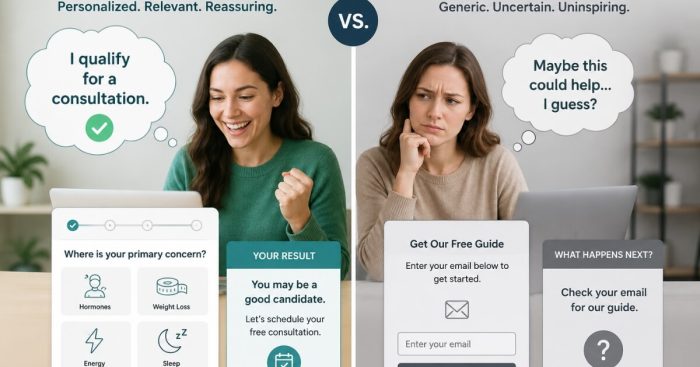
Because a quiz makes the visitor feel diagnosed and qualified, while an opt-in page just asks them to hand over their email and hope.
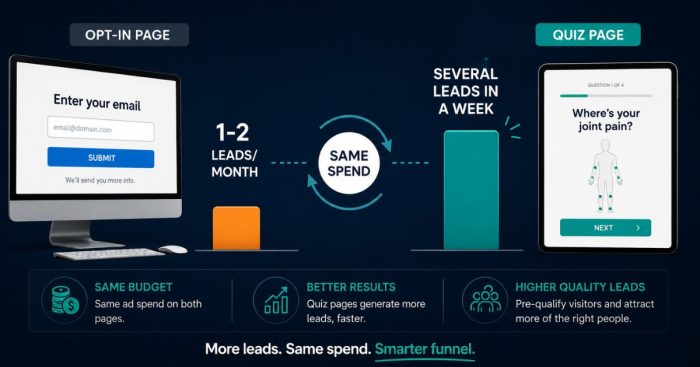
We saw this play out in real time on a regenerative and pain clinic’s Google campaign. For most of the month, the same pain keywords and the same spend were producing only one or two leads pointed at a traditional opt-in landing page.
We switched the traffic to a short pain quiz — “See if you’re a candidate for non-surgical joint pain relief” — and within about six days it had produced several qualified pain leads, one of which booked a consult. Same keywords. Same budget. The only thing that changed was the page.
The reason is that a quiz does work for the visitor. It asks where the pain is, how long they’ve had it, how bad it is, what they’ve tried, and what it’s stopping them from doing — and by the end, the person feels like they’ve been assessed and told they qualify.
An opt-in page asks for a contact detail and offers nothing in return but a promise. If your paid traffic is strong but your landing page is a plain form, that page is almost certainly the ceiling on your patient acquisition.
What is it about a quiz that makes people convert?
It affirms the visitor and gives them a sense that they’re on a path to solving their problem — which is exactly the mindset they’re in when they click a search ad.
When someone searches Google for a solution to knee pain or low energy, they’re in a “solve this now” frame of mind. A traditional opt-in page leaves that unresolved — it feels like “this might help if I call them,” which is easy to close and forget.
A quiz meets the moment. Each question validates that there’s a real problem, and the result affirms “yes, you’re a candidate, there’s a next step for you.” The visitor feels seen, qualified, and pointed forward, so booking the consult feels like the natural next move rather than a leap of faith.
There’s a timing factor too. AI tools and chat interfaces have trained people to expect fast, personalized answers. As a result, a static page that just collects an email now feels dated and passive, while an interactive quiz that responds to their inputs feels current and helpful.
The quiz gives the instant, tailored feedback people have come to expect everywhere else.
What kind of questions should a clinic’s quiz ask?
Questions that qualify the patient clinically and get them emotionally invested — location, duration, severity, what they’ve tried, and what the problem is costing them.
The pain quiz that worked asked exactly these:
- Where’s your joint pain (knee, hip, shoulder, back)?
- How long have you dealt with it?
- How bad is it, one to ten?
- Has a doctor recommended surgery?
- What have you already tried?
- What is it stopping you from doing — exercising, stairs, sleep, golf?
That last type of question matters because it makes the visitor feel the cost of the problem, which raises their motivation to book. The questions do double duty: they screen for fit and they deepen the person’s commitment with each answer.
Keep it short and finish with a soft qualification and an opt-in — “Looks like you may be a candidate for a consultation.” The goal is for the visitor to arrive at the contact form already believing they qualify, not to interrogate them.
A well-built symptom quiz is one of the most reliable lead engines in pain management marketing.
Does a quiz funnel work for treatments other than pain?
Yes — the same structure works across hormones, weight loss, longevity, and most cash-pay verticals where patients self-identify by symptoms.
The pain quiz is just one application. The identical psychology drives hormone quizzes, weight-loss assessments, and longevity screeners.
A person who suspects they have low testosterone or a hormone imbalance wants to be told whether they’re a candidate, and a quiz gives them that. Any condition where patients recognize themselves by a cluster of symptoms is a strong fit because the quiz lets them raise their hand around the symptom rather than around a treatment they may not understand yet.
This also pairs perfectly with condition-first advertising, where platforms restrict naming specific treatments. A quiz that talks about knee pain, fatigue, or weight — not about stem cells, TRT, or semaglutide — keeps your ads compliant while still capturing high-intent leads.
It’s a natural fit for regenerative medicine marketing, where treatment names often can’t appear in the ad at all.
If a quiz converts better, why do so many clinics still use opt-in pages?
Because opt-in pages are simpler to build, and most clinics never test the alternative on the same traffic.
A single-field opt-in page takes minutes to make, so it’s the default. The problem is that “easy to build” and “converts well” are different things, and without a head-to-head test on the same keywords and budget, an owner never sees what they’re leaving on the table.
The clinic above had been quietly getting one or two pain leads a month and assumed the ads were the issue — when the page was the bottleneck the whole time.
Elite Pain Doctors, a pain and regenerative clinic, added over $2 million in revenue in 10 months on the strength of a funnel built to convert, not just collect.
The fix costs almost nothing. Keep the ads exactly as they are and change only the page.
Because the traffic and spend stay constant, you get a clean read on whether the quiz lifts conversion — and in our experience it usually does, sometimes dramatically.
How do I make sure the leads a quiz generates actually convert?
Pair the quiz with instant follow-up and a booked next step, because a quiz lead is only as good as the speed and system behind it.
A quiz raises the quality and volume of leads, but it doesn’t book patients by itself. The clinic above added automated text and email follow-up to every quiz lead and worked them quickly, so the momentum from the quiz carried straight into a scheduled consult.
A validated, motivated lead that sits for two days cools off like any other. The winning combination is a quiz that qualifies and affirms, plus a follow-up system that reaches out fast and gets the consult on the calendar.
Orthobiologics Associates converts 79.4% of its leads into booked appointments because the page and the follow-up work as one system.
Track it end to end: leads from the quiz, booked consults, and shows. If the quiz lifts leads but bookings lag, the gap is in follow-up, not the funnel.
FAQ’s About Quiz Landing Pages for Cash-Pay Clinics
Why does a quiz landing page convert better than an opt-in page?
Because a quiz makes the visitor feel assessed and qualified rather than just asked for an email. Each question validates that there’s a real problem, and the result affirms they’re a candidate with a clear next step — which matches the “solve this now” mindset people are in when they click a search ad.
One clinic switched its pain campaign to a quiz and went from one or two leads a month to several qualified leads in about a week, with no change to keywords or spend.
What questions should a medical quiz funnel ask?
Ask questions that both qualify the patient and deepen their investment: where the symptom is, how long they’ve had it, how severe it is, what they’ve already tried, and what it’s stopping them from doing.
That last type — the cost of the problem — raises motivation to book. Keep it short and end with a soft “you may be a candidate” and an opt-in.
Do quiz funnels only work for pain clinics?
No. The same structure works for hormones, weight loss, longevity, and most cash-pay verticals where patients recognize themselves by symptoms.
It also pairs well with condition-first advertising, since a quiz can focus on the symptom rather than a treatment name that ad platforms may not allow.
Will a quiz alone increase my booked patients?
Not by itself. A quiz raises lead quality and volume, but bookings depend on fast, systematic follow-up.
Pair the quiz with automated text and email outreach and a clear path to a scheduled consult, and track leads, bookings, and show rate so you can see whether any gap is in the funnel or in follow-up.
What’s the next step?
If you’re spending on ads and sending that traffic to a plain opt-in page, you may be capping your own lead flow without knowing it. Book a strategy call. In 60 minutes we’ll look at your current funnel, map the quiz that fits your treatments and stays compliant with ad-platform rules, and design the follow-up that turns those leads into booked consults — often without spending a dollar more on ads.
If it’s a fit, we’ll build the quiz and the follow-up with your team.