
Why “Peptide SEO” Isn’t About Peptides (How Cash-Pay Clinics Actually Win Peptide Patients From Search)
Most clinics that want more peptide patients do the same thing: they slap “Peptide Therapy” on a services page, maybe publish a blog called “What Are Peptides?”, and then wonder why the phone doesn’t ring.
The problem isn’t peptides — it’s that patients don’t search for peptides.
They search for the problems they want fixed.
Here’s the FAQ on how cash-pay clinics actually win peptide patients from search.
Does SEO actually work for attracting peptide therapy patients to a cash-pay clinic?
Yes — but only when the pages target symptoms, not the word “peptides.”
Google rewards intent match, not buzzwords.
A prospective peptide patient almost never types “peptide therapy” into Google or ChatGPT.
They type “elbow tendon won’t heal,” “chronic fatigue help,” or “faster recovery from injury.”
Or, if they’re further along, they search “BPC-157 side effects” or “peptide for gut healing.”
If your entire SEO footprint says “We offer peptides” and none of it says “how peptides help tendon injuries heal faster,” Google has no reason to send those people to you.
Clinics that get this right see search become their highest-intent lead source.
The same intent-first logic that fills hormone consults fills peptide consults — the search phrases are just different.
Why isn’t my “Peptide Therapy” services page bringing in patients?
Because a services page answers a question nobody is asking.
“Peptide Therapy” as a page title targets people who already know what peptides are.
They already believe they want them and are shopping for a provider by modality name.
That’s a tiny sliver of the market.
The much larger pool is people living with a problem — a tendon that won’t heal, gut issues that flare every week, or recovery that takes twice as long at 45 as it did at 30.
They may have never typed the word “peptide” in their life.
A generic services page also gives Google nothing to rank.
It competes with every compounding pharmacy, telehealth startup, and med spa using the same two words.
A symptom-first page competes only with clinics that actually understand the condition — which, in most local markets, is almost nobody.
What do peptide patients actually type into Google and ChatGPT?
Problem-first phrases — and a handful of compound-specific ones from patients who’ve already done research.
The searches that bring peptide patients to a cash-pay clinic cluster into three groups.
First, pure symptom searches: “elbow tendon won’t heal,” “chronic fatigue help,” and “faster recovery from injury.”
Second, problem-plus-modality searches from people mid-research: “peptide for gut healing,” “peptides vs PRP for joint pain,” and “peptides for recovery in 40+ lifters.”
Third, compound-specific searches: “BPC-157 side effects” and “BPC-157 results.”
Each group needs a page that answers exactly what they typed.
This matters double in the LLM era.
When a patient asks ChatGPT or Perplexity “what actually helps a tendon injury heal faster,” the sources that get cited are pages that answer that specific question in plain language.
They aren’t services pages that simply list modalities.
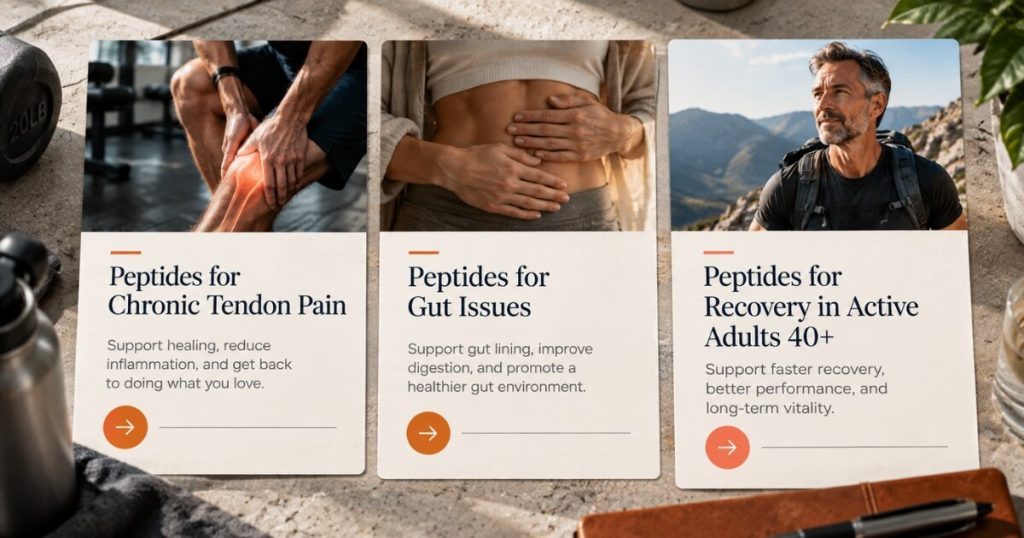
What is a symptom-first peptide page and how do I build one?
A page organized around the patient’s problem, with peptides presented as one of the tools inside it.
The clinics we see winning peptide patients with SEO build pages like “Peptides for Chronic Tendon Pain,” “Peptides for Gut Issues and IBS-Like Symptoms,” and “Peptides for Recovery in Active Adults 40+.”
Inside each page, they do four things.
They talk about the condition the way the patient experiences it.
Then they explain what peptides do in plain English.
They make it obvious who is and isn’t a fit.
Finally, they wrap it in one clear next step.
That structure wins twice.
Google sees, “this page actually answers what they typed.”
The patient sees, “this clinic understands my specific problem.”
Both beat a wall of clinical jargon and a Book Now button.
This is the core of what a focused approach to peptide therapy clinic marketing looks like — the modality supports the message; it never leads it.
How do I turn peptide page visitors into booked consults?
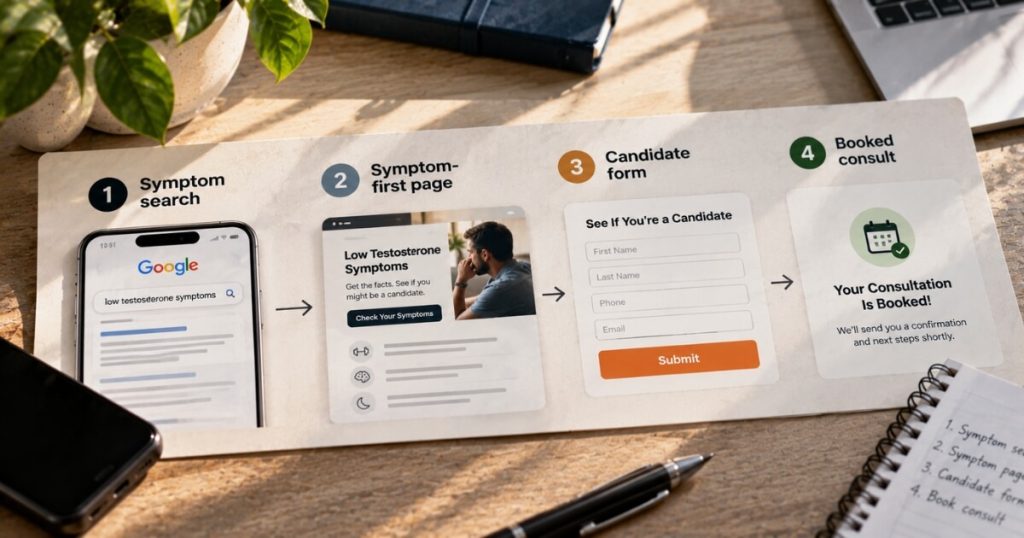
Give every page one low-friction next step: a candidate check, not a checkout.
A visitor who just searched “elbow tendon won’t heal” isn’t ready to buy a program.
They’re ready to find out whether this applies to them.
The two closers that work are a simple “Am I a candidate?” form and a “free 10-minute peptide consult” booking link.
Both let the patient raise their hand without committing.
They also give your team a warm lead with the symptom already attached.
From there it’s a patient acquisition problem you can run like a system.
The form tells you the condition, the consult qualifies the fit, and the follow-up sequence does the rest.
The page’s job is only to start the conversation the search began.
How many symptom-first peptide pages does my clinic need to start seeing results?
Three.
Start with the top three problems you actually use peptides for.
Don’t map fifty keywords.
List the three conditions where your clinic genuinely gets results with peptides — for most cash-pay practices, that’s some mix of tendon and joint recovery, gut issues, and general recovery or energy in adults 40+.
For each one, publish two assets: one “Peptides for [problem]” page and one FAQ-style blog post written in normal human language.
That’s six pieces of content, each aimed at a search someone in your city typed this week.
This is the same organic playbook that produced $309,590 in cash-pay revenue in 10 months for a regenerative clinic — without a dollar of paid ads — converting 79.4% of its organic leads into booked appointments.
Intent-matched pages attract fewer clicks than broad ones, but the clicks they attract book.
FAQ’s About Peptide SEO for Cash-Pay Clinics
Do patients really not search for “peptide therapy”?
A small minority do — usually people already sold on peptides who are provider-shopping.
The overwhelming majority of your future peptide patients search for symptoms: tendon pain that won’t resolve, gut issues, slow recovery, or low energy.
Symptom-first pages capture both groups.
A “Peptide Therapy” services page captures only the first.
How long does peptide SEO take to produce booked consults?
Expect the first movement in 60–90 days for low-competition symptom phrases and compounding results over 6–12 months.
Symptom-first pages tend to rank faster than generic modality pages because far fewer clinics target them.
Local intent — “near me” and city names — accelerates it further.
Should my peptide pages name specific compounds like BPC-157?
Yes — carefully.
Compound-specific searches like “BPC-157 side effects” are high-intent, so a plain-English education page is worth building.
Explain what the compound is used for, who’s a fit, and what the research does and doesn’t show.
Avoid disease-cure claims.
Instead, frame everything as candidacy and consultation, which is also what keeps the page compliant.
Do service pages or blog posts work better for attracting peptide patients?
Both, in pairs.
For each condition, build one evergreen “Peptides for [problem]” service-style page — the conversion asset.
Then build one FAQ-style blog post in conversational language — the discovery asset.
The blog post catches the long-tail questions and links down to the service page, which carries the candidate form.
Is SEO better than paid ads for getting peptide patients?
For most peptide-focused clinics, yes — SEO is the higher-intent, lower-risk channel.
Peptide and wellness ads face heavy ad-platform restrictions, while symptom searches carry stronger intent than interruption ads ever will.
The winning play for most clinics is SEO as the foundation, with paid traffic layered on only where policy allows.
What’s the next step?
If you want peptide patients finding your clinic instead of a telehealth startup, start with the three-page symptom-first build above.
And if you’d rather have the whole system mapped for you — which conditions to lead with, what each page needs to say, and how SEO stacks against every other lead source for your specific practice — book a strategy call.
In 60 minutes we’ll map your symptom-first page plan and show you exactly where peptide search demand exists in your market.