
Why Patients Choose a $900 Clinic Over a $250 Clinic (The Phone Call That Decides Where They Spend)
This isn’t about ads, AI tools, awkward scripts, or SEO secrets.
It’s about something you can implement today, with the team you already have. You don’t need to change how you pay them or buy anything.
And it’s the reason some cash-pay clinics grow 30–50% a year without ad spend, while cheaper competitors quietly lose patients they never knew they had.
Why would a patient pay $900 for the same service another clinic offers at $250?
Because the decision to buy isn’t made on price.
It’s made during the first phone call, based on how comfortable and important the caller feels.
Here’s the true story.
A woman named Victoria on our team needed bloodwork, and so did her partner, Vinny.
We referred her to two clinics, both existing clients.
One charged $250 for the consultation and bloodwork.
The other charged $900 for roughly the same service.
Naturally, she called the $250 clinic first.
It was even closer to home.
But she was put on hold, and the call dropped.
She called back, and the same thing happened.
On the third call — which most people would never make — she explained what had happened.
“I just got put on hold twice and you hung up on me twice.”
She received an obligatory apology.
Then, they put her on hold a third time.
She gave up.
Next, she called the $900 clinic.
Someone answered on the second ring and sounded genuinely excited to help.
They talked for 15–20 minutes, and every question got answered.
Victoria felt so comfortable that she booked bloodwork for herself and Vinny on the spot.
That’s $1,800 in revenue before anyone even mentioned a membership.
And because of how that one phone call felt, a future membership became far more likely.
What does a botched phone call actually cost a cash-pay clinic?
Far more than the visit.
It costs the patient’s lifetime value, their potential referral network, and future revenue the clinic may never know it lost.
The obvious loss was $500 from two $250 visits.
But the real loss is much bigger.
Victoria and Vinny plan to spend serious money on longevity and functional medicine for years.
The question was never IF they would spend it.
It was WHERE.
Now, every friend who asks this affluent, connected couple for a provider recommendation will likely hear about the $900 clinic.
And they’ll be warned away from the cheaper one.
That goodwill damage can ripple through a practice for years.
If Victoria had felt vindictive, she could also have left a truthful Google review:
“Don’t call this place — they don’t answer the phone and they’re rude.”
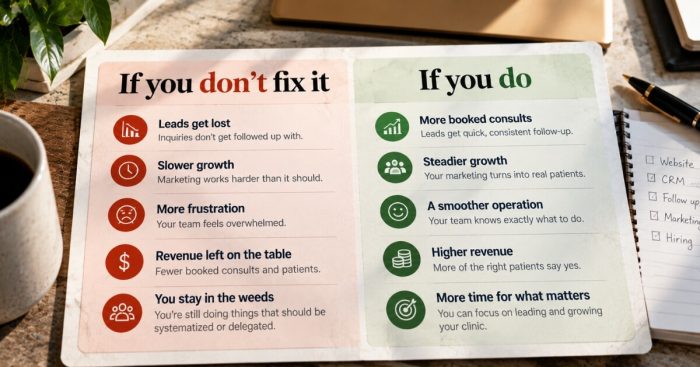
Now consider the full cost of doing nothing.
Poor lead-to-patient conversion means fewer booked appointments.
Bad reviews and negative word of mouth damage your reputation.
Meanwhile, missed opportunities for positive reviews and referrals weaken the membership growth cycle.
But the opposite is also true.
When you prioritize hospitality, you create stronger conversion, steady referral-driven revenue, and more five-star reviews.
You also develop enthusiastic advocates who keep feeding your membership growth.
This costs nothing to implement.
And it can cost you everything if you don’t.
Isn’t a caller like that “just shopping around”?
Yes — and that’s exactly the point.
Shopping around means deciding where to spend money.
And the exemplary clinic is the one that ends the shopping.
Victoria wasn’t “serious” until the second clinic made her serious.
That’s true, at some level, of every caller your front desk answers.
The decision to buy happened during that phone call.
Why?
Because the person answering made Victoria feel comfortable and important.
Dismissing people who are shopping around as unserious is one of the most expensive excuses in cash-pay medicine.
It hands your highest-intent prospects directly to a competitor.
And that competitor might treat the first call like it’s worth $1,800.
Because it is.
First impressions are everything, and they start when the phone rings.
That’s why the initial phone experience is the highest-leverage piece of any patient acquisition system we build.
How do I refocus my front desk on hospitality without changing pay, structure, or software?
Fix the focus disconnect.
Make it explicit that hospitality is the job.
Administrative tasks are the cleanup work, not the other way around.
There’s a massive lack of focus in most practices.
And it usually comes from a disconnect between what employees think the boss wants and what the boss actually values.
The person answering your phone works in a customer-facing role.
So their performance should be measured by a few simple things.
Are new patients raving about how the front desk treats them?
Are existing patients praising the support they receive when they call?
Organizational tasks still matter.
But excellent customer service should always be the priority.
Administrative work is what keeps that service running.
In practice, front-desk employees constantly get pulled into preparing charts or covering for other team members.
Make it clear that those responsibilities are secondary.
Be gracious when someone makes a mistake on an administrative task.
And when a patient compliments the way an employee treated them, acknowledge it.
Tell that employee they did a great job.
Your team optimizes for what you praise.
What does excellent hospitality actually look like at a cash-pay clinic?
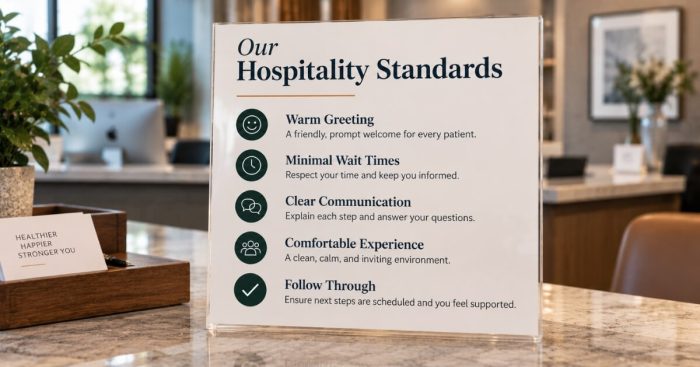
A personal touch and attention to detail everywhere possible.
Not a policy binder that says, “We practice good customer service.”
Start with how patients are greeted.
When someone walks into your clinic, welcome them warmly by name.
You already have the day’s appointment list, so learn their names and faces.
Next, make phone conversations personal.
Save every existing patient’s contact information in your CRM or phone system.
That way, you can greet returning patients by name when they call.
When patients mention their families, make a note in the CRM.
Then, ask about those family members during the next conversation.
Even putting someone on hold is an opportunity to show hospitality.
Instead of returning with “sorry for the wait,” say:
“Thank you so much for your patience. I wanted to be fully present with you — how can I help you today, [name]?”
And don’t wait for patients to contact you.
In a membership-style practice, proactively reach out and check on them.
Make a phone call or send a personal text.
Email is lazy.
Make the interaction personal enough that patients genuinely feel cared for.
None of this requires new software or a compensation change.
It requires deciding, out loud, that world-class hospitality is the priority of your business.
Can hospitality really grow a cash-pay clinic 30–50% a year without ads?
Yes — because every patient interaction can become a referral.
And referred patients already trust you before they walk through the door.
The clinics that follow this playbook grow 30–50% every year without spending money on ads.
They treat every patient as if that patient could lead to five more.
Because with excellent hospitality, they can and do.
Referrals compound exactly the way memberships compound.
More members create more advocates.
And more advocates mean cheaper, more sustainable growth.
Think about what happens when one patient has an exceptional experience.
They tell their spouse, their friends, and their coworkers.
Those people arrive already trusting your clinic because someone they know recommended it.
As a result, your team spends less time overcoming objections and more time helping patients move forward.
That’s how hospitality becomes a growth strategy rather than just a customer service standard.
Ads amplified that growth, but hospitality built it.
Share this approach with your team.
Then, make the standard explicit today.
FAQ’s About Front-Desk Phone Experience at a Cash-Pay Clinic
Does price matter less than patient experience for cash-pay clinics?
For high-intent patients, yes.
In the story above, a $900 clinic beat a $250 clinic for roughly the same service.
The difference wasn’t the treatment itself.
The more expensive clinic answered on the second ring and made the caller feel important.
Meanwhile, the cheaper clinic repeatedly placed the caller on hold and dropped the call.
Cash-pay patients aren’t simply comparing line items.
They’re deciding where to place their long-term trust.
What should front desk staff say when taking a caller off hold?
Instead of saying “sorry for the wait,” try:
“Thank you so much for your patience. I wanted to be fully present with you. How can I help you today, [name]?”
Gratitude reframes the hold as an act of care.
An apology, on the other hand, can frame the experience as a failure.
The goal is to make the caller feel appreciated, not inconvenienced.
How do I measure whether my front desk is doing a good job?
Measure how patients feel about their interactions with your team.
Are new patients praising the front desk in reviews?
Are existing patients recommending your clinic because of the service they receive?
And are patients telling you directly how well your staff treated them?
Those are the outcomes that matter most.
Administrative tasks still need to get done.
However, hospitality outcomes should be the primary performance standard for customer-facing roles.
How much does poor phone handling cost a clinic?
It can cost the immediate visit revenue, the patient’s lifetime value, and their entire referral network.
It can also lead to negative reviews and damaging word of mouth.
In the example above, repeated dropped calls cost the cheaper clinic $500 in immediate bookings.
The clinic also lost two potential long-term longevity patients.
And it may lose every friend those patients would have referred.
The most expensive part is that the clinic may never realize those opportunities existed.
What’s the cheapest way to grow a cash-pay practice?
Referrals driven by exceptional hospitality.
You can implement this approach with your existing team without purchasing new software or changing compensation.
Start by making patient experience the priority.
Answer calls warmly, remember patient details, follow up personally, and make every interaction feel important.
Clinics that prioritize this approach have grown 30–50% a year without ad spend.
That’s because every well-treated patient has the potential to become an advocate.
What’s the next step?
If you want to know how many patients your phone experience is costing you right now, book a strategy call.
We’ll mystery-call your clinic the same way Victoria called those two clinics.
Then, we’ll show you exactly what your callers experience.
We’ll also map the focus changes that can turn your front desk into your cheapest growth channel.
And we’ll do it before we ever talk about spending a dollar on ads.