
Why Not Every Lead Needs to Convert Today (The Attribution Trap That Makes Clinic Owners Kill Working Marketing)
Just because somebody didn’t give you a credit card today doesn’t mean they’re not going to send their aunt and their uncle next week. That sentence contradicts how most cash-pay practice owners evaluate marketing — a dollar into Facebook ads, organic content, or SEO, and an exact dollar amount tracked right back to it. It doesn’t always work exactly like that. And the owners who insist it must end up killing the channels that were quietly building their practice.
Why do clinic owners misjudge their marketing performance?
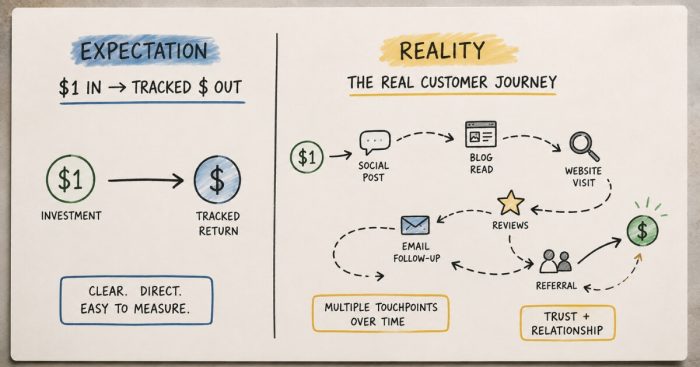
Because they evaluate it linearly: a dollar spent on a channel must produce an exact, tracked dollar back — and patient behavior doesn’t work like that.
The expectation is understandable. Ad platforms sell dashboards, dashboards imply precision, and a practice owner writing real checks wants to see spent dollars trace to collected dollars.
So they look at marketing like a linear thing. They spend a dollar on Facebook ads, a dollar on organic content, or a dollar on SEO. Then they demand an exact dollar amount tracked right back to each channel.
But the tracking can only see the shortest path: click, book, pay.
It cannot see the woman who watched your videos for three months before calling. It misses the man who found you on Google but booked after his wife’s referral. It also misses the consult that didn’t close but produced two family members a month later.
Judged linearly, those channels look like they “didn’t convert.” Judged honestly, they did the heavy lifting — the dashboard just couldn’t follow them.
The result is predictable: owners kill what was working because the receipt didn’t print where they were looking.
What does the lead who didn’t convert today actually do?
They come back in 60 days, or they send their aunt and uncle next week — if your practice stayed worth coming back to.
The no-today lead isn’t a dead lead. They’re a person mid-decision.
They inquired, learned something, met your front desk, and maybe balked at the price. Then life continued. The pain got worse, the spouse weighed in, the tax refund arrived, or a friend mentioned your name again.
Some of them book on the second touch. Others book in six months.
And some never book at all but become referrers. They tell their aunt and uncle about the clinic that treated them well on the phone, even though they didn’t buy.
None of that shows up as “conversion — Facebook ad, July 16.” Instead, it appears as an inbound call in September that the intake form logs as “referral.”
Linear attribution gives no credit to the ad that started it.
This is why practices that grow treat every inquiry as an asset with a long tail. They nurture it, follow up, and treat the person well instead of viewing every lead as a scratch-off ticket that either pays today or goes in the trash.
Why is cash-pay medicine especially non-linear?
Because patients are making high-trust, high-ticket, out-of-pocket decisions — and those decisions take multiple touches over weeks or months.
Nobody impulse-buys a $5,000 treatment program.
A cash-pay patient is choosing to pay out of pocket for something insurance would nominally cover elsewhere. That means the real product is trust.
And trust accumulates across touchpoints: the video they watched, the article that answered their question, the friend who vouched for you, and the front desk that didn’t pressure them.
By the time they buy, six things may have “caused” the decision. The dashboard will credit one.
This is also why compounding channels can look worst in linear measurement right before they pay off.
Orthobiologics Associates generated $309,590 in cash-pay revenue over 10 months from SEO with zero ad spend — but months one and two of an SEO investment always look like money spent on nothing.
An impatient linear reader cancels in month three. Clinics that understand how medical practice marketing actually compounds hold the line — and collect the curve.
How should I evaluate marketing channels instead?
Blended numbers over longer windows: total marketing spend against total new patients, trends over 90 days, and each channel judged by its role.
The practical fix isn’t abandoning measurement. It’s measuring at the right altitude.
Track blended cost per acquired patient: all marketing spend divided by all new patients. Review it monthly and trend it over a trailing quarter.
That number captures more of the referrals, delayed bookings, and assisted conversions that per-channel tracking loses.
If blended CAC is healthy and falling while patient volume grows, the system is working — even if no single dashboard proves which dollar did what.
Then judge channels by role instead of applying identical ROI math to everything.
Ads provide fast, measurable demand capture. Content and brand build trust that helps everything else convert. SEO compounds over time. Referrals harvest the goodwill the other channels planted.
NuLevel Wellness added $6.7M in one year and 3,727 new patients precisely by running multiple channels as a system rather than demanding each channel individually justify itself every Friday.
Ask, “Is the machine producing patients profitably?” before asking, “Which gear deserves credit?”

Doesn’t this mean marketing accountability goes out the window?
No — you still track ruthlessly. You just stop demanding that the tracking tell a simpler story than the truth.
This isn’t a license for vendors to hide behind “brand awareness.” The disciplines that ARE linear stay linear.
Log every inquiry with the source the patient reports. Measure booking rates weekly. Run follow-up sequences on schedule. Then review blended cost per patient every month.
If blended CAC rises for a quarter, something is genuinely wrong, and you dig in.
Likewise, if a channel produces neither trackable bookings nor plausible assists after a fair window, it earns a cut. Give compounding channels like SEO and content roughly six months to demonstrate progress. Paid ads should show measurable demand capture faster.
The distinction is between accountability and false precision.
“Show me that our total marketing produces patients at a cost we can afford” is accountability.
“Show me the exact dollar this Tuesday’s Instagram post returned” is false precision. Optimizing for that kind of measurement systematically starves the trust-building work that makes a cash-pay practice referable.
Track everything. Just interpret the numbers like patients are humans deciding over time, not vending machines with a coin slot.
FAQ’s About Lead Conversion Timelines and Marketing Attribution for Clinics
How long does it take a cash-pay lead to convert?
Anywhere from same-day to six months or more.
High-ticket, out-of-pocket medical decisions require trust. That trust often accumulates across multiple touchpoints — a video, an article, a referral, and a phone call.
As a result, a meaningful share of revenue can come from leads that didn’t convert on first contact.
Is a lead that didn’t book a wasted marketing dollar?
No.
The no-today lead may book later, refer others, or do both. The person who didn’t hand over a credit card today may send their aunt and uncle next week.
That lead only becomes wasted if the practice has no nurture system to stay in touch.
What’s wrong with tracking exact ROI per channel?
Per-channel tracking often gives too much credit to the final measurable interaction before booking.
As a result, it can undercredit content, SEO, and brand — channels that help create trust behind referrals and delayed bookings.
When owners rely too heavily on last-touch attribution, they risk cutting channels that were quietly contributing to growth.
What should a clinic track instead of per-channel ROI?
Track blended cost per acquired patient — all marketing spend divided by all new patients — over a trailing 90-day period.
Then pair it with operational conversion metrics such as inquiry volume, booking rate, and follow-up execution.
You should still track individual channels. However, judge each one according to the role it plays in the overall system rather than expecting identical attribution from every channel.
When should I actually cut a marketing channel?
When it produces neither trackable bookings nor plausible assists after a fair evaluation window.
For compounding channels such as SEO and content, give the investment roughly six months to demonstrate meaningful progress. Paid ads deserve a shorter leash because they should produce measurable demand signals much faster.
Don’t keep a channel simply because attribution is imperfect. Give it enough time to perform, measure what you reasonably can, and then make the decision from the broader business results.
What’s the next step?
If you’re about to cut a channel because the dashboard can’t prove it paid for itself — or you’re stuck at a growth plateau because only same-day-ROI marketing survives your Friday reviews — get a second set of eyes first.
Book a strategy call. In 60 minutes we’ll calculate your real blended cost per patient, map where your referrals and delayed bookings actually originate, and show you which channels are compounding versus coasting.