
Why Most Clinics Shouldn’t Run Ads — And What to Do Instead (27 of Our 30 Clinics Don’t)
Clinic owners ask us all the time: “What makes the ads you’d run for my business different from the ads every other agency has run for my business?”
And honestly, most of the time the answer is: turn the freaking ads off.
That’s a strange thing for a marketing agency to say, so here’s the FAQ on why — including the readiness math we use before spending a dollar.
We’ll also explain how 27 of the 30 clinics we currently work with grow without any paid ads at all.
Should my clinic be running paid ads?
Probably not yet.
Of the 30 clinics we work with right now, 27 don’t run any paid ads — and they’re growing anyway.
That’s not because ads don’t work.
It’s because ads are an amplifier, not a foundation.
Most clinics that come to us asking for better ads actually have a foundation problem.
The three clinics that do run ads with us are the ones where the math and the machinery are already in place.
Meanwhile, the other 27 grow through referrals, SEO, and better systems, and they don’t need ads.
That’s the whole point: paid traffic is one growth lever among several.
And it’s rarely the first one a cash-pay practice should pull.
If an agency’s answer to every clinic is “run ads with us,” that tells you what they sell — not what you need.
Why do paid ads fail for most medical practices?
Because if the foundation isn’t in place — the right offer, the right systems, the right follow-up — ads won’t fix it.
They’ll just drain your cash faster.
Ads do one thing: they buy attention and send it into whatever you’ve built.
If the offer doesn’t make a patient say “that’s exactly what I need and the price makes sense,” attention bounces.
If there’s no follow-up system, the leads that do come in leak away.
Unanswered calls, one voicemail, no nurture.
The ad account faithfully reports leads delivered while the practice quietly loses money on every one of them.
This is why the previous agencies failed those owners too.
The problem was almost never the ad copy or the targeting.
Instead, money was being poured into a funnel with holes in it.
More spend just meant faster draining.
When is a clinic actually ready for paid ads?
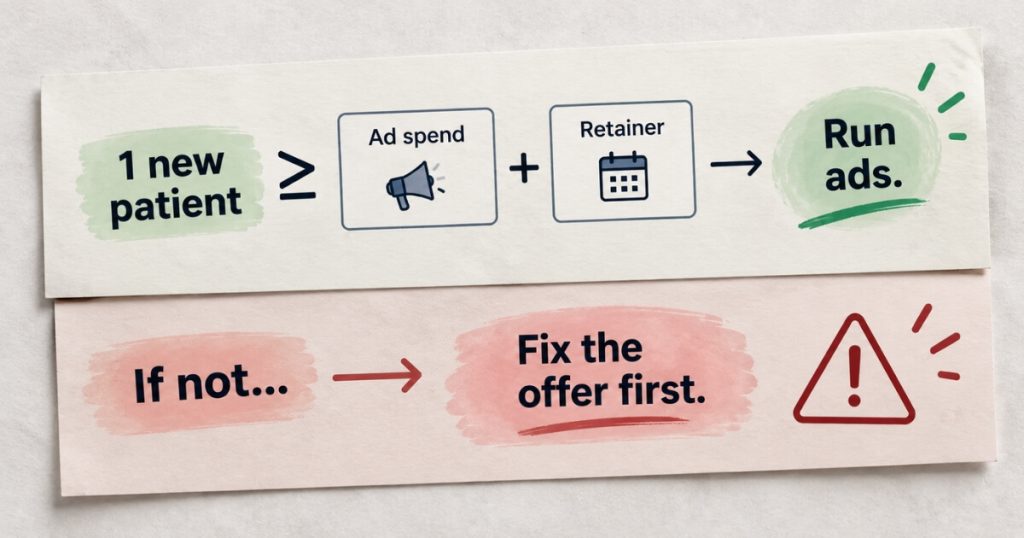
When one new patient covers the ad spend and the retainer.
If it doesn’t, we don’t run the ads until it does.
That’s the readiness math, and it’s deliberately blunt.
If your offer’s value per patient is high enough, a single new patient pays for the month’s advertising and the agency managing it.
Then ads only have to produce one patient to break even — and everything past that is profit.
If it takes five patients just to cover costs, the campaign is fragile.
One soft month, one tracking gap, or one slow front desk week, and you’re underwater.
Getting to “one patient covers it” isn’t about spending more.
It’s offer design — pricing, packaging, and lifetime value.
Fix that first, and the ad math flips from fragile to forgiving.
How do clinics grow without running ads?
Referrals, SEO, and better systems — the three channels our 27 ad-free clinics grow on.
Referrals are the highest-trust, lowest-cost channel a practice has.
They also respond to systemization: asking at the right moment, making it easy, and rewarding it.
SEO captures the patients already searching for your treatment — the hand-raisers.
And it compounds instead of stopping the day you stop paying.
Better systems, including follow-up, booking, and retention, raise the conversion of everything else.
That’s growth without a single new lead.
The proof this isn’t theory: Orthobiologics Associates generated $309,590 in cash-pay revenue in 10 months without any paid ads, converting 79.4% of leads into booked appointments.
SEO plus a disciplined follow-up system, zero ad spend.
That’s what the foundation looks like when it’s actually built.
It’s the core of how we approach medical practice marketing: build the machine that converts demand before paying to create more of it.
What’s different about ads when a clinic IS ready?
Three things: the math works before launch, the ads are written by people who understand how patients think, and they run into a system that converts.
First, the offer makes sense financially.
One new patient covers the ad spend and the retainer, or we don’t launch.
Second, the ads aren’t templated marketing copy repasted between businesses.
Instead, they’re built from what works inside real clinics, in your market, for your patients.
Third, the clinic is ready.
Follow-up automation is live, the front desk is trained, and tracking is in place.
As a result, every lead the ads produce lands in machinery built to convert it.
When those conditions hold, paid traffic stops being a gamble and becomes an amplifier.
We generated $2 million in revenue from Facebook ads for an orthopedic surgical center.
But that result came after the offer and conversion system earned the right to be amplified.
What should I do instead of running ads right now?
Fix the three foundations in order: offer, follow-up system, then organic demand capture.
Start with the offer — what a new patient gets, what it costs, and whether its economics can eventually support paid acquisition.
Then build the follow-up system.
That means a CRM pipeline, speed-to-lead automation, and a front desk process that converts inquiries into booked visits.
It’s the machinery of patient acquisition that every future channel will depend on.
Next, capture the demand that already exists.
Focus on local SEO, Google Business Profile, and content answering what your patients actually search.
Do those three, and one of two things happens.
You grow without ever needing ads — like most of our clinics.
Or you arrive at the ad decision with an offer and a system that make ads safe to run.
Either outcome beats spending first and hoping.
FAQ’s About Whether Clinics Should Run Paid Ads
Do paid ads work for cash-pay medical practices?
Yes — when the foundation exists.
Ads amplify what’s already true.
A strong offer and a working follow-up system get amplified into growth, while a weak foundation gets amplified into faster losses.
Of the 30 clinics we work with, only 3 run paid ads.
The readiness, not the platform, is the variable.
How much should a clinic spend on ads to start?
The budget question comes second.
First, check the readiness math: can one new patient cover a month’s ad spend plus management?
If yes, start with a budget where that single-patient payback holds.
If no, spend the money improving the offer and follow-up instead.
That investment will return more.
What does a “foundation” mean before running ads?
Three things: the right offer, the right systems, and the right follow-up.
The right offer means packaging and pricing that a patient immediately understands and values.
The right systems include a CRM, booking, and tracking.
Finally, the right follow-up means speed-to-lead automation and a trained front desk.
Missing any of the three turns ad spend into a leak.
Can referrals and SEO really replace paid ads?
For most practices, yes — 27 of our 30 clinics grow exactly that way.
Referrals convert at the highest rate of any channel.
Meanwhile, SEO captures high-intent searchers and compounds over time.
Systems improvements also raise revenue without generating any new leads.
Ads are optional; conversion isn’t.
Why would a marketing agency tell me to turn my ads off?
Because an agency accountable for revenue — not clicks — makes more money for clients by fixing the foundation first.
Ads running on a broken offer burn the budget and the relationship.
Instead, turn them off, fix the economics, and relaunch only when the math works.
That’s what alignment actually looks like.
What’s the next step?
If you’re spending on ads that aren’t producing patients, the foundation may be the problem.
The same applies if you’ve been burned by an agency that kept reporting clicks while your bank account shrank.
Book a strategy call.
In 60 minutes, we’ll run the readiness math on your offer and audit your follow-up system.
Then we’ll tell you straight whether ads make sense for your clinic right now or whether referrals, SEO, and systems will grow you faster.
Sometimes the most profitable advice is “turn them off.”