
Why Doesn’t a Million Followers Turn Into Booked Patients? (What an Audit of a Famous Surgeon’s Practice Found)
We recently audited a South Florida orthopedic and regenerative practice owned by one of the biggest orthopedic creators in the country — nearly a million followers, roughly half a billion video views, a 4.9-star reputation, and an NFL MVP photographed on the homepage.
His website gets 89 organic visits a month.
If you’re a practice owner posting content and wondering why the phone isn’t ringing, this audit is the clearest answer we’ve ever seen.
Why doesn’t a big social media following turn into booked patients for my practice?
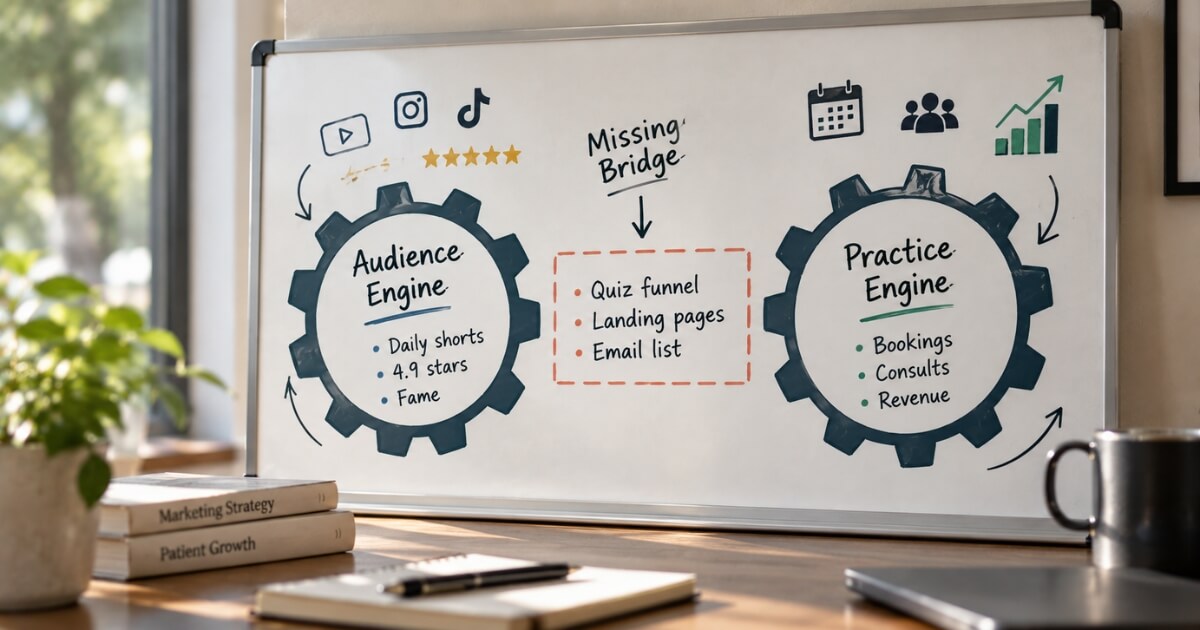
Because attention and acquisition are two different engines, and most practices never connect them.
The surgeon we audited has already won the game 99% of doctors never crack: attention.
He has roughly 221,000 YouTube subscribers, around 2,000 videos, and close to half a billion total views.
Add large Instagram and TikTok audiences, and he has nearly a million followers combined.
The content is national entertainment: gym fails, celebrity injuries, and reaction commentary.
It builds fame brick by brick.
But a 19-year-old in Ohio laughing at a squat fail is not booking a $6,000 regenerative consult in South Florida.
Every caption points to the homepage — and the homepage converts at patient-portal speed.
The audience engine and the practice engine aren’t connected.
The good news, and the reason this audit matters for every clinic owner, is that the connection is the cheapest thing on the entire list to build.
What did the audit actually find under the hood of a famous practice?
A highway with two pages on it.
The numbers tell the whole story.
The practice site has 1,608 referring domains — a link profile most practices would pay six figures to build, earned free off the owner’s fame.
Its Domain Rating is 28.
And what does that authority produce?
Thirty-five ranking keywords and 89 organic visits a month, with an estimated traffic value of $89.
The blog contains exactly two posts, both celebrity-injury breakdowns from 2022.
A year ago, the site ranked for roughly 265 keywords.
The long tail has since collapsed because those two posts decayed and nothing replaced them.
Meanwhile, the practice publishes short-form video every single day.
The editorial machine exists.
It just never touches the website.
And the pages that still rank — “stem cell therapy” city terms at #3 and surgical specialty terms in the top 10 — do so with zero content support.
On the AI side, it’s worse.
There are essentially no citations on ChatGPT, Perplexity, Gemini, or Google AI Overviews.
When a patient asks an LLM for the best regenerative doctor in the region, the famous surgeon doesn’t exist.
The franchises writing cost-and-candidacy articles do.
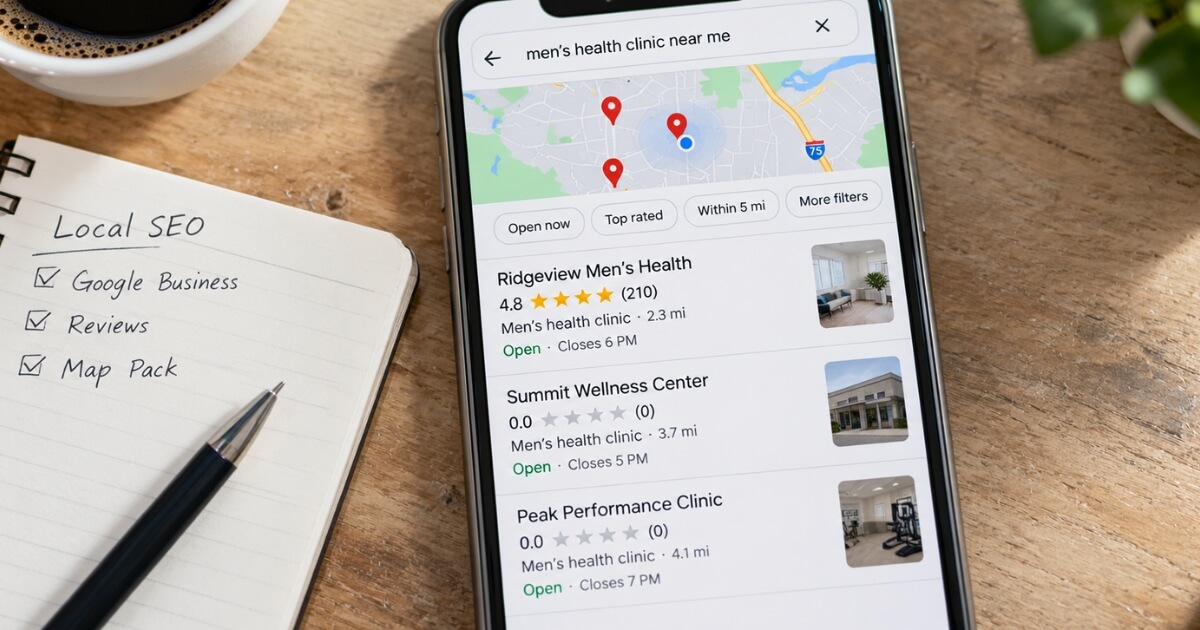
Why is my clinic invisible on Google Maps for its highest-ticket service?
Because your Google Business Profile only tells Google about one of your businesses.
This practice runs two engines under one roof.
The first is insurance-driven surgery — the credibility engine that built its 4.9 stars and 210 reviews.
The second is cash-pay regenerative medicine — the revenue engine, which runs roughly $5,000–$10,000 per joint in this market.
The Google listing runs a single category: “Orthopedic clinic.”
The result is brutal.
Search the high-ticket regenerative term for the city and the practice is not in the Maps pack.
Meanwhile, competitors with zero reviews rank, including one down the street.
Two hundred ten reviews, yet the practice loses its most valuable search to businesses with none.
The fix is unglamorous and fast.
Add secondary categories and a full services list for the cash-pay treatments.
Take ownership of the listing hours. Google was showing hours “updated by others” — crowdsourcing the practice’s front door.
Post weekly.
Then run an automated post-visit review ask that coaches happy regenerative patients to name the treatment in their review text.
Those keywords are what pull a listing into an empty pack.
This is one of the first things we fix inside a stem cell clinic marketing engagement because it’s free demand the practice already earned.
Why don’t my Google Ads produce patients even on the right keywords?
Because the right keyword pointed at the wrong destination is still a wasted click.
The audit found two active Google ads.
The text was actually good — board-certified positioning on the exact high-intent regenerative search term.
The destination was business.google.com.
The practice was paying to send a $10,000-intent click to its own Google profile: no offer, no proof, no financing, no form.
Right offer, right keyword, no funnel.
Meanwhile, the dominant cash-pay competitor in the market — a national regenerative franchise staffed by non-surgeons — runs roughly 200 ads and answers the phone until 10 PM.
The ad gap is 100 to 1 on the exact service where the surgeon holds the credential advantage.
For context on what the same click is worth when the funnel exists, another cash-pay client runs a men’s health quiz funnel on Google.
It produces a 15:1 return on ad spend on $15,000–$20,000 tickets.
The mechanics transfer directly: one flagship campaign, four to five ad groups, pointed at a dedicated landing page with a candidacy quiz, financing options, and proof.
What is the “bridge” between a social audience and a full schedule?
A conversion layer: somewhere for attention to land, and a way to follow up with it forever.
The audited practice has no lead magnet, no chat, and no email capture anywhere.
If a visitor doesn’t book today, the practice has no way to ever talk to them again.
And “book” means completing an EHR patient-portal questionnaire that asks for date of birth and primary care provider before anyone offers a time.
A cash-pay lead worth five figures walks the same path as a post-op paperwork request.
The bridge has three planks.
First, the link in every bio goes to a quiz or a lead magnet — with an email sequence behind it.
That way, anonymous reach becomes a list the practice owns.
Second, publish one patient-facing long-form condition video a month, such as “Do you actually need surgery? An honest breakdown.”
Then the existing shorts team clips it like everything else.
That’s the video that produces patients because the buyer self-selects.
Dr. Joy Kong built the #1 stem cell channel on YouTube, hired four more doctors off it, and scaled herself out of the day-to-day — and the surgeon we audited has roughly ten times her reach.
Third, fix the front door.
Use one primary call-to-action that opens a real scheduler or a four-field form with a five-minute callback standard.
That’s because a predictable patient acquisition system is built on speed-to-lead, not on paperwork.
How much revenue is a disconnected audience actually worth?
For this practice, roughly $500,000 to $1,000,000 a year — with no new equipment, no new location, and no new content.
The math is conservative.
Two additional cash-pay regenerative cases a week at $5,000–$10,000 per case is $500K–$1M annually.
The demand already exists inside the practice.
Every surgical patient is a regenerative lead — the other knee, the shoulder that isn’t bad enough to cut yet — and surgery is the trust event.
A patient who trusts a surgeon to open their knee trusts them with a $6,000 biologic.
Most practices never sell the second thing.
And the organic proof exists in this exact niche.
That’s what happens when a fraction of this kind of attention gets a path to the schedule.
FAQ’s About Turning a Social Media Audience Into Patients
Do I need more followers before social media can produce patients?
No.
The audited practice proves followers aren’t the constraint — nearly a million of them produced 89 website visits a month.
The constraint is the conversion layer: a quiz or lead magnet in the bio, an email list, landing pages for the high-ticket services, and a booking flow that offers a time instead of a questionnaire.
Most clinics need a bridge, not a bigger audience.
What should the link in my clinic’s bio point to?
A candidacy quiz or a condition-specific lead magnet with an email sequence behind it — not your homepage.
A homepage asks visitors to figure out what to do.
A quiz captures contact information and tells you exactly which service they want.
Then a human can call them within minutes.
My content gets national views but my practice is local. Is the audience useless?
No — but it converts indirectly.
A small percentage of national viewers are in or near your market, and high-ticket cash-pay patients routinely travel for credibility.
The fix is a local call-to-action pinned on locally relevant videos, plus city-and-condition pages on your site.
Then publish one patient-facing long-form video a month that lets serious buyers self-select.
What’s the fastest fix if I already post video every day?
Repurpose it into your website.
Every injury or condition breakdown you’ve filmed becomes an article on your domain.
Then add condition-and-city pages for your cash-pay services.
Two per week for 90 days lets an established domain’s authority do the rest.
The audited practice had 1,608 referring domains waiting for content that never came.
How do I get my cash-pay service into the Google Maps pack?
Add secondary categories and a services list for the treatment.
Own your hours, post weekly, and run an automated post-visit review ask that encourages happy patients to name the treatment in the review text.
The audited clinic had 210 reviews but one category.
And it lost the highest-ticket local search to competitors with zero reviews.
What’s the next step?
If you’re posting content, collecting followers, and still can’t trace a single patient back to any of it, the problem is almost never the content.
It’s the missing bridge between the audience engine and the practice engine.
That bridge is the cheapest, fastest thing to build in your entire marketing stack.
Book a free strategy call and we’ll audit your practice the same way: your funnel, your Google listing, your ads, your booking flow, and the exact revenue sitting in the gap between attention and schedule.