
Why Lead Intent Changes Everything in Medical Practice Growth (Google Leads vs. Facebook Leads Explained)
Two leads arrive at your clinic the same afternoon.
One typed their problem into Google and clicked your ad. The other was scrolling Facebook and got interrupted by one.
Same form, same fields, same “lead” in your inbox — and completely different people.
Understanding that difference — lead intent — is the single most underrated variable in medical practice growth.
That’s because it determines your sales process, your follow-up, your channel strategy, and your real cost per patient.
Here’s the FAQ.
What is lead intent and why does it change everything in medical practice growth?
Lead intent is how ready a person was to solve their problem when they became a lead.
And it dictates everything that has to happen next to convert them.
A high-intent lead raised their hand: they searched for the problem, compared options, and contacted you on purpose.
A low-intent lead was interrupted: an ad caught their attention mid-scroll, and curiosity — not urgency — filled out the form.
Both are real prospective patients.
But they need different conversations, different timelines, and different follow-up systems.
A practice that treats them identically will convert one group and burn the other.
Intent is why “leads” is a nearly useless metric on its own.
A hundred hand-raisers and a hundred interrupted scrollers cost different amounts, close at different rates, and demand different machinery.
Growth planning starts with knowing which kind you’re buying.
What’s the difference between a Google ad lead and a Facebook ad lead?
A Google ad lead is somebody with intent who raised their hand and said, “I have a problem.”
A Facebook ad lead is usually somebody who was interrupted — often not ready to buy.
That’s the exact framing we use with clients, and it’s not a knock on Facebook.
It’s a description of how the platforms work.
Google captures existing demand: the person searched “knee pain treatment without surgery” before they ever saw your name.
Facebook and other social platforms create demand.
The person was in the middle of their day — sometimes, as we like to put it, interrupted on the toilet — when your ad found them.
They may have the problem.
However, they weren’t actively shopping to solve it in that moment.
What we’ve found in medical practices specifically is that the sales process most clinics already have aligns more naturally with converting Google leads.
The same applies to the process we build together.
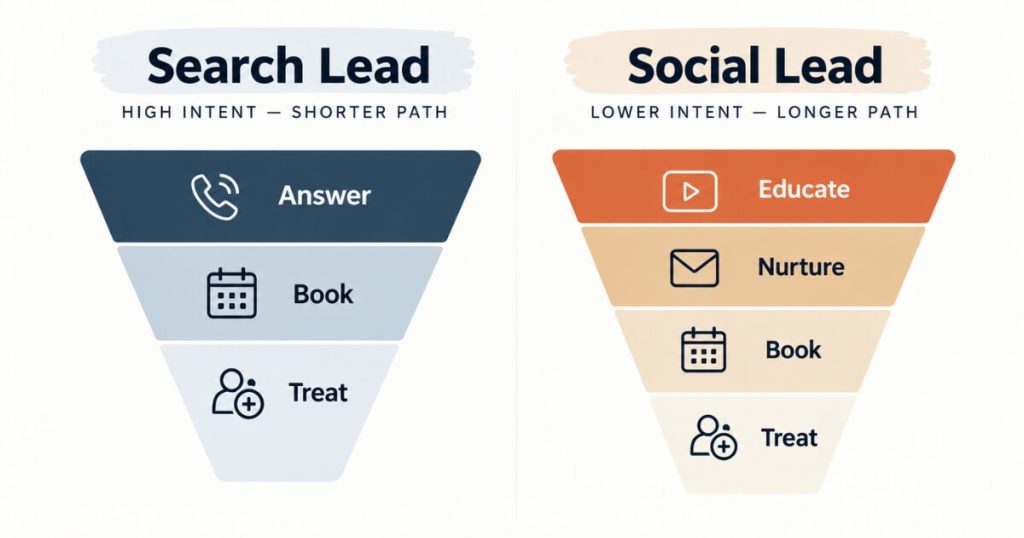
The hand-raiser matches the way clinics are used to selling: answer questions, book the consult.
The interrupted scroller needs something most practices don’t have by default.
Why does my sales process convert search leads but fail with social leads?
Because a clinic’s default sales process assumes the patient is ready — and social leads usually aren’t yet.
When a hand-raiser calls, the front desk answers questions and books the appointment.
That works because the lead did their deciding before they contacted you.
Run the same process on a social lead, and it collapses.
They don’t answer the phone call (“who’s this?”), they balk at the consult fee, and they “want to think about it.”
The practice concludes social leads are junk.
They’re not junk — they’re early.
They entered the funnel at a different stage, and the process never accounted for that.
Converting interrupted leads requires a nurture layer.
That means an instant response while attention is still warm, followed by education about the treatment and pricing before the booking ask.
It also requires a follow-up sequence that stays present over days and weeks.
That gives the person’s readiness time to catch up to their interest.
Should my practice run Google ads or Facebook ads first?
Start where intent is highest — search.
Then add interrupt channels once your follow-up system can nurture colder leads.
High-intent channels convert on infrastructure most clinics already have.
As a result, they produce revenue fastest and prove the offer works.
That’s the sequencing logic at the heart of a durable patient acquisition strategy: capture existing demand before paying to create new demand.
But “start with search” doesn’t mean social can’t be a monster channel.
With the right process behind it, it absolutely can.
We generated $2 million in revenue from Facebook ads for an orthopedic surgical center — high-ticket, cash-pay procedures sold to leads that started as interrupted scrollers.
The difference was the machinery.
Education-first funnels and follow-up were built for lower-intent leads, not a front desk waiting for hand-raisers.
How does lead intent affect my cost per patient?
Low-intent leads look cheaper and often cost more.
That’s because cost per patient is cost per lead divided by conversion, and intent drives conversion.
Facebook leads routinely cost a third of what search leads cost, which is exactly why owners chase them.
But consider what happens when the sales process doesn’t match the lead.
If a $30 social lead converts at 5%, the cost per acquired patient is $600.
Meanwhile, if a $90 search lead converts at 40%, the cost per acquired patient is just $225.
| Metric | Facebook Ads | Google Ads |
|---|---|---|
| Cost per lead | $30 | $90 |
| Lead-to-patient conversion | 5% | 40% |
| Cost per acquired patient | $600 | $225 |
The “cheap” channel is producing $600 patients, while the “expensive” one produces $225 patients.
Intent is the hidden variable that makes the dashboard lie.
The practical rule: judge every channel on cost per acquired patient.
And expect that number to depend on two things you control: the intent of the leads you buy and the fit of the process that receives them.
Improve either, and the channel transforms.
This is also why high-intent organic channels compound so well.
Eternity Health Partners built $1.7M a year in membership revenue from SEO alone — hand-raisers, arriving free, into a process built to convert them.
FAQ’s About Lead Intent in Medical Practice Growth
What does “lead intent” mean in medical marketing?
It’s how actively the person was trying to solve their problem when they became a lead.
A search lead who typed “TRT clinic near me” has high intent.
Meanwhile, a social lead who clicked an interesting ad mid-scroll has low-to-medium intent.
Intent predicts close rate, sales cycle length, and the follow-up effort required.
Are Facebook leads worth it for a medical practice?
Yes — if you have a nurture system built for them.
Social leads are earlier-stage, so they need instant response, education before the booking ask, and a multi-week follow-up cadence.
With that machinery, social ads have produced millions in cash-pay revenue.
Without it, they mostly produce frustration.
Why do my Facebook leads not answer the phone?
Because they weren’t waiting for your call.
They were interrupted, expressed casual interest, and moved on with their day.
That’s why speed and channel matter.
A text within minutes of the form fill catches them while the ad is still fresh.
Meanwhile, a cold call the next day reaches someone who barely remembers clicking.
Which leads are cheaper — Google or Facebook?
Facebook leads usually cost less per lead, while Google leads usually cost less per patient.
Search traffic is more expensive because intent is priced in.
Those leads close faster and at higher rates.
Therefore, compare channels on cost per acquired patient, never cost per lead.
How do I raise the intent of the leads I’m already getting?
Qualify inside the funnel.
Use quizzes, condition-specific landing pages, transparent pricing, and consult fees to filter casual clickers before they hit your front desk.
As a result, volume drops, but the close rate jumps.
The leads that do arrive behave more like hand-raisers.
What’s the next step?
If your practice is generating leads that don’t convert — or you’re deciding where the next marketing dollar goes — the answer starts with an intent audit.
Which channels are your leads coming from, what stage are they at, and does your sales process match?
Book a strategy call.
In 60 minutes, we’ll map your channels against your process.
Then we’ll show you whether your growth problem is really a lead problem — or an intent mismatch you can fix in weeks.