
Why Does Every Cash-Pay Clinic Need a Documented Patient Journey System? (How a Built-Out Journey Drives Retention and Patient LTV)
Every cash-pay clinic has a patient journey. The only question is whether it’s documented and automated, or living in your team’s heads and reinvented for every patient by whoever happens to be on shift. The clinics that retain patients and compound lifetime value are the ones that built the journey once — the automated texts, the tasks, the reminders, the intake forms, the scripts, all mapped to a communication cadence — and then made it run. Meanwhile, the clinics that leak patients are the ones still doing it ad hoc. Here’s why a documented patient journey system is the difference, and why you almost certainly don’t have to build it from scratch.
Why does every cash-pay clinic need a documented patient journey system?
Because a documented patient journey system turns retention and lifetime value from luck into a repeatable process.
It defines the exact communication cadence and touchpoints every patient receives.
As a result, nothing depends on whoever happens to be working that day.
Many clinics communicate with patients reactively.
Someone sends a reminder if they remember.
The team follows up if the schedule allows.
Likewise, the front desk sends an intake form if it is not overwhelmed.
That inconsistency is where retention begins to leak.
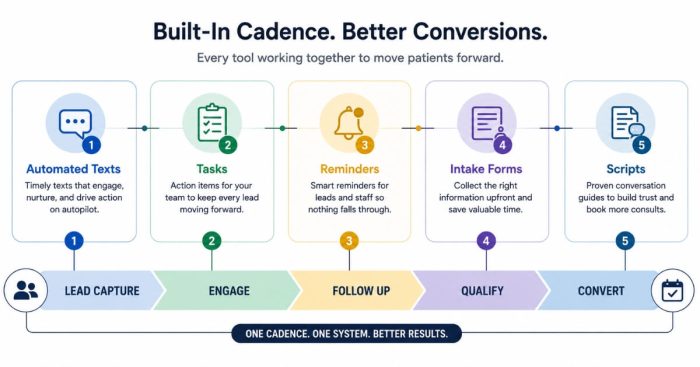
Instead, a built-out journey replaces that uncertainty with a defined sequence of:
- Automated texts
- Tasks
- Reminders
- Intake forms
- Scripts
Each touchpoint follows the communication cadence appropriate for that patient type.
Once the journey is documented and automated, every patient receives the same proven experience.
Whether the clinic is having a quiet day or a chaotic one no longer matters.
That consistency keeps patients engaged.
It also brings them back for their next visit.
Over time, it extends how long they stay.
In a cash-pay clinic, that is the primary driver of lifetime value.
The same systematized approach is what drove VYVE Wellness, a functional-medicine and longevity clinic, to 100+ inbound calls per month and a 900% increase in website leads in four months.
However, leads only become lifetime value when the journey behind them is designed to retain patients.
What exactly is in a built-out patient journey system?
A built-out patient journey system is the complete set of communication touchpoints a patient moves through.
It combines automations with team workflows that include:
- Automated texts
- Tasks
- Reminders
- Intake forms
- Scripts
Automated texts handle routine communication.
For example, they send confirmations, check-ins, and re-engagement messages without anyone having to remember.
Meanwhile, tasks and reminders tell the team exactly what to do and when to do it.
Because of that, follow-up becomes a workflow instead of a hope.
Intake forms gather the right information at the right stage.
Consequently, both the clinical conversation and the sales conversation become more informed.
Scripts complete the system.
They ensure every team member says the right thing at every touchpoint.
Just as importantly, they ensure it is delivered the same way every time.
Together, these elements create a documented communication cadence from the patient’s first interaction through long-term retention.
The journey is built once.
Then the clinic documents it and runs it consistently.
Nobody has to reinvent the experience for every patient or every shift.
This operational framework sits underneath effective functional medicine & longevity clinic marketing.
Marketing brings patients into the clinic.
The documented journey is what keeps them there.
How does a patient journey system drive retention and lifetime value?
A documented patient journey drives retention and lifetime value by making timely communication automatic.
Because patients consistently hear from the clinic, they stay engaged instead of drifting away between appointments.
Lifetime value is simply retention multiplied by patient spend over time.
Likewise, retention depends largely on whether patients feel cared for between visits.
A documented journey delivers the right communication at the right moment.
That includes:
- Appointment reminders
- Post-treatment check-ins
- Re-engagement messages when patients become inactive
- Intake forms that surface problems before they become cancellations
Automation handles these touchpoints.
Therefore, they never rely on memory or available bandwidth.
Patients experience consistent communication throughout their care.
As a result, they are more likely to renew, refer friends, and upgrade their treatment.
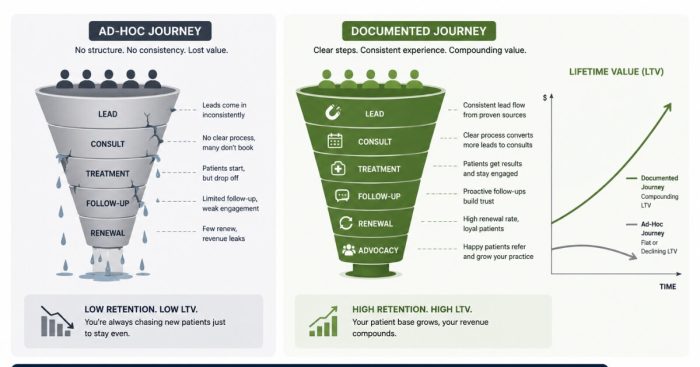
Clinics without a documented journey lose patients in the gaps.
By comparison, clinics with one close those gaps systematically.
Their lifetime value compounds because patients continue investing over time.
That advantage matters even more in functional medicine and longevity.
Those specialties are built around long-term relationships rather than one-time visits.
A documented journey becomes the difference between a single consultation and a patient who remains on a program for years.
Why is an undocumented, ad-hoc patient experience costing my clinic money?
An ad-hoc patient experience costs your clinic money because inconsistency creates silent leaks at every stage.
Missed follow-ups, forgotten check-ins, and dropped re-engagement quietly become lost revenue that never appears on a report.
When the patient experience exists only in people’s heads, it changes from one team member to the next.
It also changes depending on how busy the clinic is that day.
As a result, one patient receives an excellent follow-up.
Another patient receives nothing and never returns.
No alert tells you a patient quietly drifted away.
Instead, the clinic simply never had a system designed to catch them.
Multiply that across hundreds of patients and the lost lifetime value becomes enormous.
Unfortunately, most clinics never see those losses because they happen quietly over time.
A documented patient journey changes that.
It creates a consistent experience.
It also exposes the leaks, allowing the clinic to keep revenue that previously slipped through the cracks.
Ultimately, the biggest cost is losing patients without ever knowing why.
You cannot fix a problem you cannot see.
Do I have to build a patient journey system from scratch?
No.
Most cash-pay clinics do not need to build a patient journey from scratch.
Instead, they can adapt a proven framework to fit their services and patient types.
We have already built customer journeys for nearly every type of cash-pay clinic.
Because of that, we typically begin with an existing blueprint rather than a blank page.
Most of the system already exists, including:
- Automated texts
- Tasks
- Reminders
- Intake forms
- Scripts
That foundation makes implementation much faster.
Instead of spending months designing a new workflow, the clinic customizes an existing one.
Then the team focuses on implementing it consistently.
Designing the ideal sequence has never been the hardest part.
Building it, deploying it, and following it every day are the real challenges.
Fortunately, a proven template removes most of that work.
As a result, clinics begin seeing retention improvements much sooner.
The framework stays the same.
Only the details change to match the clinic’s services and patient journey.
How do I get my team to actually run the patient journey consistently?
Start by automating every step that does not require a person.
Next, support every human interaction with clear tasks, reminders, and scripts.
That approach makes following the journey easier than ignoring it.
Many clinics struggle because the correct process feels like extra work.
A documented journey reverses that.
Automated texts send themselves.
Tasks appear automatically in the workflow.
Likewise, reminders tell the team exactly what to do next.
Scripts remove the guesswork from every patient interaction.
When the right action becomes the easiest action, consistency naturally improves.
Accountability completes the system.
The workflow should clearly show when someone skips a step so the team can correct it immediately.
The same principle applies to call-handling scripts.
They only work when everyone follows the same process.
The goal is a patient journey that runs itself whenever possible.
Meanwhile, the team stays accountable for the human touchpoints that automation cannot replace.
Together, automation and accountability create a consistent patient experience that improves retention and lifetime value instead of becoming another forgotten operations manual.
FAQ’s About a Documented Patient Journey System
Why does every cash-pay clinic need a documented patient journey system?
A documented patient journey system turns retention and lifetime value into a repeatable process.
It defines the communication cadence and touchpoints every patient receives instead of relying on memory.
Automated texts, tasks, reminders, intake forms, and scripts work together to create a consistent experience.
Because every patient follows the same journey, engagement increases, retention improves, and lifetime value grows.
What exactly is in a built-out patient journey system?
A complete patient journey system includes automated texts, tasks, reminders, intake forms, and scripts.
Automated texts handle routine communication.
Tasks and reminders guide the team’s workflow.
Intake forms collect the right information at the correct stage.
Scripts standardize conversations.
Together, these elements create a documented communication cadence from the patient’s first interaction through long-term retention.
How does a patient journey system drive retention and lifetime value?
A documented patient journey delivers consistent communication at the right moments.
Patients receive reminders before appointments, check-ins after treatments, re-engagement when they become inactive, and intake forms before issues become cancellations.
Automation handles those touchpoints, so they do not depend on memory.
As a result, patients feel consistently cared for and are more likely to renew, refer others, and continue investing in their care.
Why is an undocumented, ad-hoc patient experience costing my clinic money?
Without a documented system, every patient’s experience depends on the person working that day.
Some patients receive excellent follow-up.
Others receive none.
Those missed touchpoints quietly reduce retention and lifetime value.
A documented journey creates consistency and helps the clinic identify revenue leaks before they become permanent losses.
Do I have to build a patient journey system from scratch?
No.
Proven patient journey systems already exist for nearly every type of cash-pay clinic.
Rather than inventing one from the beginning, the clinic adapts an established framework that already includes automations, reminders, tasks, intake forms, and scripts.
That approach speeds implementation while improving retention much sooner.
How do I get my team to actually run the patient journey consistently?
Automate every step that can be automated.
Then reinforce the remaining human touchpoints with tasks, reminders, and scripts.
Review completion regularly and hold the team accountable.
When the next action appears automatically inside the workflow, consistency becomes much easier to maintain.
What’s the next step?
If your cash-pay clinic spends real money bringing patients through the door but loses them between visits, the solution is not more marketing.
Instead, build a documented patient journey system.
Map automated texts, tasks, reminders, intake forms, and scripts to the correct communication cadence for every patient type.
Build the system once.
Then run it consistently.
That is what transforms marketing-generated leads into long-term lifetime value.
Better yet, you do not have to start from scratch.
Proven patient journeys already exist for nearly every type of cash-pay clinic.
That makes it much faster to customize one for your clinic and keep your team accountable for following it.
We have done exactly that for clinics like VYVE Wellness, where we drove a 900% lead increase and 100+ inbound calls per month.
The patient journey is what turns that lead volume into retained, high-lifetime-value patients.
If you want yours built and deployed, that is the conversation to book.