
Why Your Clinic Offer Isn’t Working (And How to Fix It): Ideal Patient, Lifetime Value, and the Math Behind Both
When a cash-pay practice stalls, the owner almost always blames the marketing.
But the first thing clinic owners screw up — the thing that prevents them from ever really scaling while still pulling profits out of the business — usually isn’t the ads or the agency.
It’s that the offer is not set up properly, the lifetime value of the patient is not set up properly, and nobody can say precisely who the ideal patient is.
Here’s the FAQ on diagnosing and fixing all three.
Why isn’t my clinic’s offer working?
Because it wasn’t designed — it accumulated.
Most clinic offers are a price list of services, not a deliberate answer to “who is this for, what problem does it solve, and what is this patient worth over time?”
That’s the first thing that prevents practices from scaling profitably.
The offer and the patient lifetime value aren’t set up properly, so the owner can’t identify the ideal patient.
Everything downstream inherits the confusion.
The website speaks to everyone and converts no one.
The ads attract bargain hunters.
The front desk quotes prices instead of explaining value.
None of those are fixable at their own level because they’re symptoms of an offer that was never engineered.
A working offer answers three questions a stranger could repeat back after one visit to your website:
- Who is it for?
- What transformation does it deliver?
- Why does the price make sense?
If your team can’t answer those identically, the offer is the problem — not the marketing.
Why can’t I spend money on marketing without knowing my patient lifetime value?
Because it’s impossible to buy patients profitably when you don’t know what a patient is worth.
LTV is the number every marketing decision divides by.
We say this to owners bluntly: it is impossible to spend money on marketing if you do not understand the lifetime value of your patient and who your actual ideal patient is.
Every acquisition question comes down to a comparison between what a patient costs and what a patient is worth.
That includes how much a lead can cost, which channels are affordable, and whether an agency retainer pencils out.
Skip the second number, and you’re not making decisions; you’re guessing.
The difference is dramatic in practice.
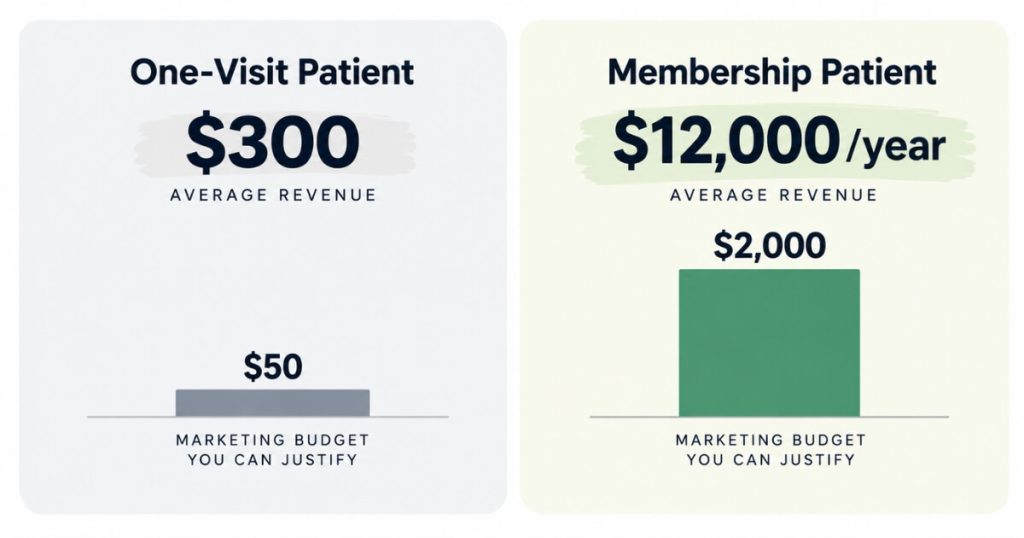
A clinic whose average patient is worth $300 can barely afford any paid acquisition.
Meanwhile, a clinic whose average patient joins a $1,000-a-month membership can outspend every competitor in its market and still profit.
Same specialty, same city — different math.
That’s because one designed its LTV and the other left it to chance.
How do I define my ideal patient?
Pick the patient segment whose problem you solve best AND whose economics support your growth.
Then build the offer for them alone.
Ideal doesn’t mean “anyone who pays.”
It means the intersection of three filters:
- Clinical fit: Patients you get great outcomes for.
- Economic fit: Patients whose condition drives ongoing care rather than one-off visits.
- Volume fit: Patients your market has enough of.
For a hormone practice, that’s the symptomatic 35–55-year-old committed to long-term optimization.
Not the curiosity shopper price-checking a single lab panel.
Defining this sharply feels like turning patients away.
It’s the opposite.
When the offer, website, and ads all speak to one person specifically, that person converts at multiples of the generic rate.
As a result, the practice grows faster on fewer, better-fit patients.
How do I build lifetime value into my offer?
Structure the offer as an ongoing relationship — program, membership, or treatment pathway — instead of a menu of one-off visits.
LTV is designed, not discovered.
The design moves start with packaging care into programs with a defined arc.
For example, a 6-month metabolic reset beats 6 separate visits.
Next, convert maintenance into membership through monthly optimization, labs, and access.
Then map each patient’s natural next step so there’s always an appropriate continuation.
That’s because the offer was engineered around long-term hormone optimization, not per-visit billing.
It’s the model logic behind effective men’s hormone clinic marketing.
The membership isn’t a payment plan; it’s the product.
Design LTV first, and marketing gets easier everywhere.
Higher patient value funds better acquisition, retention smooths cash flow, and the practice stops needing a constant flood of new leads to stay flat.
How do I know if my offer can support paid marketing?
Run the payback math.
If one new patient’s value covers a month of ad spend plus management, the offer is ready.
If it takes five patients to break even, fix the offer before the ads.
This is the readiness test we apply before running ads for any clinic.
It’s also why offer design comes before channel strategy.
The same campaign that bankrupts a $300-per-patient offer prints money for a $12,000-per-year membership offer.
When the offer is right, marketing converts it at scale.
NuLevel Wellness Medspa added $6,708,600 in revenue and 3,727 new patients in a single year on the strength of an offer whose economics could absorb aggressive multi-channel acquisition.
If your ads “don’t work,” check the denominator first.
Weak offers make every channel look broken; strong offers make average campaigns look brilliant.
What are the signs my offer is broken (versus my marketing)?
If leads arrive but don’t buy, price objections dominate, and every patient needs custom explanation — it’s the offer.
If nobody arrives at all, it’s the marketing.
The signs of a broken offer are easy to spot.
Consults end in “let me think about it.”
The front desk can’t explain what’s included without checking.
Every sale is negotiated individually.
Revenue depends entirely on new patients because nobody continues past visit two.
And you can’t say what a patient is worth over twelve months.
Those problems survive any agency change because new traffic into a confusing offer just produces confusion at higher volume.
The fix sequence starts with defining the ideal patient.
Next, package the transformation they want with the LTV designed in.
Then price it so the payback math works — and market it.
Offers built that way make every downstream decision easier, from ad budgets to hiring.
FAQ’s About Fixing a Clinic Offer That Isn’t Working
What makes a cash-pay clinic offer “not set up properly”?
It’s a list of services and prices instead of a designed product.
There’s no defined ideal patient, no built-in continuation (so lifetime value stays low), and pricing is disconnected from acquisition math.
The result is a practice that can’t scale profitably, no matter how good its marketing gets.
What is patient lifetime value and how do I calculate it?
LTV is the total revenue an average patient generates across their entire relationship with your practice.
That includes the first program, memberships, renewals, and additional services.
Estimate it as average monthly patient value multiplied by average months retained.
If you can’t calculate it, that itself is the finding: the offer has no designed continuation.
Should every clinic move to a membership model?
Not every clinic.
However, most cash-pay practices in continuing-care verticals — hormones, functional medicine, longevity, and weight loss — benefit from one.
That’s because the clinical reality is ongoing anyway.
Membership aligns the billing with the care, stabilizes cash flow, and multiplies LTV — which funds acquisition.
How specific should my ideal patient definition be?
Specific enough that your website copy, ad targeting, and consult script all obviously speak to one recognizable person.
“Adults who want to feel better” is not a definition.
“Men 40–60 with low-T symptoms who want a data-driven, long-term protocol” is.
How long does it take to fix a broken offer?
The redesign itself takes weeks, not months.
Ideal patient, packaging, pricing, and payback math are decisions, not projects.
What takes longer is the rollout: retraining the front desk, updating the website, and migrating existing patients.
Most clinics see conversion improvements within the first month or two of relaunch.
What’s the next step?
If your practice is generating attention that doesn’t convert — or converting patients who never come back — the offer is the first place to look.
Book a strategy call.
In 60 minutes, we’ll pressure-test your offer against the three filters: who it’s for, what it’s worth over a patient lifetime, and whether the math can fund your growth.
Fixing that one layer is often the difference between a practice that buys leads and a practice that scales.