
Why Your Clinic Keeps Buying Software It Already Owns (And the Training Fix That Costs $0)
On a strategy call with a concierge medicine practice we consult with, the owner admitted he’d just sat through a demo for Weave — a new phone system — because callers were reaching the wrong brand’s voicemail and nobody knew the fix.
Halfway through the demo, he realized every feature being pitched already existed in GoHighLevel, the CRM the practice already pays for.
His exact words: “I don’t know how to use GoHighLevel. That’s my big problem.”
That sentence is worth more than most marketing budgets.
Here’s what it teaches.
Why do clinics keep buying new software instead of using what they already own?
Because an untrained team experiences missing knowledge as missing features.
And vendors are happy to sell the “missing” feature again.
This practice runs multiple brands — a concierge membership, a travel-medicine service, and an urgent care offering — through one system.
Calls to one brand rolled to another brand’s voicemail.
The recording sounded unprofessional.
Patient texts sat unanswered.
So the owner started shopping for phone systems, and the algorithm obliged.
“I’ve been talking about phone systems for two weeks, and now stuff keeps popping up about phone systems.”
The demo looked magical.
It offered professional voicemail and automatic missed-call text back: “Hey, sorry we missed you, want to continue by text or a call back?”
There was also call recording and one thread per patient.
Every single one of those features was already sitting inside the CRM the practice pays for.
The gap was never capability.
It was training.
What does a missed or mishandled call actually cost a cash-pay clinic?
Patients you already paid to attract — quietly, invisibly, every day.
On the same call, we shared the screen and read the practice’s unanswered inbox out loud.
There was a patient asking about filling a glaucoma prescription.
A prospect in Minnesota was asking about pharmacy services.
And then there was the expensive one: “Tell me more about the membership costs and the appointments.”
A ready-to-buy membership inquiry had been sitting unanswered since the day before.
When the front desk is traveling, at a tennis match, or just away from the desk, calls and texts don’t pause.
Clinics with real inbound volume live or die on this.
VYVE Wellness went from a quiet phone to 100+ inbound calls a month in four months — and volume like that is only an asset if every call routes, records, and gets a response.
The owner’s instinct was right: “I’m sure we’re losing people that are calling and it’s answered by another business.”
What can a CRM phone system already do for a medical practice?
Almost certainly everything the phone-system vendor just demoed.
In GoHighLevel specifically, this practice already owned:
- Separate phone numbers for each brand — with a distinct recorded voicemail per number, so no caller ever hears the wrong business name.
- Automatic missed-call text back, sent the moment a call goes unanswered.
- Call recording and a single conversation thread per patient across calls and texts.
- Answering from the web app, the desktop, or forwarding to any phone.
- In-app notifications so a new message lights up every team member’s phone.
- A point-of-sale in the mobile app — tap to pay on iPhone, a product catalog, payment links, and stored cards — so one-off services like IV add-ons get collected on the spot instead of invoiced into limbo.
That last discovery changed the practice’s revenue workflow on the call itself.
The team is now building a priced menu of add-on services — IV fluids, boosters, and add-on injections.
They’ll load those into the catalog so anyone can charge a patient in seconds from their phone.
Why does the team believe the software “doesn’t work”?
Because configuration debt looks identical to broken software.
On this one call, we found several problems.
The owner had logged into an old account from a previous program.
That’s why his catalog showed the wrong prices and his newest message was from months ago.
App notifications were switched off on every device, so no one ever saw new patient texts.
We also found a product catalog that displayed for one team member but not another.
Each of these reads as “this system is junk” to a busy clinician.
All of them took minutes to fix once someone looked.
This is why the answer to “should we buy different software?” is almost always “not until someone audits what you own.”
It’s the same reason experienced medical practice marketing consultants start engagements with a systems audit rather than a shopping list.
The fastest ROI in most practices is unlocking tools already being paid for.
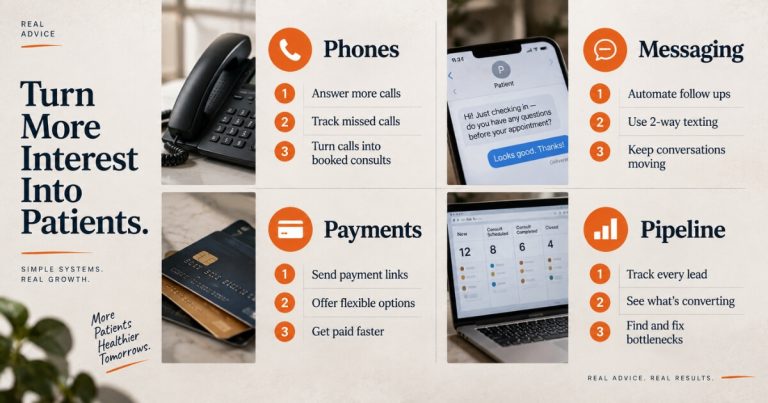
What should a clinic CRM training session actually cover?
Two hours, four blocks — this is the exact agenda we set with this practice:
Phones: call routing between brands and team members, recorded voicemail per number, the internal voice menu, automatic missed-call text back, and answering from web, desktop, or a forwarded phone.
Messaging: the website chat widget, two-way texting, email, and snippets — saved replies so membership questions get answered in seconds.
Payments: transactions, payment links, products and the catalog, and tap to pay for in-clinic collection.
Pipeline: how opportunities move, and who cleans the board daily.
One rule makes the training stick: every team member logs into the correct account, on their own device, with notifications on, before the session ends.
Knowledge that isn’t installed on the actual phones in the actual building evaporates by Friday.
In what order should a clinic fix billing, communications, and its EMR?
Billing first, communications second, EMR migration last.
This practice was also fighting its EMR.
Patients were charged $100 urgent-care fees on $300 establish-care visits.
There were also payments patients swore they’d made that no one could locate.
The temptation was to switch EMRs immediately.
The order we set instead was simple: get billing and accounts receivable sorted, move all patient communication into the CRM, then switch the EMR.
Sequenced that way, the cleanup pays for the migration.
And the practice isn’t rebuilding three systems at once while patients are mid-treatment.
An HRT clinic we scaled from $1M to $4M a year got there on exactly this systems-before-spend discipline: infrastructure first, then growth that the infrastructure can hold.
FAQ’s About Clinic Software, Phone Systems, and CRM Training
Does my clinic need a separate phone system like Weave if we have a CRM?
Probably not.
Modern CRMs like GoHighLevel include multi-number call routing, per-brand voicemails, missed-call text back, call recording, and web/desktop answering.
That’s the core feature set phone-system vendors sell separately.
Audit what your CRM already does before adding another monthly bill and another inbox to check.
What is missed-call text back and why does it matter for a medical practice?
It’s an automatic text sent the instant a call goes unanswered.
For example: “Sorry we missed you, want to continue by text or a call back?”
It converts missed calls from dead ends into open conversations.
That matters because cash-pay patients rarely leave voicemails. They just call the next clinic.
Can a clinic take payments through its CRM?
Yes.
This practice discovered its CRM’s mobile app includes a point of sale with tap to pay, a product catalog, payment links, and stored cards.
That lets the team charge for add-on services like IV therapy on the spot instead of routing one-off charges through the EMR’s invoicing.
Why does my staff say our practice software doesn’t work?
Usually configuration debt: wrong account logins, notifications switched off, permissions not set, and catalogs not synced.
Each looks like broken software to a busy team.
A one-hour audit typically finds fixes that cost nothing.
It also reveals that the team was never trained on half the features being paid for.
Should we switch EMRs if billing is a mess?
Not first.
Sort billing and accounts receivable, move patient communication into the CRM, then migrate the EMR.
Switching systems on top of dirty billing data migrates the mess.
A phased order also means the savings from cleanup effectively fund the transition.
What’s the next step?
If your team is drowning in missed calls and unanswered texts — or you’re two demos deep into buying software that might duplicate what you already pay for — book a strategy call.
In 60 minutes, we’ll audit your current stack.
We’ll show you which “missing” features are already sitting in it and map the training agenda that turns tools you own into patients you keep.