
Why Do Cash-Pay Patients Keep Saying “Let Me Think About It”? (Inside an Offer Audit of a $795 Men’s Health Diagnostic)
A men’s health clinic we work with sells a $795 cash-pay diagnostic — 130+ biomarkers, a 55-nutrient intracellular assay, body composition, and an hour with a physician, delivered as a written 90-day plan.
Strong mechanism, verifiable credentials, real testimonials.
And on the recorded sales calls, every single lost prospect said some version of the same thing: “Let me think about it.”
Not one said no.
We ran a full offer audit to find out why — and the answer applies to almost every cash-pay practice selling a high-ticket first step.
Why do cash-pay patients keep deferring instead of buying?
Because the offer sells a map, not a destination — and nobody wakes up wanting a blueprint.
“Find out what’s holding you back” is a means-goal.
The patient doesn’t want information.
He wants his energy, his body, his focus, and his drive back.
When $795 buys information, the buyer can’t picture what he’ll have when it’s done.
And information is the single hardest category of thing to price.
That’s why the recorded calls showed prospects itemizing the diagnostic against everything else on the menu until they had built themselves a five-figure objection.
A map invites comparison shopping.
A destination doesn’t.
The audit scored the offer on the four levers of the value equation.
Perceived likelihood: strong — physician-led, honest, willing to say no.
Dream outcome: weak, because the destination was missing from the close.
Time delay: the worst leg — the first meaningful deliverable arrived 7–14 days after payment.
Effort: moderate in reality, but never addressed, so perceived effort ran higher than actual.
Three of four levers were leaking.
And none of them is a pricing problem.
What is a “naked offer,” and why does it invite negotiation?
A product with a number attached — no stack, no bonuses, no guarantee, no deadline.
Naked.
The audited diagnostic was a single SKU: “$795.”
Nothing itemized what that contained or anchored it against what the components cost separately.
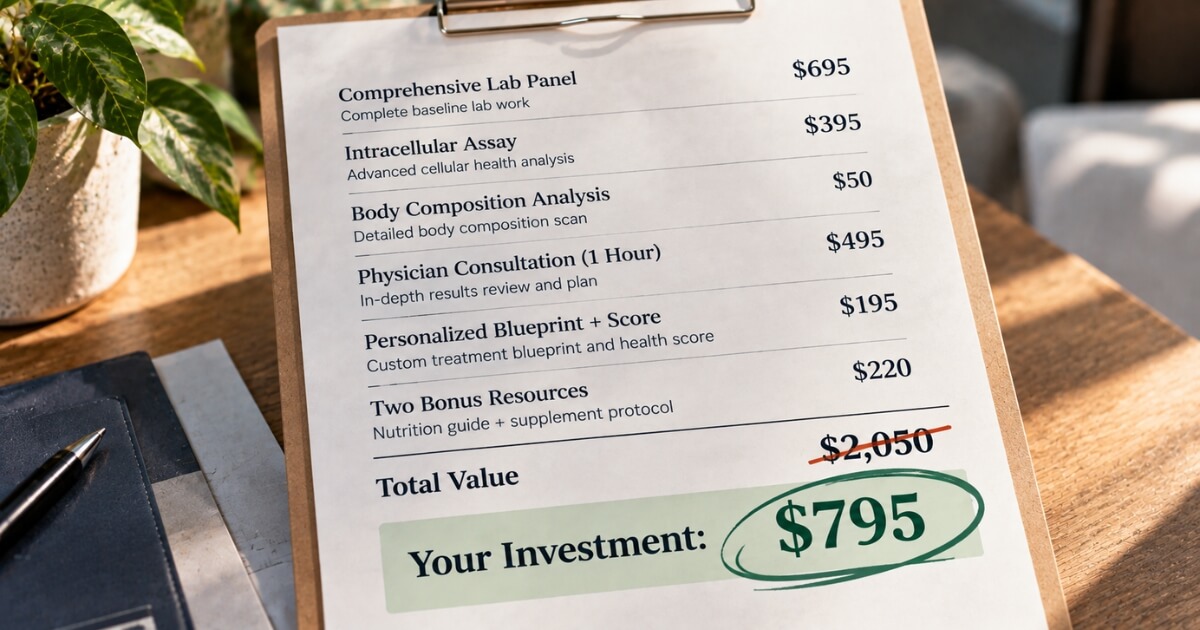
So the audit rebuilt it as a stack, presented in order, with the price arriving last:
- 130+ biomarker panel ($695)
- Intracellular nutrient assay nobody else in the category runs ($395)
- Body composition ($50)
- Full hour one-to-one with the physician ($495)
- Written 90-day blueprint with a trackable score ($195)
- IV infusion, which the clinic had been describing on calls as “a fun little bonus” ($125)
- Day-one starter kit ($95)
Total itemized value: $2,050.
Investment: $795.
That’s a 2.6:1 value-to-price ratio — slightly under the 3:1 rule of thumb.
And we shipped it anyway because an honest 2.6 beats an inflated 3.
The point isn’t the arithmetic.
It’s that a patient who sees the stack stops line-item negotiating.
A patient who hears “$795” naked at the end of a call starts.
The same failure shows up across men’s hormone clinic marketing: the category quotes prices; the winners present offers.
What’s the single highest-leverage fix for a high-ticket cash-pay offer?
A guarantee.
The audited clinic was asking for $795, cash, from a man who had never set foot in the building — with zero risk reversal.
The fix we recommended is what we call the All-Clear Refund:
“If every one of your 130+ markers comes back in optimal range — you don’t need us. We’ll refund your diagnostic in full and tell you to keep doing what you’re doing.”
It’s rarely triggered, cheap to honor, makes no medical claim, and proves the mechanism and the ethics in one sentence.
The only way the patient loses money is by being perfectly healthy.
Notice what that guarantee is not.
It’s not “results guaranteed,” which a medical practice can’t say.
Risk reversal in healthcare works when it’s built on deliverables and honesty.
You’ll leave with the written plan in hand.
Or the report will tell you more than any physical ever has.
Or the panel comes back clean and you pay nothing.
Every cash-pay practice has a version of this available.
Almost none use it.
How do you create urgency without discounting a medical service?
With bonuses and genuine capacity — never with the price.
Deferral is the enemy, not rejection.
So the rebuilt offer attacks it three ways.
First, use a fast-start window.
Book your draw within 7 days and the two bonuses — worth $220 on the stack, costing the clinic very little — are included.
Urgency built from bonuses can run permanently without training the market to wait for a sale.
Second, use genuine capacity, stated plainly.
The physician personally reviews every panel, so the clinic only takes a set number each week.
“I’ve got two slots left for the week of the 12th, do you want one?”
Say it only while it’s true.
Third, state the cost of waiting once, without pressure.
Nothing here is an emergency, but everything on the panel moves in one direction while you wait.
What never moves is the number.
Discounting a $795 diagnostic doesn’t rescue the sale.
It repositions the medicine as negotiable.
Eternity Health Partners grew from $1M to $4M a year with 250 members paying $1,000 a month — full price, membership model, no negotiation — because price integrity is what makes a high-LTV panel possible in the first place.
How do you handle “I need to talk to my wife”?
By removing the second conversation entirely — offered when the call is booked, not when the objection arrives.
Two of the clinic’s five recorded lost calls died on the spouse objection.
And you cannot beat it by arguing with it.
The fix:
“If your wife’s part of this decision, have her join us — fifteen minutes, she can ask me anything, and you two decide together with the same information in front of you. Thursday at six or Friday at noon?”
That converts an indefinite deferral into a scheduled event with a date.
And when “my wife” really means “I’m not convinced,” the invitation surfaces that immediately.
He declines, and the honest objection finally comes out where it can be handled.
The soft version if he won’t schedule:
“What’s the one thing she’s most likely to ask that you’d want a good answer for?”
Now the real conversation starts.
How fast should a patient feel like the program has started?
Day 0.
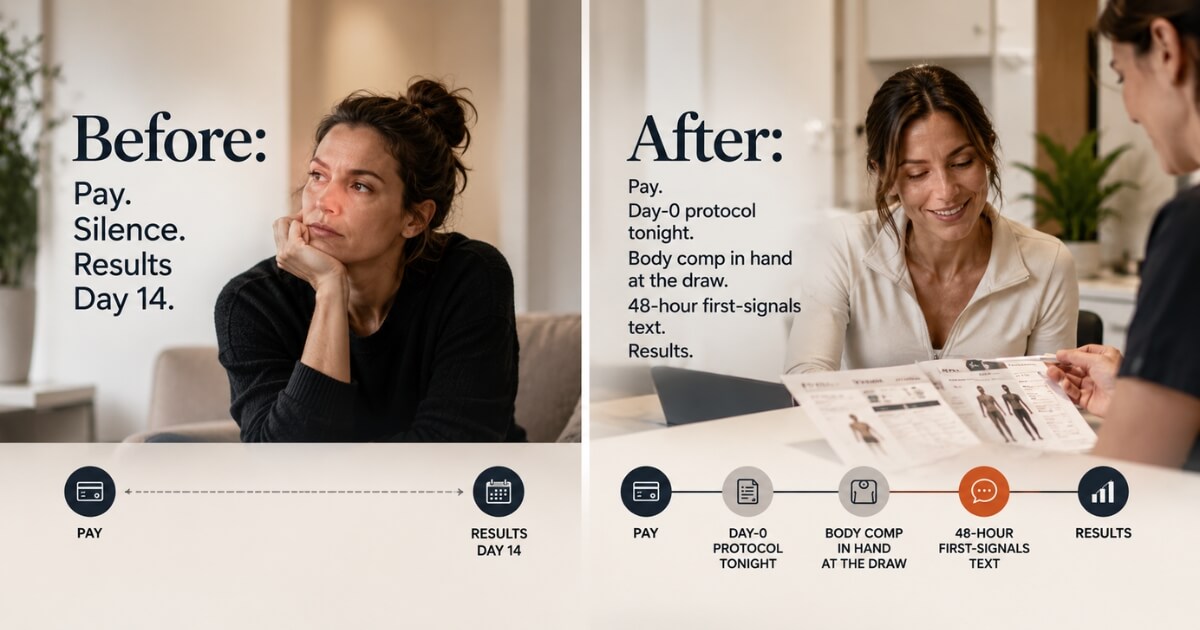
The audited clinic’s first meaningful deliverable arrived on day 14 — and the space between paying and receiving is where buyer’s remorse lives.
The audit’s time-to-value fixes cost almost nothing.
Run body composition on draw day and put a printed result in the patient’s hand.
He arrived having paid for a promise and leaves holding an artifact.
Send a day-one protocol the moment he pays: three safe universal actions he can start tonight.
Now he’s in the program in hour one instead of week two.
Text at 48 hours when the fast markers resolve:
“Your metabolic markers are in — one thing already worth knowing. We’ll go deep on Thursday.”
Dead air becomes anticipation.
And say the timeline out loud on every call — draw this week, results in seven days, plan in hand within two.
Perceived speed rises even when actual speed doesn’t move.
This is the retention lesson hiding inside an acquisition audit.
And it’s why offer design sits at the center of functional medicine & longevity clinic marketing: high-consideration patients don’t churn at month six because the medicine failed — they churn because nothing happened in week one.
FAQ’s About Fixing a Cash-Pay Offer That Isn’t Converting
Is my price the problem when patients keep deferring?
Almost never.
The audit found $795 was correctly placed and under-priced against its own components.
The problem was that the number arrived naked at the end of a call with no anchor in front of it.
Present the stack first, anchor against real alternatives, and let the price arrive last.
Fix that and the same number reads as a discount.
What kind of guarantee can a medical practice safely offer?
One built on deliverables or honest self-assessment, never on clinical outcomes.
Examples from the audit include: “you’ll leave your consult with a written 90-day plan in hand, or you don’t pay for the consultation.”
Another is the All-Clear Refund:
“If every marker comes back optimal, we refund the diagnostic in full.”
No medical claim, essentially no compliance exposure, and it’s often the single highest-leverage change in the funnel.
How do I create urgency without discounting?
Attach time-limited bonuses instead of touching the price.
For example: “book within 7 days and the infusion and starter kit are included.”
Then state genuine capacity limits plainly when they’re true.
Bonuses create urgency that can run permanently.
Discounts train your market to wait for the next one.
Why did the audit reject a 3:1 value stack in favor of 2.6:1?
Because every number in the stack had to be defensible.
An inflated anchor that falls apart under one skeptical Google search costs more trust than it creates.
Ship the honest ratio.
Then earn 3:1 later by adding a real deliverable — like a 90-day retest — or by raising the price the stack now supports.
What’s the fastest zero-cost improvement to a high-ticket offer?
Say the timeline out loud on every call:
“Draw this week, results in seven days, your plan in hand within two.”
The audit scored time delay as the offer’s worst lever.
Naming the timeline raises perceived speed immediately — before you change anything operational at all.
What’s the next step?
If your consults end in “let me think about it” more than they end in yes or no, you don’t have a closing problem — you have an offer problem.
Deferral is what a naked offer produces, and no amount of sales training fixes what the offer itself is causing.
Book a free strategy call and we’ll run this same audit on your offer: the four value-equation levers, the stack, the guarantee you’re not using, and the urgency mechanisms that don’t touch your price.