
Why Does Healthcare Marketing Keep Changing — And How Do Cash-Pay Clinics Keep Up?
If it feels like the rules for marketing your cash-pay clinic change every few months, it’s not your imagination. Compliance shifts, ad-platform policies move, and now the way patients search is changing underneath everyone as AI answers replace blue links. As one clinic owner put it about the constant churn with peptides, “we couldn’t say it for a long time, we couldn’t advertise it,” then the rules moved again. “So much change in this industry, it’s somewhat exhausting at times, but you gotta do it.” This FAQ explains why healthcare marketing keeps changing and how to build a marketing foundation that survives the churn.
Why does healthcare marketing keep changing?
Healthcare marketing keeps changing because three different forces are constantly evolving:
- Medical compliance rules
- Ad-platform policies
- The way patients search for healthcare providers
Compliance is the first challenge.
What you are allowed to say about a treatment changes as regulators review products and advertising standards.
A treatment you could promote a few months ago may suddenly require different messaging—or become off-limits altogether.
The second force is advertising policy.
Google, Meta, and other advertising platforms regularly update what healthcare advertisers can:
- Promote
- Claim
- Target
One policy update can pause an entire campaign overnight.
The third force is search itself.
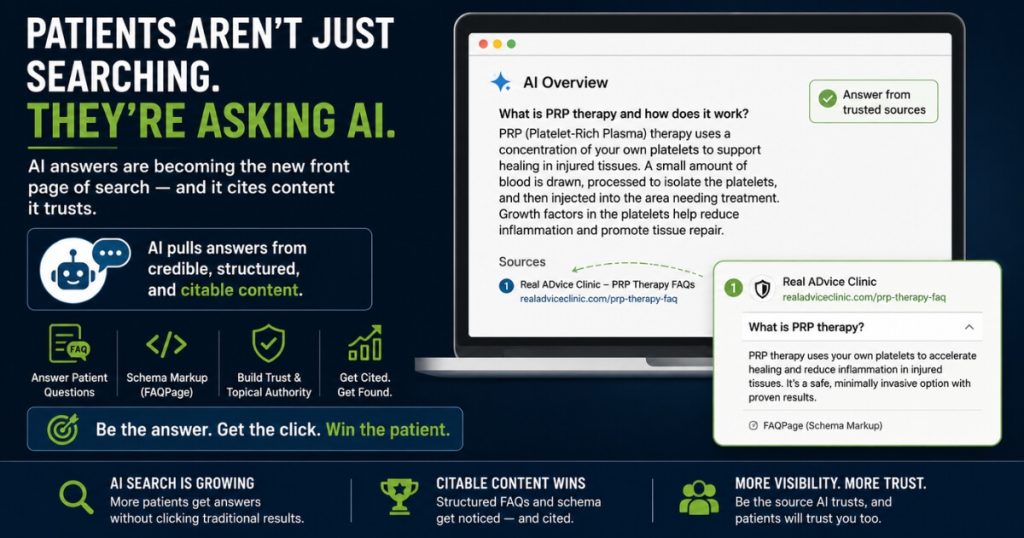
Patients are increasingly asking AI tools for answers instead of scrolling through traditional search results.
That changes what it means to “be found” online.
These forces will continue changing.
Rather than chasing every update, focus on building assets that do not depend on a single platform.
A durable medical practice marketing strategy assumes the outside environment will always evolve.
Your foundation should be built on assets you actually own.
Why do the rules on what I can say and advertise keep moving (like with peptides)?
Because many cash-pay treatments operate in rapidly changing regulatory environments.
Both regulators and advertising platforms regularly update their positions.
Peptides provide one of the clearest examples.
There was a period when clinics simply could not advertise peptides.
Many clinics had to:
- Remove content.
- Pause advertising.
- Rewrite messaging.
Then the landscape changed again.
The same pattern appears throughout cash-pay medicine, including:
- Hormone therapy
- Weight loss
- Regenerative medicine
- Peptide therapy
The compliance line continues moving.
Marketing that was acceptable one quarter may become risky the next.
Ignoring those changes creates unnecessary exposure.
The practical response is straightforward.
Stay informed about the rules affecting your specific treatments.
Avoid building your entire marketing strategy around a single protocol whose status may change.
Always verify compliance before launching campaigns.
That same principle applies across peptide therapy clinic marketing, where regulations tend to evolve more frequently than almost any other category.
How do I keep up with all the changes without it being exhausting?
Stop trying to react to every platform update.
Instead, build your marketing around durable assets that you own.
Then use fast-changing platforms to support that foundation.
The exhaustion comes from treating every policy change as an emergency.
That approach never ends.
A stronger strategy is to invest in assets you control, such as:
- Your website
- SEO
- Google Business Profile
- Online reviews
- Your email list
- Your patient database
- Patient experience
Those assets continue producing value regardless of what any advertising platform changes next month.
Once that foundation exists, paid advertising and new platforms become accelerators instead of lifelines.
If an advertising account gets suspended, your clinic still has:
- Organic traffic
- Referrals
- Reviews
- Existing patients
- Email marketing
Keeping up becomes much less stressful.
The goal is not reacting faster.
The goal is needing to react less because your foundation remains stable.
Why is referral-based marketing more resilient to all these changes?
Because referrals do not depend on advertising platforms, algorithms, or policy updates.
They depend entirely on one thing:
An outstanding patient experience.
Many successful cash-pay clinics grow consistently through referral-based marketing for exactly that reason.
No advertising platform can suspend word of mouth.
No algorithm can prevent a satisfied patient from recommending your clinic.
The patient experience becomes the engine.
That engine consistently produces:
- High-trust patients
- Lower acquisition costs
- Higher conversion rates
Those advantages remain regardless of what happens on Google or Meta.
That is why referrals belong at the center of your marketing strategy.
They are not simply a bonus.
They are one of your most durable acquisition channels.
Build experiences that patients naturally want to recommend.
Make referrals easy.
Then create a growth engine that no algorithm update can take away.
How is AI and LLM search changing how patients find clinics—and how do I stay visible?
Patients increasingly receive answers directly from AI tools instead of browsing pages of search results.
Those tools include:
- ChatGPT
- Perplexity
- Gemini
- Google’s AI Overviews
That makes AI visibility increasingly important.
When patients ask AI questions about treatments or providers, those systems summarize information from trusted websites.
If your website clearly answers patient questions, AI systems can reference your clinic in their responses.
If your content is:
- Thin
- Generic
- Poorly structured
your clinic becomes much harder to discover.
The solution is straightforward.
Create content that:
- Answers real patient questions.
- Uses clear question-based headings.
- Provides direct answers immediately.
- Uses plain language.
- Includes structured schema markup.
That approach helps:
- Patients
- Traditional search engines
- AI search tools
all understand your content more easily.
Creating genuinely useful, well-structured information is one of the most future-proof investments your clinic can make.
What’s the durable foundation that survives every algorithm and policy change?
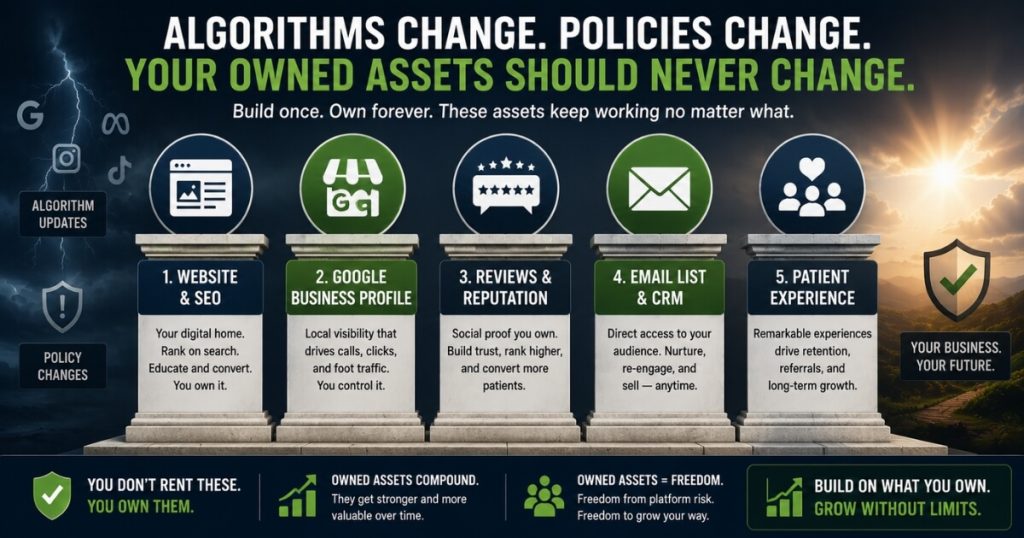
Build your marketing around assets that you own.
Those assets include:
- Your website
- SEO
- Google Business Profile
- Patient reviews
- Your email list
- Your patient database
- Patient experience
Unlike advertising platforms, no company can suddenly switch these assets off.
Each one continues growing over time.
For example:
- Your website earns rankings naturally.
- Google Business Profile builds local visibility.
- Reviews increase trust.
- Your email list lets you communicate directly with patients.
- Great patient experiences continue generating referrals.
Together, these create a marketing foundation that keeps producing patients regardless of platform changes.
The best long-term strategy is simple:
- Invest consistently in owned assets.
- Layer paid advertising on top.
- Test new channels without depending on them.
We’ve seen how durable this approach becomes.
For example, a regenerative clinic generated $309,590 in cash-pay revenue in 10 months from SEO alone with zero ad spend.
That is exactly what a strong owned-asset strategy looks like.
Advertising channels will always change.
Your foundation should not.
FAQ’s About Keeping Up With Healthcare Marketing Changes
Should I stop marketing peptides given how the rules keep moving?
Not necessarily.
However, you should avoid building your entire business around a treatment whose compliance status could change quickly.
Instead:
- Stay current on the latest regulations.
- Keep your marketing claims compliant.
- Diversify your services and marketing channels.
That way, one regulatory change does not disrupt your entire business.
Operating in fast-moving treatment categories requires ongoing attention.
It is part of running a successful cash-pay clinic—not a reason to avoid those services altogether.
Is SEO still worth it now that patients use AI search?
Yes.
In fact, SEO is becoming even more valuable.
AI platforms generate answers by reading trusted web content.
That means the same content that performs well in traditional search often becomes the content AI systems reference.
Create pages that:
- Answer real patient questions.
- Use clear question-and-answer formatting.
- Include schema markup.
- Provide specific, helpful information.
That approach benefits:
- Google Search
- AI search tools
- Prospective patients
SEO is no longer just about rankings.
It is about becoming the trusted source AI chooses to reference.
That makes it one of the most future-proof marketing investments available.
How often do ad-platform policies for health actually change?
Frequently—and often without much warning.
Google, Meta, and other advertising platforms regularly update policies that affect healthcare advertisers.
Changes may involve:
- Targeting options
- Approved claims
- Landing page requirements
- Campaign eligibility
A single update can pause or restrict campaigns almost immediately.
That is exactly why no clinic should rely on one advertising platform as its only source of new patients.
Paid advertising should support your marketing.
It should never become your entire marketing strategy.
When owned assets generate patients consistently, policy updates become inconveniences rather than business emergencies.
What kind of content gets cited by AI tools?
AI systems favor content that is:
- Clear
- Direct
- Well structured
- Genuinely helpful
The strongest pages usually include:
- Question-based headings
- A direct answer in the opening sentence
- Plain language
- Specific details
- Structured schema markup
AI systems can easily understand and summarize that format.
On the other hand, content that is:
- Vague
- Thin
- Overly promotional
- Poorly organized
is much less likely to appear in AI-generated answers.
If your goal is long-term visibility, write for real patient questions first.
That approach benefits both traditional search engines and AI-powered search.
What’s the next step?
If keeping up with compliance updates, advertising policies, and AI search feels exhausting, the answer is not to react faster.
It is to build a marketing foundation that requires fewer reactions.
Start by investing in assets you own, including:
- Your website
- SEO
- Google Business Profile
- Patient reviews
- Your email list
- Referral systems
Next, create content that is:
- Clear
- Helpful
- Structured
- Easy for both people and AI systems to understand
Then use paid advertising as an accelerator—not as the foundation of your business.
When your core marketing is built on owned assets, changing algorithms and advertising policies become much less disruptive.
During a strategy call, we’ll review how dependent your current marketing is on individual platforms.
We’ll identify where your biggest risks exist.
Then we’ll show you how to strengthen your owned assets—including making your content more likely to be cited in AI-generated answers.
It’s the same long-term strategy we’ve used with clinics like an HRT clinic we grew from $1M to $4M per year, where sustainable growth came from owned channels instead of rented ones.