
How Do I Reactivate Cold Web Leads With an Outbound Call? (The Script That Reopens “I Requested an Appointment” Leads)
You’re paying to drive traffic to your website, patients are clicking “schedule,” and then they vanish. The problem usually isn’t your marketing — it’s what happens the moment a new patient tries to book. Most cash-pay clinics send first-time visitors straight into a scheduler built for existing patients, and the newcomers, unsure whether they even qualify, quietly leave. Here’s the FAQ on why the booking step leaks patients and how to fix it.
Why is my website losing patients right at the booking step?
Because it asks a brand-new visitor to commit to a specific treatment before they know whether they’re a fit — and uncertainty kills the booking.
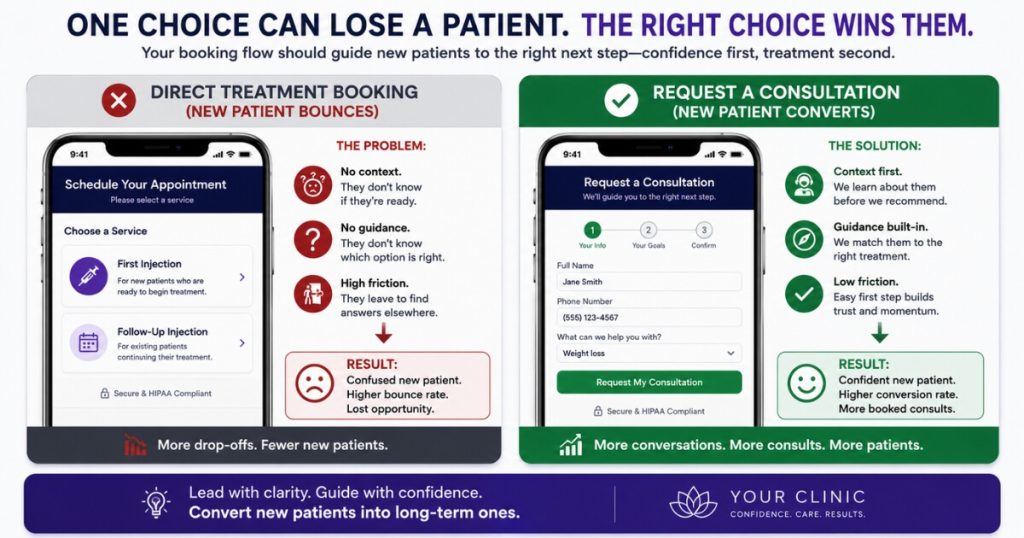
Picture a real example: a prospective patient clicks “request more information” or “schedule a consult,” and the site drops them straight into a scheduler offering only “first injection,” “follow-up injection,” or a couple of similar options. Their honest reaction is, “But how do I know if I’m even ready for my first injection?” There’s no path for someone who’s interested but not yet sure. So instead of booking, they close the tab.
That’s the leak. Your booking flow was probably designed for people who already know what they want, but a big share of your web traffic is people still deciding. Give them only expert-level options and you filter out exactly the new patients your marketing worked so hard to attract. Fixing this is one of the highest-ROI moves in patient acquisition because you’re recovering demand you already paid for.
What’s wrong with sending everyone straight to “book an appointment”?
It assumes every visitor is as informed as you are — and new patients aren’t.
An existing patient knows they want their next injection and just needs a time slot. A first-time visitor doesn’t know what they qualify for, what the first step should be, or whether your clinic even treats people like them. When the only available action presumes all that knowledge, the new visitor feels lost, and a lost visitor doesn’t book — they leave to “think about it,” which usually means never coming back.
The direct-booking flow isn’t wrong; it’s just incomplete. It serves returning patients well and new patients poorly. Since new patients are where growth comes from, an incomplete flow quietly caps how much your website can grow the practice.
Should I offer “request a consultation” instead of direct booking?
For most cash-pay services, offer both — and make “request a consultation” the obvious path for anyone who isn’t already a patient.
A “request a consultation” step gives the unsure visitor a low-commitment way to raise their hand. It also does something powerful for your positioning: it signals that you don’t just inject anyone who walks in — that there’s a process, a fit assessment, a standard. As one approach we recommended put it, position the practice as “we don’t just take anybody and everybody — you have to request a consultation.” That framing simultaneously lowers the friction for the patient and raises the perceived quality of the clinic.
Keep direct booking available for returning patients who know what they need. But route new traffic to a consult request, capture their information, and let your team guide them to the right first step. That single change often recovers a meaningful share of the visitors who were bouncing.
How does my positioning change the way patients should book?
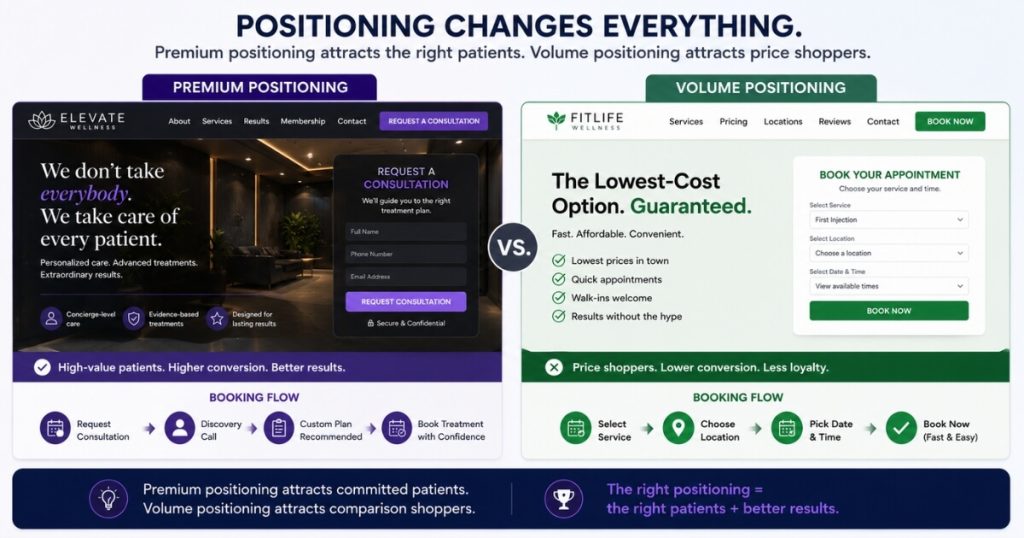
Your booking flow should match the promise your homepage makes — premium positioning calls for a consultation gate, volume positioning calls for frictionless self-booking.
Consider the contrast. A clinic whose homepage headline is “the lowest-cost semaglutide in Texas and Louisiana” is explicitly going for volume, and for that model, fast, frictionless self-booking makes sense — you want as many people as possible to convert instantly on price. A clinic positioning itself as selective and premium should do the opposite: gate access behind a consultation request so the experience matches the message. Trouble starts when the two are mismatched — a premium message with a cattle-chute booking flow, or a volume promise buried behind a slow consult form.
The lesson from the example above is that a clinic can even do both deliberately: run a volume offer to fill the funnel and a consultation path to capture higher-consideration patients — as long as each has a booking experience built for it.
Volume or premium positioning — which is right for my clinic?
Whichever matches your economics — but even a volume clinic needs a low-friction path for the “not sure yet” visitor.
Volume positioning works when your margins tolerate lower prices and your operations can handle high patient counts efficiently. Premium positioning works when you’re selling outcomes and relationships and can command higher prices with fewer, better-fit patients. Neither is universally right. What’s always wrong is having no path at all for the interested-but-uncertain visitor — because that describes a large fraction of everyone who lands on your site.
Whatever you choose, decide it on purpose and build the booking experience to match. Orthobiologics Associates converts 79.4% of its leads into booked appointments in part because its intake path fits the high-consideration nature of what it sells — the flow and the offer are aligned.
What should my booking flow actually look like?
Two clear paths: a “new patient — request a consultation” route that qualifies and guides, and a “returning patient — book directly” route for people who already know what they need.
The new-patient path should ask a couple of simple qualifying questions, capture contact information immediately (so no lead is lost even if they don’t finish), and set the expectation for a consult where fit is confirmed and the first step is prescribed. The returning-patient path should be as fast as possible. Label them clearly on the site so each visitor self-selects instantly rather than guessing.
We helped a longevity and functional medicine clinic, VYVE Wellness, increase website leads by 900% a result that starts with a website that captures the interested-but-uncertain visitor instead of filtering them out at the booking step.
FAQ’s About Fixing a Cash-Pay Clinic’s Website Booking
Why do patients drop off at my website’s booking step?
Usually because the site sends new visitors straight into a scheduler built for existing patients — asking them to book a specific treatment before they know whether they qualify. Uncertain visitors leave rather than commit. Adding a “request a consultation” path recovers many of them.
Should a cash-pay clinic use “request a consultation” or direct booking?
Offer both. Make “request a consultation” the obvious path for new visitors, since it lowers their commitment and signals a selective, high-quality practice. Keep direct booking for returning patients who already know what they need.
How does positioning affect my booking flow?
Your booking experience should match your homepage promise. Premium, selective positioning calls for a consultation gate; volume, price-led positioning calls for fast self-booking. A mismatch — like a premium message with a frictionless cattle-chute flow — confuses patients and costs bookings.
What should a cash-pay clinic’s booking flow include?
Two clearly labeled paths: a new-patient consultation request that asks a few qualifying questions and captures contact info immediately, and a fast direct-booking route for returning patients. Clear labeling lets each visitor self-select instead of guessing.
What’s the next step?
If your website traffic is strong but bookings are weak, the leak is almost certainly at the booking step — and it’s fixable this month. Book a strategy call. In 60 minutes we’ll audit your booking flow, show you where new patients are dropping off, and map the consult-versus-direct paths that match your positioning so you stop losing the visitors you already paid to attract.
If it’s a fit, we’ll rebuild the flow with your team.