
Why Do Bottom-of-Funnel Patients Convert Faster at a Cash-Pay Clinic? (And How to Build Offers They Actually Buy)
Two leads fill out the same form on your website. One has been vaguely wondering why they’re tired all the time. The other has spent three weeks researching TRT, knows the medication they want, and is comparing clinics by price and availability. Same form, wildly different readiness. Understanding that difference — market awareness, top of funnel versus bottom of funnel — is the highest-leverage idea in cash-pay patient acquisition, and it should change both what you rank for and what you put inside your offers.
Why do bottom-of-funnel patients convert faster at a cash-pay clinic?
Because they’ve already decided to solve the problem.
Now they’re deciding who to buy the solution from.
Market awareness happens in stages.
Patients sit at different points in the funnel depending on how far they’ve progressed in their decision-making process.
Top-of-funnel patients are just beginning.
They have a symptom.
They don’t yet have a plan.
Bottom-of-funnel patients are ready to buy.
Someone searching for a treatment by its specific name has usually:
- Educated themselves
- Decided the treatment works
- Developed a rough expectation of cost
At that point, only one question remains:
Which clinic should they choose?
That’s why bottom-of-funnel patients:
- Book faster
- Show up more consistently
- Close at higher rates
- Require less selling
The practical takeaway is straightforward.
Your marketing shouldn’t treat every lead the same.
Instead, your patient acquisition system should prioritize capturing the ready-to-buy audience first.
That’s where the shortest path to revenue exists.
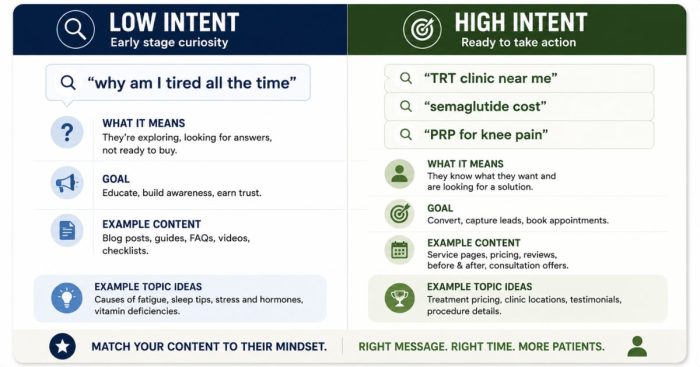
What’s the difference between top-of-funnel and bottom-of-funnel leads?
Top-of-funnel patients search for explanations.
Bottom-of-funnel patients search for providers.
A top-of-funnel search usually sounds like:
- Why am I gaining weight?
- Why is my energy low?
- What helps joint pain?
These patients need education.
They may still be weeks—or even months—away from spending money.
Bottom-of-funnel searches look very different.
People search for treatments by name, such as:
- Testosterone replacement therapy
- Semaglutide
- PRP injections
Often, they’ll also include buying modifiers like:
- Cost
- Near me
- Their city name
The search terms themselves reveal how ready someone is to buy.
Neither group is better than the other.
However, each requires a different marketing asset.
Top-of-funnel visitors need:
- Educational articles
- Helpful resources
- Nurture sequences
Bottom-of-funnel visitors need:
- A clear offer
- A confident consultation
- A fast booking process
One of the biggest mistakes we see is clinics investing heavily in broad awareness content while ignoring the ready-to-buy searches happening in their own city.
Then they conclude that marketing “doesn’t convert.”
What are bottom-of-funnel search terms — and why should a clinic’s SEO start there?
Treatment-by-name searches.
When we build SEO for cash-pay clinics, we prioritize bottom-of-funnel keywords first because purchase intent is significantly higher.
People searching for therapies, medications, or procedures by name are the patients most likely to convert.
That’s why the SEO sequence looks like this:
- Own every treatment-by-name search for the services you provide in your market.
- Expand into symptom-based and educational content that feeds the funnel over time.
The difference in revenue is substantial.
The website didn’t change.
The services didn’t change.
The search intent did.
How do I build a program or membership that bottom-of-funnel patients actually buy?
Include the treatments people are actively searching for.
That means naming the medications.
This is where many clinics struggle.
They successfully attract someone searching for a specific treatment.
Then they present a vague:
- Wellness program
- Optimization membership
without ever mentioning the medication the patient wanted.
Patients are looking for confidence.
Nothing increases that confidence more than seeing the exact treatment they researched included in the offer.
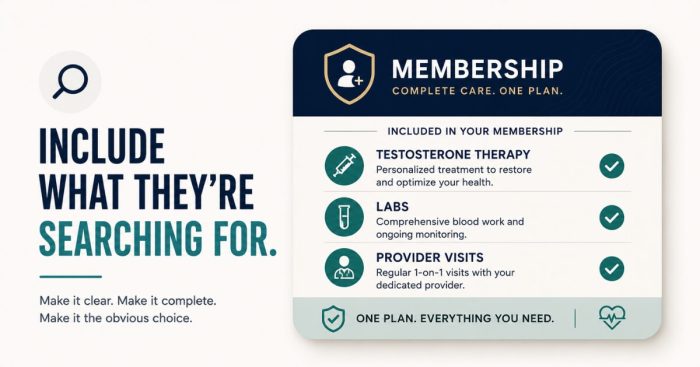
That’s why TRT memberships perform so well.
Patients search for testosterone therapy.
Then they see that testosterone therapy is clearly included in the membership.
The program also includes:
- Laboratory testing
- Provider visits
- Ongoing follow-up
The medication becomes the recognizable hook.
The surrounding care delivers the clinical value—and the business margin.
Build every offer the same way.
Lead with the named treatments your bottom-of-funnel patients are already searching for.
Then surround those treatments with the complete structure that helps patients achieve the outcome they’re seeking.
That’s the offer-design side of men’s hormone clinic marketing.
The same principle applies to:
- GLP-1 programs
- PRP treatments
- Peptide therapy
Should my clinic ignore top-of-funnel content entirely?
No.
However, fund it with bottom-of-funnel profits instead of replacing them.
Top-of-funnel content plays an important role.
It helps you:
- Build your brand
- Grow retargeting audiences
- Create future demand
The clinics that dominate their markets over time all invest in educational content.
The difference is timing.
Top-of-funnel content compounds slowly.
If your practice needs new patients this quarter, it shouldn’t be your starting point.
The sequence that works looks like this:
- Own the treatment-by-name searches in your market.
- Convert those visitors with clear, named offers.
- Use the revenue those patients generate to fund symptom-based and educational content.
- Connect every educational article to the bottom-of-funnel offer pages that convert.
Awareness content without a bottom-of-funnel foundation turns your clinic into a media company.
A bottom-of-funnel foundation without educational content eventually reaches a plateau.
The strongest marketing system includes both.
Just build them in that order.
FAQ’s About Bottom-of-Funnel Patient Marketing
What are examples of bottom-of-funnel keywords for a cash-pay clinic?
Bottom-of-funnel searches combine treatment names with buying intent.
Examples include:
- TRT clinic near me
- Semaglutide cost
- PRP injection for knee pain
- Hormone replacement therapy + your city
When someone names the treatment—especially alongside phrases like “cost,” “near me,” or a location—they’re typically at the bottom of the funnel.
Why do TRT memberships sell better when the medication is named in the offer?
Because patients searched for that medication.
Seeing it clearly listed inside the program increases their confidence they’ll receive exactly what they’re looking for.
A vague “optimization program” forces patients to wonder whether it actually includes the treatment they researched.
Naming the medication removes that uncertainty.
Isn’t bottom-of-funnel search volume smaller?
Yes.
But that isn’t the metric that matters most.
One hundred highly motivated searchers often produce more revenue than ten thousand people casually researching symptoms.
Win the smaller, high-intent audience first.
Then expand upward into broader educational content.
Do paid ads work on bottom-of-funnel terms too?
Yes.
Search ads targeting treatment-by-name keywords are often the highest-converting paid traffic available to a cash-pay clinic.
They’re also one of the fastest ways to validate an offer while SEO continues building.
The same principle still applies.
Your landing page should clearly include the treatment patients searched for.
How long does bottom-of-funnel SEO take to produce patients?
It usually works faster than broad educational SEO.
These pages target:
- More specific searches
- Smaller keyword groups
- Lower competition
Even so, expect months—not days.
The clinics that win view treatment pages as long-term infrastructure.
They build them once.
They rank them.
Then they continue attracting ready-to-buy patients every month afterward.
What’s the next step?
If your clinic’s website attracts mostly researchers who never schedule—or your programs contain tremendous value that patients can’t immediately recognize because nothing is clearly named—book a strategy call.
In 60 minutes, we’ll:
- Map the bottom-of-funnel searches in your market.
- Show you which high-intent keywords competitors currently own.
- Restructure your primary offer around what patients are already searching for.