
Why Doesn’t AI Ever Recommend My Clinic? (326 Reviews, 59 Patient Videos, Zero Citations — an Audit)
In August 2026 we audited a hormone and medical weight loss clinic in a fast-growing Nashville suburb.
On paper it should own its market: 326 Google reviews at 4.8 stars — double its nearest competitor — a supervising MD, a Biote Legacy certification held since 2020, and 59 filmed patient testimonial videos.
Then we checked the new scoreboard: zero AI citations.
Not falling. Zero, ever — across ChatGPT, Gemini, Perplexity, Copilot, Grok, and Google AI Overviews.
Here’s the FAQ on why that happens to genuinely good practices, and what fixes it.
Why doesn’t AI ever recommend my clinic, even with hundreds of five-star reviews?
Because AI engines need two things to cite you — trusted local signals AND published, crawlable content.
Most clinics have only the first.
This clinic’s Google Business Profile was carrying the entire business.
It ranked number one in the map pack for hormone replacement therapy in its town, with fresh photos and owner responses.
But the website behind it was nearly invisible to machines.
It had a domain rating of 1.2, six ranking keywords, and about 32 organic visits a month.
The site also had no LocalBusiness schema or FAQ schema.
Even the homepage title tag had no city and no service in it.
When ChatGPT or Perplexity assembles an answer to “best hormone clinic near me,” it cites pages.
This practice had essentially no pages worth citing.
Reviews make you credible.
Content makes you quotable.
You need both, and the second one is where almost every cash-pay clinic is losing right now.
What happens to a clinic’s SEO when it stops publishing content?
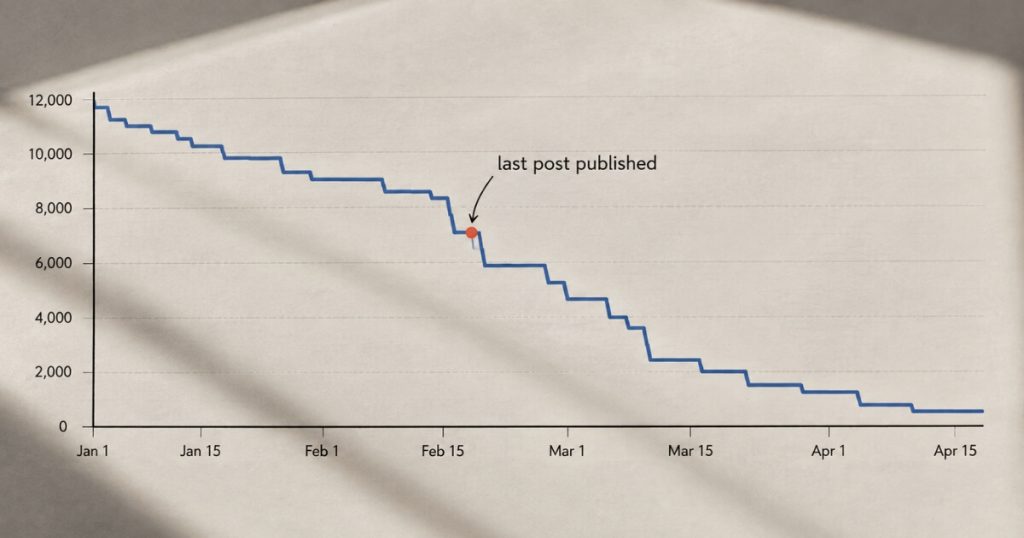
A staircase down that starts the exact month you stop — this clinic went from roughly 49 ranking keywords to 6 after its blog went silent.
The practice had been publishing about twice a month through 2025 — 17 posts.
Then it stopped dead on December 18.
The keyword chart afterward shows a staircase down beginning that precise month.
By the August audit, organic traffic had fallen to 32 visits a month, with a traffic value of about $32.
However, the strategic context makes this fixable rather than fatal.
Every local competitor was equally invisible.
Nobody in the suburb cleared 100 organic visits a month.
Nobody earned AI citations.
The market hadn’t been won by someone else.
It simply goes to whoever publishes first, consistently, with local intent.
That’s the whole game in suburban cash-pay markets right now.
It’s also why men’s hormone clinic marketing built on a steady publishing engine compounds so fast against dormant competition.
Why does ranking #1 for a big national keyword produce zero patients?
Because AI Overviews now eat national how-to traffic before it reaches your site.
This clinic ranked #1 for a 2,400-search-a-month query and got zero visits from it.
The query was a generic weight-loss how-to.
Position one.
Twenty-four hundred searches a month.
Zero visits.
Google’s AI Overview answers the question on the results page, so nobody clicks through.
That one line item teaches the whole post-2025 content lesson: national informational content is donated to the AI engines now.
What still pays is local intent.
Think town-plus-service queries where the searcher is choosing a provider instead of reading an explainer: semaglutide in your town, pellet therapy in your town, TRT in your town, menopause specialist in your town.
Those queries produce consults.
The pages that win them also get cited by AI assistants when someone asks for a recommendation in that town.
And almost no local clinic is writing them.
How should a clinic actually use its patient testimonial videos?
As raw material for the publishing engine — not as trophies on a YouTube channel nobody watches.
This practice did the hard part almost nobody does.
It filmed 59 real patient stories, including a 115-pounds-down transformation that credits hormone balance.
Then the videos went to a YouTube channel with 59 subscribers.
Incredibly, the practice had split them across two channels sharing an audience of 70.
The videos collected just 14 to 43 views each.
Four months of proof, unseen.
Every one of those videos is a local-intent blog post, an FAQ page, a Google Business Profile post, and an AI-citable patient story a competitor cannot write.
A year of weekly content is already filmed.
It just needs to be transcribed, structured, and published.
That’s the same engine behind Dr. Joy Kong becoming the #1 stem cell expert on YouTube — a presence that let her hire four more doctors and scale herself out of the clinical schedule: proof, published relentlessly, in the formats the machines and the patients actually consume.
What technical basics make a clinic eligible for AI answers?
City and service in every title tag, LocalBusiness and FAQ schema on every key page, and an open robots.txt — about a day of work.
This clinic’s homepage title was a slogan: no city, no service.
Google — and every AI engine downstream of it — had no machine-readable statement of what the practice does or where.
The site had no LocalBusiness or MedicalBusiness schema.
It also lacked FAQ schema on service pages, which is the exact format AI answer engines lift from.
The good news: robots.txt was wide open.
Nothing blocked the crawlers.
There was simply nothing structured for them to read.
The fix list takes a single day.
Rewrite title tags as service + city + name.
Add LocalBusiness schema with the same name, address, and phone as the Google listing.
Then add FAQPage schema to every service page, answering the questions patients actually type.
Add the money math for motivation.
This clinic’s weight-loss front door feeds a roughly $300-a-month hormone membership.
At 200 members, that’s $720,000 a year of recurring revenue.
It’s the model behind GLP-1 & weight loss clinic marketing engines that don’t depend on ad spend.
None of it compounds until the machines can read the practice.
FAQ’s About Getting Your Clinic Cited by AI Engines
Do Google reviews get my clinic recommended by ChatGPT?
They’re necessary but not sufficient.
AI engines lean on review mass and location data for credibility, but they cite published pages when composing answers.
A clinic with strong reviews and a near-invisible website typically earns zero citations.
Reviews make you credible.
Content makes you quotable.
Should my clinic still blog in the AI era?
Yes — but local-intent only.
National how-to content now gets absorbed by AI Overviews and sends nothing back.
Town-plus-service pages and question-formatted content aimed at patients choosing a provider still produce visits, consults, and AI citations.
What schema markup does a medical clinic need?
LocalBusiness or MedicalBusiness schema should match your Google listing’s name, address, and phone exactly.
You should also add FAQPage schema to service pages.
FAQ-formatted structured data is the format AI answer engines most readily lift and attribute.
Do patient testimonial videos help AI visibility?
Only once they’re transcribed and published as pages.
A video sitting on a low-subscriber YouTube channel is invisible to text-based answer engines.
Turn it into a story page with schema and local context.
Then each testimonial becomes citable proof no competitor can replicate.
How fast can a clinic go from zero AI citations to being cited?
There’s no fixed timeline, but the inputs are knowable: consistent weekly local-intent publishing, correct schema, and a consolidated Google profile.
In suburban markets where every competitor is dormant, the first clinic to publish consistently typically becomes the market’s default answer.
What’s the next step?
If your clinic has real reviews and real patient results but AI engines have never once cited you — and your website produces a fraction of what your reputation should — book a strategy call.
In 60 minutes we’ll run the citation check live across the major engines, audit what’s blocking you, and map the publishing engine your existing proof library can already fuel.
You’ll leave with the priority list either way.