
Why Accountability Builds (or Breaks) Your Healthcare Business (Your Team Has Seen This Show Before)
Here’s the strange truth about growing a cash-pay practice: the advice is usually the easy part. If I tell a provider “change this, this, this, and this” and they go do it — we’ve done it, we’ve grown. What breaks growth isn’t bad strategy. It’s a team that quietly declines to implement good strategy because experience has taught them they can wait it out. That’s an accountability problem, and it builds or breaks healthcare businesses more reliably than any marketing decision.
Why do growth plans fail even when the advice is correct?
Because growth doesn’t come from knowing the changes — it comes from implementing them, and accountability determines whether implementation happens.
The mechanics of growing a clinic are often embarrassingly direct: change how calls are answered, how follow-up happens, how the consult is structured, and what gets measured. If the provider takes that list and the practice actually makes those changes, growth follows.
We’ve seen it over and over. The difference between a stalled practice and a growing one frequently comes down to four or five operational changes, none of them exotic.
So why doesn’t every practice that gets good advice grow?
Between “the owner agreed” and “the practice changed” sits the team. Their willingness to implement isn’t a given. Owners earn or forfeit that willingness through every previous initiative they announced and then abandoned.
Strategy is a commodity. Follow-through is the scarce asset.
Why is my team reluctant to implement new systems?
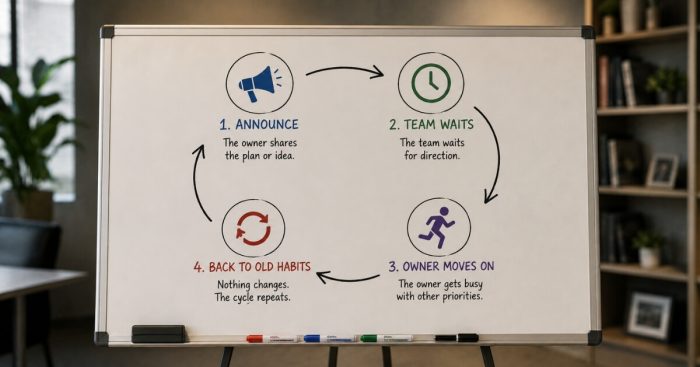
Because they’ve seen this show before: initiatives arrive, nobody enforces them, and everything quietly returns to normal.
When a provider announces a change and the team hesitates, individual laziness is rarely the reason. Usually, the team has learned this behavior over time.
They’ve tried things in the past — or watched other initiatives come and go — without seeing the owner hold anyone accountable for implementing them.
Eventually, the team internalizes the lesson: this too shall pass.
They know they can cut corners. They can ignore the new thing they were told to do until the new vendor, consultant, or owner’s latest enthusiasm goes away.
They’ve seen this show, and they know how it ends.
This is the hidden reason so many clinic engagements with outside experts underperform. The advice enters a culture that has already learned to outlast advice.
That’s also why the first question worth asking isn’t “what should we change?” Instead, ask: “What happened to the last three things we tried to change?”
The answer usually explains everything.
What does weak accountability actually train a team to do?
To optimize for the owner’s attention span instead of the practice’s results.
Every unenforced initiative teaches the team something.
Skip the new intake script for a week and nothing happens — noted. Stop logging calls in the new system and nobody asks — also noted.
Within a few cycles, the team develops an accurate, unspoken model of what the owner actually requires versus what the owner merely announces. They’re not wrong to build that model. They’re responding rationally to the incentives the owner created.
The cost compounds invisibly.
The practice pays for systems nobody uses, agencies whose recommendations die in the hand-off, and training that evaporates in a month.
Worse, the standard-setters on the team — the people who would implement — watch others cut corners without consequences. Eventually, they either lower their own standards or leave.
Weak accountability doesn’t just stall initiatives. It selects for the wrong culture, one tolerated shortcut at a time.
When owners tell us, “we tried that and it didn’t work,” the honest history is usually different: “we announced that, and nobody took responsibility for making it work.”
How does an owner rebuild accountability after years of dropped initiatives?
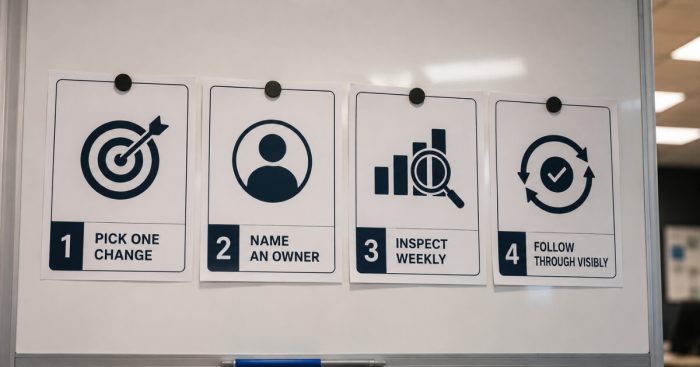
Start with one change, name one owner, inspect it weekly, and follow through visibly. Credibility rebuilds the same way it eroded: one cycle at a time.
You can’t announce your way back. Your team’s model of you changes through evidence, so start generating different evidence.
Pick a single high-value change — say, the new phone script or the follow-up sequence. Give it one named owner on the team, establish a concrete definition of “done,” and create a weekly moment where everyone reviews it together.
Then do the part that actually rebuilds the culture: follow through.
Acknowledge the person doing it well. Speak privately and directly with the person who isn’t. Then repeat the process next week.
The structure we install for this is the 4 R’s — Roles, Responsibilities, Reporting, Results. Every function gets a name, a number, and a weekly review.
Eternity Health Partners ran on exactly this accountability structure while growing from $1M to $4M — and it’s what let both owner-operators eventually step out of the day-to-day without the standards collapsing behind them.
Accountability isn’t the owner hovering. It’s the system that makes hovering unnecessary.
What does accountability look like in a practice that’s actually growing?
Numbers with names on them, reviewed on a schedule, with recognition and consequences both real — and it shows up in retention as much as revenue.
In a healthy practice, accountability is boring and continuous. Each core function has an owner, with a weekly number attached to it.
The team reviews those numbers in a standing meeting, and both excellence and neglect get a response.
As a result, nobody wonders whether the new process is optional. Last week’s review already made the expectation clear.
Outside advice compounds in this environment, too. Every recommendation from a consultant or agency lands on a team that implements by default.
This is also the honest filter for hiring medical practice marketing consultants: the engagement only pays off if you enforce implementation on your side of the table.
Accountability done right also builds teams rather than burning them.
Clear standards, fairly enforced, are a form of respect. Strong performers finally see that their effort matters.
Dr. Groysman’s practice grew monthly revenue by $40K+ while team retention improved — growth and a stronger team, produced by the same discipline.
Accountability doesn’t cost you your culture. It’s what your best people were waiting for.
FAQ’s About Accountability in a Healthcare Business
Why does my clinic team ignore new initiatives?
Because past initiatives died without consequences, and the team learned the pattern: wait it out and the new thing — and the new vendor — goes away.
Unenforced announcements create this learned behavior. Individual laziness usually isn’t the root cause.
What’s the difference between announcing a change and implementing one?
An announcement is words. Implementation requires a named owner, a definition of done, a weekly inspection, and visible follow-through.
Practices grow on the second one. The advice itself is usually the easy part.
How do I hold clinic staff accountable without damaging morale?
Set clear standards and enforce them fairly. Recognize the people doing the work well, and have private, direct conversations with those who aren’t.
Strong performers usually respond well to that clarity. What damages morale is watching others cut corners without consequences.
What is the 4 R’s accountability framework?
Roles, Responsibilities, Reporting, Results.
Every function gets a named owner, defined duties, a reporting line, and weekly numbers that person owns. This structure lets the practice maintain standards without requiring the owner to personally enforce everything.
Should I fix accountability before hiring a marketing agency?
Yes — or at least in parallel.
Outside recommendations only produce revenue when your team implements them. Therefore, an agency engagement layered on a wait-it-out culture typically underperforms regardless of the agency’s quality.
What’s the next step?
If you’ve watched good advice, good software, and good agencies all produce nothing at your practice, the pattern isn’t bad luck. It’s an accountability gap your team learned from you, and you can fix it faster than you might think.
Book a strategy call. In 60 minutes we’ll identify which changes would grow your practice and, more importantly, map the accountability structure that makes this the initiative your team actually implements.