
When Should a Cash-Pay Clinic Stop Chasing a Lead? (The 6-Call, 5-Text Rule and the Six Reasons to Mark a Lead Lost)
Most clinics get lead follow-up wrong in one of two directions: the front desk gives up after one voicemail, or the pipeline fills with zombie leads nobody will ever close and nobody is allowed to kill.
This article is the exact stop-rule from a follow-up system we built for a cash-pay weight loss and hormone telehealth practice.
Here’s when to keep dialing, when to stop, which leads to disqualify on the spot, and why the note you write when you mark a lead Lost is one of the most valuable marketing assets your clinic produces.
When should a cash-pay clinic stop chasing a lead?
After 6 calls and 5 texts across 8 days with zero response — or the moment a lead hits one of five instant disqualifiers, whichever comes first.
That’s the whole rule.
It’s specific on purpose.
“Use your judgment” produces two failure modes.
Some reps quit after one attempt because rejection is uncomfortable.
Others keep a dead lead warm for months because marking it Lost feels like failure.
A numbered cadence with a defined end removes both.
Every lead gets a real, documented effort. The team makes enough attempts that the clinic never wonders, “what if we’d called one more time?”
Then the rep closes the file with a reason and puts their attention back on leads that can actually convert.
The end of the cadence isn’t silence, either.
Instead, the rep sends a final close-out text:
“I don’t want to be the guy who keeps texting. Should I hold your file open for a few more weeks, or close it out for now?”
In the system we built, that is the highest-replying message in the entire sequence.
It hands the lead a graceful exit, and most people would rather keep a door open than shut one.
“Close it out” creates a clean Lost.
Meanwhile, “hold it open” converts a dead chase into a scheduled future conversation.
What should the follow-up cadence look like before you’re allowed to stop?
Five touch-days across eight calendar days: Day 0, Day 1, Day 3, Day 5, and Day 8.
After each unanswered call, the rep leaves a voicemail and sends a text within seconds.
Day 0: Make two calls back-to-back the moment the lead comes in. Leave a voicemail on the second dial, then send a text within seconds.
Day 1: Make two more calls at a different time of day, followed by a voicemail and text.
Day 3: Make one call, then leave a voicemail and send a text.
Day 5: Call once more, followed by a voicemail and text.
Day 8: Send the close-out text above. No call.
Six calls, five texts, done.
Two mechanics make this cadence work harder than the usual “call them a few times.”
First, use the voicemail-plus-instant-text pairing.
Announcing the text in the voicemail makes the text land as expected instead of cold.
The pairing lifts reply rates — not either channel alone.
Second, every message names what the lead actually inquired about.
Then it ends with a two-option question, such as: “Is before 10am easier for you, or after 4pm?”
That’s better than an open ask.
This is the operating layer of a real patient acquisition system.
The ads fill the top, but the cadence is what turns a form-fill into a consult.
Which leads should a cash-pay clinic disqualify immediately, without finishing the cadence?
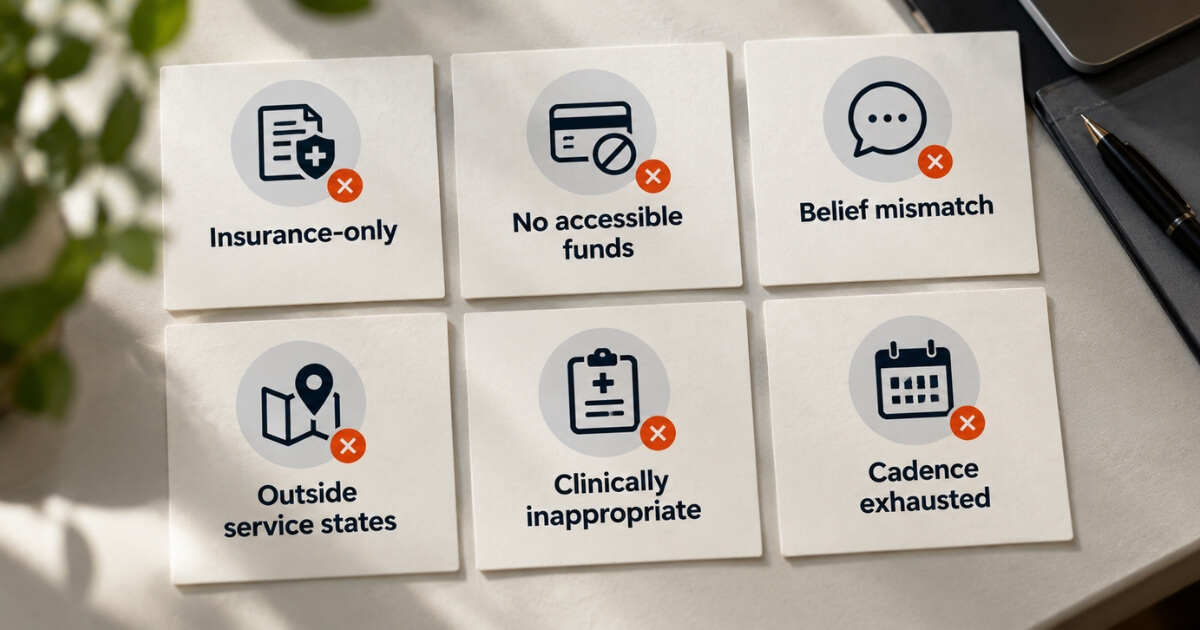
Five kinds: insurance-only shoppers, leads with no accessible funds, belief-system mismatches, leads outside the states you serve, and leads who are clinically inappropriate.
Each one has a defined exit.
For an insurance lead, first offer a superbill, letter of medical necessity, and HSA/FSA guidance.
If they still won’t consider direct-pay, end the chase there.
When a lead has no accessible funds, mark them Lost without a discount and without inventing a payment plan.
It’s real, it’s common, and it’s not a failure on the rep’s part.
For a belief mismatch, thank the lead instead of arguing with them.
Confirm location early with out-of-state leads.
It’s the cheapest disqualifier in the system and should never surface at the end of a long call.
Finally, respectfully close out clinically inappropriate leads — people seeking something you don’t provide or who need a different level of care.
The sixth reason is the cadence itself expiring: 6 calls, 5 texts, zero response.
All six end the chase deliberately.
The rep changes the stage and writes a note instead of letting the card rot in “Called 2x” until everyone forgets why it’s there.
Why does the reason you write when marking a lead Lost matter so much?
Because the notes field is the only place your clinic learns anything — and the pattern in your Lost reasons is a map of what’s wrong with your marketing.
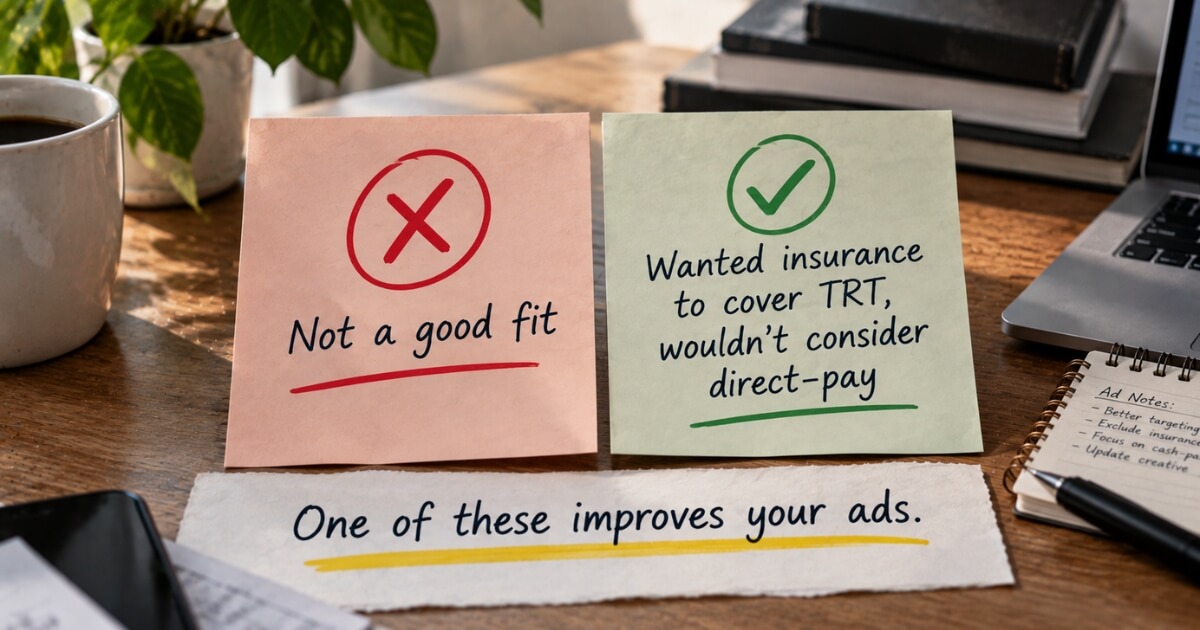
“Not a good fit” tells you nothing.
“Wanted insurance to cover TRT, wouldn’t consider direct-pay” tells you exactly which ad angle is pulling the wrong people.
Ten of those in a month is not a front-desk problem.
It’s a targeting and messaging problem.
More importantly, you can fix it upstream in the ads before spending another dollar to attract patients who were never going to buy.
The same logic runs through every disqualifier.
For example, a spike in out-of-state Losts means your geo-targeting leaks.
Meanwhile, a spike in no-funds Losts means the ad promises something the price point doesn’t match.
This is the discipline that separates practices that scale from practices that churn spend.
Orthobiologics Associates ran a 79.4% lead-to-booked conversion rate and collected $309,590 in cash-pay revenue in 10 months — numbers like that don’t come from more leads.
They come from a pipeline where every card is either moving or closed with a reason someone can act on.
What’s the difference between a Lost lead and a “Needs Nurture” lead?
A date.
A nurture with no date is a Lost you haven’t admitted to.
When a lead says “not right now,” the rep’s job is to get a specific month or date before the thread ends.
Next, move the card to Needs Nurture and write that date on it.
When the date arrives, move the lead back to the top of the cadence.
The re-engagement message should reference both what they inquired about and the specific reason they gave for waiting.
That’s what makes the follow-up feel like a kept promise instead of a cold call.
However, the stage only works if the team audits it.
First thing daily, move anything in Needs Nurture past its follow-up date back into the cadence.
Call anyone who has sat in “In Contact” for more than 48 hours.
Resolve any no-show that’s more than 24 hours old.
Automation doesn’t push those stages forward — which is exactly why pipelines quietly die there.
Should a clinic ever discount to rescue a lead that’s about to be Lost?
No.
A discount doesn’t rescue a bad-fit lead — it recruits a bargain shopper who churns at month three.
The practice this system was built for presents its intake price the same way every time:
“$900 total — $450 for labwork, and $450 for the consultation. The only thing due now is the $450 for labs. If a program isn’t appropriate, you just pay for the provider’s time. If you move forward, the $450 consultation is credited toward your first month.”
Two rules sit under that script.
First, never end the sentence on $900.
The total can exist in the sentence, but it can’t be the last number they hear.
Second, always credit the consult fee. Never “waive” it.
Waiving positions the provider’s time as worthless.
If a lead can’t get past a price presented that cleanly, respectfully mark the lead Lost and write down the reason.
Don’t discount.
High-LTV verticals live and die on this.
A men’s hormone clinic marketing funnel that discounts intake to close fills the panel with patients acquired on price.
And patients acquired on price leave on price.
For scale, look at what disciplined volume actually produces.
NuLevel Wellness added $6.7M in revenue and 3,727 new patients in one year — volume that only works because the pipeline triages hard and the offer is never negotiated lead-by-lead.
FAQ’s About Disqualifying and Closing Out Clinic Leads
How many follow-up attempts should a clinic make before marking a lead Lost?
Make six calls and send five texts across eight days — Day 0, Day 1, Day 3, Day 5, and Day 8.
Leave a voicemail on every unanswered final dial and send a text within seconds of every voicemail.
If there’s zero response after the Day-8 close-out text, mark the lead Lost with the note “no contact” and stop.
What should the final message to an unresponsive lead say?
Use a graceful close-out with two options:
“Should I hold your file open for a few more weeks, or close it out for now?”
In the system this article is based on, it’s the highest-replying message in the sequence.
It gives the lead an easy exit.
However, many choose to keep the door open instead.
That response converts a dead chase into a scheduled follow-up.
Should we keep chasing no-shows?
Yes — make three attempts, starting within 15 minutes of the missed appointment, with zero guilt in the messaging.
Assume logistics, not rejection.
Most no-shows don’t rebook because they’re embarrassed, not because they lost interest.
After three attempts, move a no-show with a reason and timeline to nurture and give it a date.
If the lead stays silent, mark them Lost.
What do we say to leads who want to use insurance?
Offer the superbill, a letter of medical necessity, and HSA/FSA guidance — empathetically and without apologizing for being direct-pay.
If they still won’t consider paying directly, mark the lead Lost and record their exact words.
A pattern of insurance-only leads points to an advertising problem upstream, not a front-desk failure.
What counts as a “won” lead in a cash-pay pipeline?
An attended appointment — not a booking.
A booked call that no-shows is not a win.
Treating bookings as wins hides the leak between the calendar and the chair.
Define Won as “sat in the appointment.”
Then audit the booked and no-show stages daily so nothing sits longer than 24–48 hours.
What’s the next step?
If your pipeline is full of leads nobody has touched in two weeks — or your front desk is quietly deciding on their own when to stop calling — you don’t have a lead problem.
You have a system problem.
The fix is a defined cadence, defined disqualifiers, and a daily audit that your team follows inside your CRM.
Book a free strategy call and we’ll walk through your current pipeline stage by stage: where leads are dying, which Lost reasons you should be mining for ad intelligence, and what a full-cadence follow-up system would look like for your practice.