
What Does ChatGPT Say About My Clinic? (Ask It for the Cons, Then Answer Every One on Your Own Website)
We ran this audit on ourselves. On a strategy call last October, a content partner we work with put Real ADvice into ChatGPT and asked a deliberately plain question: what are the pros and cons of doing business with these people? The cons that came back weren’t accusations. They were objections sitting in the public record with no answer published anywhere — which meant each one was a page we hadn’t written. Here’s the method, and what to do with what you find.
How do I find out what ChatGPT says about my medical practice?
Open ChatGPT, type your practice name, and ask for the pros and cons of doing business with you.
Then read the cons, not the pros.
That’s the whole audit. It takes two minutes.
Most owners have either never done it or have only asked flattering questions. Those return flattering answers and teach you nothing.
The pros are the easy half. You already know your strengths, and the model is mostly reflecting your own marketing back at you.
The cons are the half that matters.
They are assembled from what exists publicly about you and what conspicuously doesn’t.
Run the audit more than once and in more than one place.
Ask the same question in a fresh chat. Then try a different model. After that, add your city or specialty.
You’re not looking for a verdict. You’re building a list.
This is the first exercise we run with practices as medical practice marketing consultants, before touching a single ad, because it shows what a prospective patient may be told about you when you’re not in the room.
What prompt should I use to see how AI describes my clinic?
Use a short, plain prompt.
As the partner running the audit put it: give me the pros and cons of teaming up with them in business, or doing business with them — something like this.
That was deliberately simple.
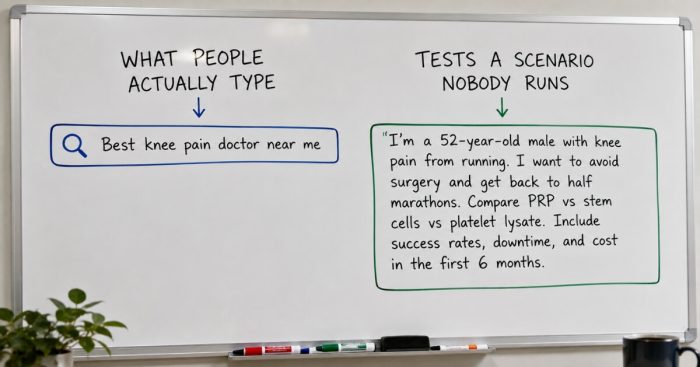
Real patients and practice owners do not usually write structured prompts with roles and constraints.
They type one sentence, sometimes with a typo, and take the first answer seriously.
An elaborate prompt tests a scenario few people actually run. It also tends to produce a more careful answer than the one your real prospect may see.
So write the prompt the way your worst-case reader would:
“Is [practice] any good.”
“Pros and cons of going to [practice].”
“Should I use [practice] or [category alternative].”
Save what comes back verbatim.
The wording of the con often gives you the exact objection you need to answer.
What do I do with the cons ChatGPT lists about my practice?
Treat each one as a page you haven’t written yet.
But first, understand what the con actually is before you get defensive about it.
Here is the distinction that makes the exercise useful.
The model may be identifying perceptual risks for your business. That is not the same as saying those risks are objectively true.
An LLM is not adjudicating whether your practice is good.
It is summarizing the information available to it, including gaps in the public record.
If nothing on the open web addresses a reasonable buyer question, the model may fill that silence with caution.
That caution is what you read as a con.
The fix is unglamorous and completely within your control.
Every con can become a page, section, or FAQ answer.
Write the answer. Publish it on your own domain. Then the public information available about that objection changes.
Take the worked example from our own audit.
One con amounted to: how do I know the claims are true?
The answer is published case studies and reviews — and, critically, having them on our own site where they can be read and referenced.
But it only works as public proof if it exists somewhere crawlable.
A number that lives only inside a sales call cannot help someone researching you online.
To be straight about provenance: the full walk-through of every con on that list got scheduled and then skipped on the call.
So take the method and the one worked example, not an invented inventory of what a model says about anyone.
Why does answering objections on my own website change what AI says about me?
Because models answer from available information, and an objection with no published answer can turn into caution.
Your own domain is the source with your name on it.
When the answer to “are these results verifiable,” “what happens if it doesn’t work,” or “why does this cost what it costs” exists as indexed text on your site, that answer becomes available to summarize and reference.
When it does not, the gap itself can become part of the uncertainty.
This is also why format matters more than length.
Write the question as a heading, exactly as someone would ask it.
Answer it in the first sentence. Then elaborate.
Do not open with three paragraphs of context before the answer arrives.
If the reader has to work too hard to find the answer, the page stops functioning as objection-handling content.
And be specific.
“We deliver great results” answers nothing.
A named, dated, checkable outcome does.
Where do these objection-answering pages belong in my sales process?
At the point where a prospect is close to deciding — which is exactly where most clinics have nothing.
The gap showed up on the same call.
The video producer looked at our existing library and noted that plenty of content already explained the service.
What wasn’t there was a closer.
If somebody felt one step away from deciding, was there a video or page to put in front of them?
Most practices have the same shape.
They have plenty of awareness content: what is TRT, what is PRP, five signs you need this.
But they have little for the person who already understands the treatment and is deciding whether to trust the practice.
Objection-answering pages are closing content.
Place them accordingly.
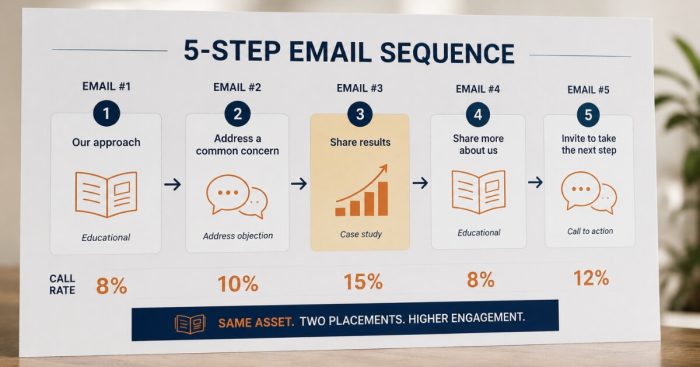
Put the relevant asset into your nurture sequence and test its position.
Measure what percentage of people who sign up actually call. Then move the asset to position one, then position three, and watch whether the call rate changes.
That is a real test with a real number attached.
Also rewrite the ask so it serves the reader’s job.
Never just say “download our free course.”
Instead: here’s a course we prepared for your staff. Download it and share it with them so they can be more efficient.
If you simply drop a link to the course, many people will never click it.
Why don’t my clinic’s marketing videos and blog posts turn into patients?
Usually because they were built for reach instead of for a job — and because they argue logically at people who often decide emotionally.
Judge content by function, not by views.
As the partner on our call put it: 300 views is better than 3 million when the 300 are the right people at the right moment.
That video is not how you make money from the video itself.
The real value comes from putting the right asset in front of somebody at a specific point in your sales process.
That could happen in an email or a text.
Apply the same standard to objection pages.
A page that 40 people read can outperform a post with far more reach if one reader is a prospect mid-decision and another is an AI crawler.
The second reason is harder to hear, and it was aimed at us.
A lot of your content is very logical, and people often make decisions emotionally.
The version that lands starts with how the provider feels after spending a hundred grand on ads and sitting there looking at statistics, scratching their head.
The prescription was simple: show that you understand how they feel before showing them the framework.
One caveat from the producer on the same call matters too.
Single-owner practices tend to buy more emotionally. Larger groups often buy on nuts and bolts, logic all the way.
So segment the message.
The solo owner needs to feel understood first and see the mechanism second.
The group needs the mechanism, the numbers, and the process. Too much emotional framing can get in the way.
FAQ’s About Auditing What AI Says About Your Practice
How do I find out what ChatGPT says about my medical practice?
Type your practice name into ChatGPT and ask for the pros and cons of doing business with you.
Then read the cons rather than the pros.
Run the same question in a fresh chat, in a second model, and with your city or specialty attached.
You are building a list of objections, not looking for a verdict.
The exercise takes about two minutes.
What prompt should I use to check how AI describes my clinic?
Use a short, plain, slightly skeptical prompt because that is how real prospects type.
Something like “give me the pros and cons of doing business with them” is deliberately simple.
An elaborate structured prompt tests a scenario few people actually run.
It also tends to return a more careful answer than the one your prospect may see.
Are the cons ChatGPT lists about my business real?
Not necessarily.
What the model identifies may be perceptual risks for your business, which is not the same as saying they are true.
It is summarizing the public record about you, including gaps.
When nothing online addresses a reasonable question, the model may fill that silence with caution.
That caution can read like a con.
How do I change what AI says about my clinic?
Answer every con on your own website.
Each one tells you what information is missing or unclear.
Write the question as a heading exactly as someone would ask it.
Then answer it in the first sentence and publish it on your own indexed domain.
As the public record changes, the inputs available to models change too.
Where should objection-answering content sit in a clinic’s sales process?
At the point where a prospect is close to deciding.
Most practices have plenty of awareness content and almost nothing designed to close the gap between interest and trust.
Insert the relevant page or video into your nurture sequence.
Then test its position by measuring what percentage of people who sign up actually call.
Move the asset to position one, then position three, and watch whether the call rate changes.
What’s the next step?
Do the two-minute version today.
Open ChatGPT, ask for the pros and cons of doing business with your practice, and paste the cons into a document.
That document becomes your content calendar for the next quarter, written by the thing your patients are already asking.
Book a strategy call and we’ll run the audit with you.
We’ll sort the cons into the ones that need a page, the ones that need proof, and the ones that need nothing.
Then we’ll place the resulting assets where they can actually change a decision.