
What Do the Cash-Pay Clinics That Generate the Most New Patients Actually Do Differently? (Lessons From 75,000 Leads and 20,000 New Patients Across 37 Clinics)
Last year we worked inside cash-pay clinics and tracked every part of the process. Across 37 clinics nationwide, 75,000 leads became 20,000 new patients and generated $87M in revenue. I also sat through 1,354 one-on-one strategy calls with clinic owners. One pattern became clear. Some clinics printed money, but only because the offer, the patient journey, and the consult process were built correctly. Other clinics generated similar lead volume but stayed stuck. This FAQ explains what the highest-performing clinics actually did differently—and why the answer was never simply “more leads.”
What do the cash-pay clinics that generate the most new patients have in common?
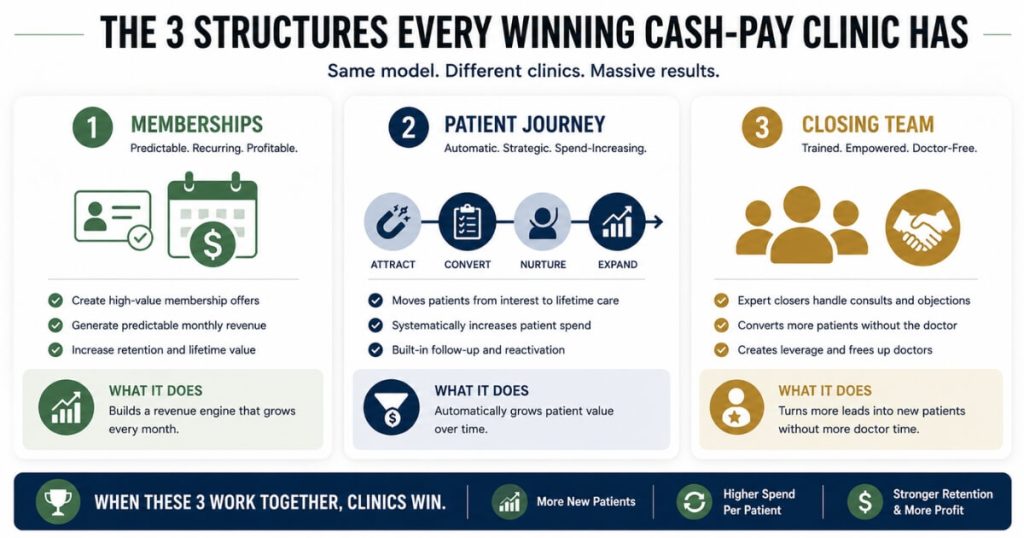
Three things separate the highest-performing clinics:
- Memberships instead of one-off packages
- A patient journey that automatically increases lifetime value
- A team that can close consults without the doctor rescuing every sale
Those three factors consistently appeared across all 37 clinics.
The lead volume itself was often very similar.
What separated the clinics that scaled from the clinics that plateaued was everything that happened after the lead arrived.
A clinic with:
- A strong offer
- A mapped patient journey
- A trained closing team
turned a lead into a long-term patient.
A clinic missing those pieces often turned that same lead into one visit and a goodbye.
Looking across 75,000 leads and 20,000 new patients, the story was never about the ad account.
It was about the structure waiting behind the lead.
The rest of this article explains each of those three systems.
They work together.
- Memberships create predictable revenue.
- The patient journey increases lifetime value.
- The closing team removes the owner as the bottleneck.
Put all three together and the same marketing budget produces dramatically more patients.
That is exactly why a predictable patient acquisition system matters more than raw lead volume.
Why do memberships beat one-off packages for a cash-pay clinic?
Memberships turn one-time sales into recurring revenue.
Recurring revenue gives you predictable cash flow.
Predictable cash flow gives you confidence to invest in patient acquisition.
A clinic selling random packages starts over with every patient.
Every sale must be won again.
That creates:
- Unpredictable revenue
- Uncertain cash flow
- Advertising decisions based on hope instead of math
Membership clinics operate differently.
Before the month even begins, they already know approximately how much revenue will recur.
That changes everything.
Advertising becomes a calculation.
If a member is worth a known monthly amount and stays for a known number of months, the clinic knows exactly how much it can afford to spend acquiring another member.
That is why the fastest-growing clinics in our portfolio rely on memberships.
For example, an HRT clinic we grew from $1M to $4M per year built that growth on recurring memberships.
The clinic maintained:
- Approximately 250 active members
- Around $1,000 in monthly revenue per member
Growth did not come from hoping patients would continue buying random packages.
Memberships created predictable, compounding revenue.
Random packages eventually create a ceiling.
Memberships allow a clinic to keep growing.
What is a patient journey that increases spend automatically?
A patient journey is a planned sequence of visits, follow-ups, and next-best offers.
Each step naturally moves the patient toward higher-value, longer-term care.
That happens without anyone needing to “sell” at every appointment.
Consider the difference.
Without a patient journey:
- A patient buys one weight-loss visit.
- The clinic earns approximately $300.
- The patient disappears.
With a patient journey:
- The patient completes the initial visit.
- Laboratory testing follows.
- The patient enters a membership.
- Appropriate hormone or longevity programs are introduced.
Each recommendation is simply the next logical clinical step.
It is not a sales pitch.
The patient’s lifetime value increases because the journey was intentionally designed that way.
Over one year, the difference becomes dramatic.
One clinic earns approximately $300.
Another earns several thousand dollars from the same patient.
This is where many clinics quietly lose the most money.
The missing revenue is invisible.
You can easily notice:
- A poor advertisement
- A broken landing page
You cannot easily see:
- The membership that was never offered
- The lab work that was never scheduled
- The follow-up that never happened
Mapping the patient journey intentionally transforms a one-time transaction into a patient relationship lasting several years.
Once the system is built, it continues operating automatically.
Why does my sales team need to close without the doctor rescuing the sale?
Because a practice cannot grow beyond the doctor’s calendar if every consult depends on the doctor personally closing the sale.
This is one of the most common patterns among plateaued clinics.
The provider becomes:
- The brand
- The closer
- The final decision-maker
Every patient must pass through the owner’s schedule.
More marketing simply creates more consults that the owner personally has to rescue.
Eventually, the owner’s calendar becomes the limiting factor.
No advertising budget can solve that problem.
The solution is building a team that can:
- Run the consult
- Present the treatment program
- Handle objections
- Close confidently
Building that capability takes work.
It requires:
- Scripts
- Role-playing
- Weekly review of recorded consults
It does not happen by hiring someone friendly and hoping for the best.
However, the payoff is enormous.
The clinic begins adding patients by increasing capacity—not by increasing owner hours.
When we help clinics grow, this is often the biggest transformation.
- We redesign the patient journey.
- We strengthen the consult process.
- We remove the owner as the bottleneck.
That is also the foundation of durable medical practice marketing.
Marketing only compounds once the consult can close successfully without the owner.
Does generating more leads actually fix a cash-pay clinic’s growth problem?
Usually not.
Adding more leads to a broken patient journey simply creates more lost opportunities.
It also creates a larger advertising bill.
This is one of the most expensive misunderstandings in cash-pay medicine.
Many owners feel stuck.
Their first conclusion is simple:
“We need more leads.”
So they increase advertising spend.
Unfortunately, they send those additional leads into:
- The same offer
- The same patient journey
- The same consult process
Nothing actually changes.
The result is predictable.
They spend more money.
They lose more leads.
Eventually they conclude that advertising does not work.
In reality, the advertising often worked perfectly.
The system behind it did not.
Fix the offer.
Then, fix the patient journey.
And finally, fix the closing process.
Then the exact same lead volume produces dramatically more patients.
That is the real story behind the 27% lead-to-patient conversion rate across 37 clinics.
It was never a lead-generation story.
It was a conversion story.
The fastest-growing clinics were not buying the most leads.
They were wasting the fewest.
How many leads does it take to generate thousands of new patients at cash-pay clinics?
Across 37 clinics:
- 75,000 leads
- 20,000 new patients
- $87M in revenue
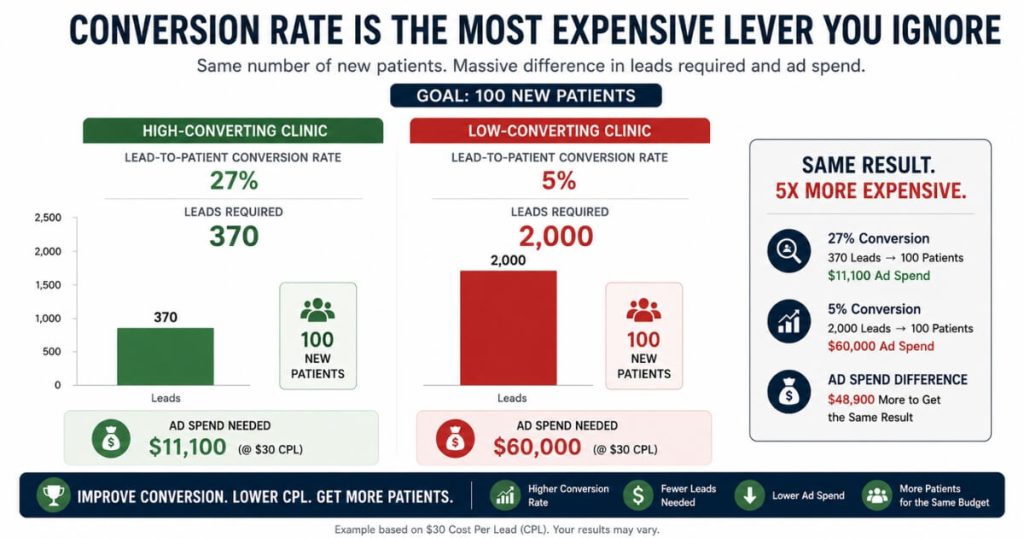
That works out to roughly a 27% lead-to-patient conversion rate.
However, that percentage is the result of strong systems—not the starting point.
Consider the math.
A clinic converting only 5% of leads would need four to five times as many leads to generate the same number of patients.
That means:
- Four to five times the advertising spend
- Four to five times the acquisition cost
- The exact same number of patients
The clinics reaching 27% were not spending dramatically more.
They were converting dramatically better.
Why?
Because they had:
- Memberships
- A patient journey that increased lifetime value
- A team capable of closing consults without the doctor
We saw exactly the same pattern at a medspa we scaled to $6.7M in one year across 3,727 new patients.
Multi-channel advertising generated the demand.
However, the offer, the patient journey, and the follow-up systems turned that demand into long-term patients.
Leads are the fuel.
The structure is the engine.
Buying more fuel for a broken engine simply burns through the fuel faster.
FAQ’s About Generating New Patients at a Cash-Pay Clinic
Is a 27% lead-to-patient conversion rate realistic for my clinic?
Yes, but only if the right conversion systems are already in place.
Those systems include:
- Memberships
- A mapped patient journey
- A trained closing team
The 27% figure came from the blended performance of 37 clinics operating with those structures.
Clinics without those systems usually convert only a fraction of that rate.
That is why “we need more leads” is often the wrong diagnosis.
Before increasing your advertising budget, improve your conversion system.
When the structure improves, the conversion rate improves with it.
Should I switch from packages to memberships even if my patients are used to packages?
Yes.
In most cases, memberships create a stronger business model.
Memberships make revenue predictable.
They also make advertising decisions much easier because recurring revenue provides a reliable financial foundation.
Patients usually adapt quickly when the membership is presented as ongoing care instead of simply a larger bill.
You do not need to change everything overnight.
A gradual transition often works best.
For example:
- Continue honoring existing packages.
- Introduce memberships as the default option for new patients.
- Allow the recurring revenue base to grow naturally over time.
That approach creates stability without disrupting current patients.
How do I build a patient journey that increases spend without feeling pushy?
Start by identifying the genuine clinical next step after each service.
Then make that recommendation every time it is appropriate.
For example:
- Complete the initial consultation.
- Recommend laboratory testing.
- Review the results.
- Introduce an appropriate membership.
- Recommend additional programs only when medically appropriate.
When every recommendation represents the patient’s logical next step, it does not feel like selling.
It feels like good clinical care.
The “automatic” part comes from documenting the journey.
Your team follows the same process with every patient instead of relying on the owner to remember each recommendation.
What’s the first thing to fix if my clinic is stuck despite steady leads?
Start with the consult and closing process.
That is where many otherwise qualified leads quietly disappear.
If the doctor has to rescue every sale, address that first.
Build a repeatable process by:
- Creating a consult script.
- Practicing through regular role-play.
- Reviewing recorded consults every week.
- Coaching the team consistently.
Once your team can confidently close consults on its own, marketing begins to compound.
That single improvement often produces more revenue than launching another advertising campaign.
What’s the next step?
If you own a cash-pay clinic and feel like you’ve been buying more leads without solving your growth problem, the data from 37 clinics points to the same conclusion.
The problem usually is not promotional.
It is structural.
Build the foundation first:
- Replace one-off packages with memberships.
- Map a patient journey that increases lifetime value.
- Build a closing team that no longer depends on the owner.
Those three systems consistently separated the clinics that scaled from the clinics that plateaued.
More leads were never the deciding factor.
Better structure was.
If you want help identifying where your biggest opportunity is, that is exactly what we do.
Before discussing advertising, we’ll evaluate:
- Your current offer
- Your patient journey
- Your consult process
Then we’ll show you exactly which of those three areas is costing you the most patients today.
If it’s the right fit, we’ll rebuild that system alongside your team so your marketing produces far more value from the leads you already generate.