
What’s the Phone Script That Converts Weight-Loss and Direct Primary Care Leads Into Booked Patients? (Word-for-Word)
A weight-loss or direct-primary-care lead is hottest in the first 60 seconds of the call.
And that is exactly when most clinics lose it, because whoever answers the phone has no script.
The leads that convert get routed, qualified, given permission to be helped, and assumed into the calendar with a card on file before price ever comes up.
Below is the actual word-for-word phone script a clinic uses to turn GLP-1 weight-loss, hormone, and DPC inquiries into booked, paid-to-reserve appointments.
It includes the pricing-objection rebuttal and the outbound version.
How should a weight-loss or DPC clinic open the phone call to route the lead correctly?
Open with a name capture.
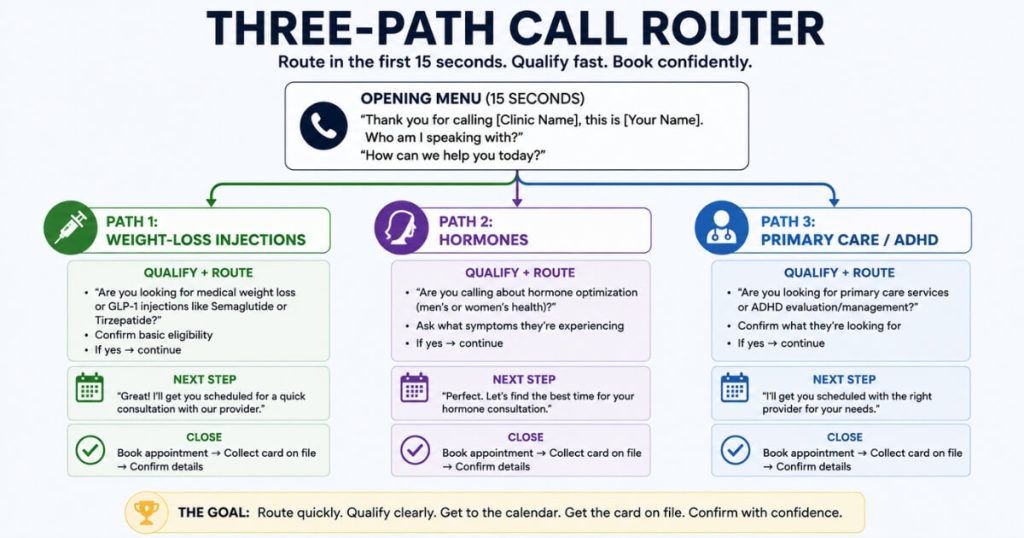
Then route by service in the first 15 seconds.
Use this exact opener:
“Thank you for calling [clinic], this is [name]. Who am I speaking with?”
Then mirror their name back:
“Hey [first name], how can we help you today?”
If they do not volunteer the reason, offer the menu:
“Are you calling about weight-loss injections, hormones, or primary care / ADHD, or something else?”
The routing matters because a GLP-1 lead, a hormone lead, and a direct-primary-care membership lead each need a different path.
Each one also needs a different next step.
Naming the caller immediately and mirroring their first name back builds rapport in the first breath.
Offering the three-option menu also prevents the dead air where an untrained rep fumbles for what to ask.
Once they pick a lane, jump straight to that path’s qualifying questions.
Do not run a generic script that fits no one.
This is the conversion layer of a real patient acquisition system.
The ads and SEO create the call.
The script is what turns it into revenue.
How do you book a GLP-1 weight-loss lead without quoting a price first?
Qualify, get permission to explain, then sell the complimentary discovery call with a card on file to hold the slot.
Then assume the close on the calendar before price ever comes up.
Start with these questions:
- “Have you tried weight-loss injections before, or would this be your first time?”
- If first-time: “How did you hear about us?”
- If experienced: “Do you remember what you were taking and roughly what dose?”
- “What happened last time that made you stop?”
- “About how many pounds are you looking to lose?”
Then transition:
“Perfect, thank you for sharing that. Maybe we can help. Would you like me to explain what it looks like to get started here?”
When they say yes, explain the first step:
“The first step is a complimentary discovery call with one of our providers. They will review your goals and health history, make sure there is no reason the medications would be an issue, and talk through a safe, realistic plan.”
Then use the card-on-file line:
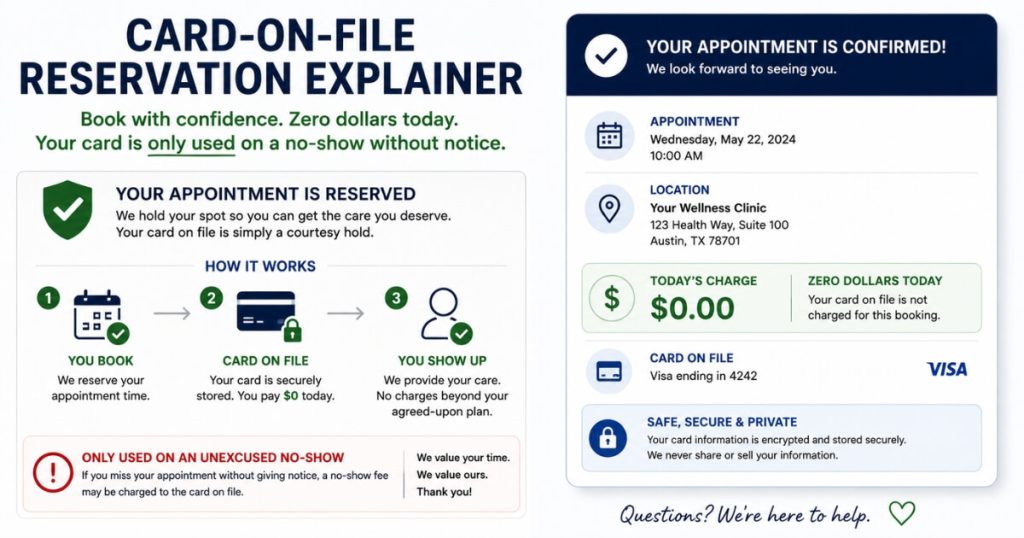
“There’s no charge for that call. We just keep a card on file to reserve the appointment so we don’t give your spot away. It’s zero dollars today; it only gets used if you no-show without letting us know.”
Then assume the close:
“What day usually works best, early in the week or later? Morning or afternoon?”
Once they pick a time, take the card:
“Great, I can hold that slot for you. To hold the appointment, what kind of card do you want to use, Visa or Mastercard?”
This card-on-file booking discipline is core to effective GLP-1 & weight loss clinic marketing.
No-shows quietly kill an otherwise profitable funnel.
What do you say when a weight-loss caller demands pricing before booking?
Tell them the truth.
Pricing depends on the dose and medication.
You are not a medical provider.
And it would be unsafe to guess.
Then pivot to the free call as the fastest way to a real number.
Use this word-for-word rebuttal:
“I totally get that. Our pricing is based on the dose and the specific medication, and because I’m not a medical provider it’s actually unsafe for me to guess on a dose or price without them reviewing your situation. The good news is that discovery call is complimentary. The provider will tell you what they recommend, go over the exact dosing, and then give you precise pricing options before you decide anything. So the fastest way to get a real number is to get you on that free call. I can reserve a spot and it’s zero dollars today, we just keep a card on file to hold it.”
The framing reverses the objection.
Refusing to quote becomes a safety feature, not a dodge.
If you want an anchor, use this:
“We do have programs starting as low as $200, depending on the dosage the provider recommends.”
That gives them a floor without committing to a number the provider has not set.
This kind of inside-sales discipline is exactly what scaled NuLevel Wellness Medspa, a weight-loss and medspa clinic where we added $6.7M in revenue in one year across 3,727 new patients.
How do you present hormone labs and the review visit so the patient pays upfront?
Explain the two-step labs-plus-review structure with real numbers.
Then credit the review fee toward the first month so the consult feels free if they move forward.
Use this structure:
“Step one is labs. You pay the clinic $300 for your initial labs. We send a lab order to Quest, Labcorp, or Rupa, you go get your blood drawn, and results come back to your provider.”
Then explain step two:
“Step two is the hormone review visit, which is $300. The provider reviews your labs, goes over symptoms, and designs a custom plan.”
Then add the credit:
“And here’s the nice part: if you decide to start on our membership, that $300 consultation fee is credited toward your first month. So effectively, the review is free if you move forward.”
That credit-toward-first-month framing removes the friction of paying twice.
It also rewards commitment.
When a patient asks to run labs through insurance, use this rebuttal:
“It’s not that we don’t want that for you. When we’ve done that in the past, a lot of people ended up getting surprise bills for thousands of dollars months later because insurance codes things weird and denies parts of the panel. So we negotiated discounted labs through the practice so you know the cost upfront and don’t get a surprise bill later.”
Then book and take the card the same way:
“To take care of the labs and reserve that provider review, what card do you want to use today, Visa or Mastercard?”
How do you sell a direct primary care or ADHD membership over the phone?
Lead with the membership-first structure.
The patient enrolls first.
Then they get an initial consult where the provider handles meds, refills, and the treatment plan.
Ongoing access is included.
Start with discovery questions:
- “Do you have a primary care provider right now?”
- “Why are you looking to switch?”
- “What are you hoping for that you’re not getting now?”
Then explain the model:
“You enroll in the membership first. As part of that, you get an initial consult where the provider can handle meds, refills, and your treatment plan on that first visit. Then ongoing access and follow-ups are included as part of the membership.”
Then use the choice-close:
“Would you like me to go over pricing and what’s included, or would you prefer we start with getting you on the provider’s calendar to make sure it’s a fit?”
Either branch ends the same way:
Explain, schedule, and take a card on file.
Direct primary care is a recurring, high-LTV model.
So the patient who enrolls is worth far more than a single visit.
That is exactly why the booking discipline on the first call matters so much.
How should every weight-loss or DPC call end, and what does the outbound version look like?
No call ends without a scheduled next step.
If they truly will not book, capture the cell number and text the scheduling link before they hang up.
Use this fallback line:
“Totally fine. If it’s okay with you, I’ll text you our scheduling link so when you’re ready you can grab a spot before they fill up. What’s the best cell number to use?”
For outbound, use this opener:
“Hi, is this [name]? This is [rep] with [clinic].”
If no, hang up and add to do-not-disturb.
If voicemail, leave a specific message naming the consultation for weight-loss injections and peptides with a callback number.
If yes, use this warm line:
“I had a few minutes and I saw you hadn’t scheduled your free provider consultation yet, so I wanted to reach out. Do you have any immediate questions, or would it be easier if I just helped you schedule over the phone?”
From there, qualify:
- Have they tried injections before?
- Have they tried other peptides or hormones?
- How many pounds do they want to lose?
- Do they have any events making this a priority right now?
Then empathize so they feel understood.
Get permission to explain.
Present the free-consult-with-card-on-file step.
Anchor with:
“We have programs starting as low as $200, depending on the dosage the provider recommends.”
Then check alignment:
“Does that feel like it’s in alignment with the next steps you were hoping for?”
Then collect the full intake:
- Appointment time
- Full name
- Phone
- Date of birth
- Address
- Gender
- Pounds to lose
- Allergies
- Current medications with dosages
- Past surgeries
- Contraindication screen
- Card details
For the contraindication screen, ask about:
- Medullary thyroid cancer
- MEN 2
- Type 1 diabetes
- Pregnancy
- Breastfeeding
Reuse anything already gathered so you never ask the same question twice.
FAQ’s About the Weight-Loss and DPC Phone Script
How should a weight-loss or DPC clinic open the phone call to route the lead correctly?
Open with a name capture.
Then route by service in the first 15 seconds.
Use:
“Thank you for calling [clinic], this is [name]. Who am I speaking with?”
Then:
“Hey [first name], how can we help you today?”
If they do not volunteer the reason, offer the menu:
“Are you calling about weight-loss injections, hormones, or primary care / ADHD, or something else?”
The routing matters because a GLP-1 lead, a hormone lead, and a direct-primary-care membership lead each need a different path.
They also need a different next step.
Naming the caller immediately and mirroring their first name back builds rapport in the first breath.
The three-option menu prevents dead air.
Once they pick a lane, jump straight to that path’s qualifying questions.
Do not run a generic script that fits no one.
How do you book a GLP-1 weight-loss lead without quoting a price first?
Qualify, get permission to explain, then sell the complimentary discovery call with a card on file to hold the slot.
Then assume the close on the calendar before price ever comes up.
Ask whether they have tried weight-loss injections before.
If they are a first-timer, ask how they heard about you.
If they are experienced, ask what they took, what dose, and what made them stop.
Then ask how many pounds they want to lose.
After that, say:
“Perfect, thank you for sharing that. Maybe we can help. Would you like me to explain what it looks like to get started here?”
When they say yes, explain that the first step is a complimentary discovery call.
The provider reviews goals and health history, confirms there is no reason the medications would be an issue, and talks through a safe, realistic plan.
Then use the card-on-file line:
“There’s no charge for that call. We just keep a card on file to reserve the appointment so we don’t give your spot away. It’s zero dollars today; it only gets used if you no-show without letting us know.”
Then assume the close:
“What day usually works best, early in the week or later? Morning or afternoon?”
Then take the card:
“To hold that slot, what kind of card do you want to use, Visa or Mastercard?”
What do you say when a weight-loss caller demands pricing before booking?
Tell them the truth.
Pricing depends on the dose and medication.
You are not a medical provider.
And it would be unsafe to guess.
Then pivot to the free call as the fastest way to a real number.
Use this:
“I totally get that. Our pricing is based on the dose and the specific medication, and because I’m not a medical provider it’s actually unsafe for me to guess on a dose or price without them reviewing your situation. The good news is that discovery call is complimentary. The provider will tell you what they recommend, go over the exact dosing, and then give you precise pricing options before you decide anything. So the fastest way to get a real number is to get you on that free call.”
The framing reverses the objection.
Refusing to quote becomes a safety feature, not a dodge.
If you want an anchor, use this:
“We have programs starting as low as $200, depending on the dosage the provider recommends.”
That gives expectations without committing to a number the provider has not set.
How do you present hormone labs and the review visit so the patient pays upfront?
Explain the two-step labs-plus-review structure with real numbers.
Then credit the review fee toward the first month so the consult feels free if they move forward.
Use this:
“Step one is labs. You pay the clinic $300 for your initial labs. We send a lab order to Quest, Labcorp, or Rupa, you go get your blood drawn, and results come back to your provider.”
Then:
“Step two is the hormone review visit, which is $300. The provider reviews your labs, goes over symptoms, and designs a custom plan.”
Then:
“And here’s the nice part: if you decide to start on our membership, that $300 consultation fee is credited toward your first month. So effectively, the review is free if you move forward.”
That credit-toward-first-month framing removes the friction of paying twice.
It also rewards commitment.
When a patient asks to run labs through insurance, use this:
“It’s not that we don’t want that for you. When we’ve done that in the past, a lot of people ended up getting surprise bills for thousands of dollars months later because insurance codes things weird and denies parts of the panel. So we negotiated discounted labs through the practice so you know the cost upfront and don’t get a surprise bill later.”
How do you sell a direct primary care or ADHD membership over the phone?
Lead with the membership-first structure.
They enroll first.
Then they get an initial consult where the provider handles meds, refills, and the treatment plan.
Ongoing access is included.
Start with discovery:
“Do you have a primary care provider right now?”
“Why are you looking to switch?”
“What are you hoping for that you’re not getting now?”
Then explain:
“You enroll in the membership first. As part of that, you get an initial consult where the provider can handle meds, refills, and your treatment plan on that first visit. Then ongoing access and follow-ups are included as part of the membership.”
Then use the choice-close:
“Would you like me to go over pricing and what’s included, or would you prefer we start with getting you on the provider’s calendar to make sure it’s a fit?”
Either branch ends the same way.
Explain, schedule, and take a card on file.
Direct primary care is a recurring, high-LTV model.
So the booking discipline matters.
How should every weight-loss or DPC call end, and what does the outbound version look like?
No call ends without a scheduled next step.
If they truly will not book, capture the cell number and text the scheduling link before they hang up.
Use this:
“Totally fine. If it’s okay with you, I’ll text you our scheduling link so when you’re ready you can grab a spot before they fill up. What’s the best cell number to use?”
For outbound, open with:
“Hi, is this [name]? This is [rep] with [clinic].”
If no, hang up and add to do-not-disturb.
If voicemail, leave a specific message naming the consultation and a callback number.
If yes, say:
“I had a few minutes and I saw you hadn’t scheduled your free provider consultation yet, so I wanted to reach out. Do you have any immediate questions, or would it be easier if I just helped you schedule over the phone?”
From there, qualify:
- Have they tried injections before?
- Have they tried other peptides or hormones?
- How many pounds do they want to lose?
- Do they have any events making this a priority right now?
Then empathize, get permission to explain, present the free-consult-with-card-on-file step, anchor with “programs starting as low as $200,” check alignment, and collect the full intake.
Collect:
- Appointment time
- Name
- Phone
- Date of birth
- Address
- Goals
- Allergies
- Current medications
- Contraindication screen
- Card details
Reuse anything already gathered so you never ask twice.
What’s the next step?
If your weight-loss or direct-primary-care clinic is paying for leads and then losing them on the phone, the highest-leverage fix you can make this week is a script.
The word-for-word flow above is the difference between a calendar full of paid-to-reserve appointments and a voicemail box full of “let me think about it.”
The sequence is simple:
- Route by service
- Qualify
- Get permission to explain
- Present the complimentary call with a card on file
- Assume the close
- Handle pricing and insurance objections
- End every call with a next step
That conversion discipline is what turns ad spend into 7-figure growth.
It is the same engine behind NuLevel Wellness Medspa, where we added $6.7M in revenue across 3,727 new patients in a single year.
If you want help building the inbound and outbound scripts, the card-on-file booking flow, and the intake form behind them for your clinic, that is the conversation to book.