
Why Is My Website Getting Traffic but No Cash-Pay Bookings? (The Staffing Fix That Beats Hiring Another Provider)
A hybrid clinic we work with launched a new website in August.
Daily clicks went from 10–30 to 70–100. Inbound calls jumped from 670 in September to 1,100 in October.
And the owner still looked at the schedule and said she “didn’t see that many cash patients.”
Her instinct was to recruit another cash-pay provider.
Our answer was no.
Here’s the FAQ on what was actually broken — and the staffing fix that solves it.
Why is my website getting traffic but no cash-pay bookings?
Because you’re demand-constrained at the phone, not supply-constrained at the schedule.
When traffic 7×’s and the phone “doesn’t stop ringing,” every new peptide, HRT, and weight-loss inquiry lands on whoever answers.
Usually, that’s a front desk person already buried in insurance scheduling, refill questions, and walk-ins.
The cash inquiry is the call that’s easiest to shortcut: take a message, promise a callback, move on.
The demand is real.
It’s just dying in the queue.
On this clinic’s call, we said it directly: “I don’t think we’re constrained by supply. I think we’re constrained by our ability to convert our demand.”
They had booked 28 new cash patients the prior month, with leads tracked stage-by-stage in the CRM: new → called → talking → booked → no-show.
The leads existed.
The conversion structure didn’t.
Should I hire another provider to grow my cash-pay line?
Not until you know your lead-to-patient conversion rate — and in most stalled clinics, the honest answer is that nobody knows it.
Adding a provider adds capacity.
Capacity isn’t the problem when the schedule isn’t full.
The owner on this call offered to recruit a cash-pay provider. That’s attractive since a cash provider “can start as soon as they get through onboarding” versus a 60-to-120-day insurance credentialing wait.
We still said no.
Every dollar spent on supply before conversion is fixed is a dollar spent making the same leak bigger.
The proof this works when you get it right:
Conversion rate is the multiplier on everything your website already produces.
Who should answer cash-pay leads at my practice?
One dedicated person, physically and operationally separated from the insurance front desk.
We call it putting the cash-line person “in a separate universe work-wise.”
If your cash closer shares a desk, a phone queue, and a task list with the general front desk, the busiest line always wins.
And the busiest line is never the cash line.
This is a structural rule, not a people problem.
The same employee who “can’t close” at the front desk often converts fine once the chaos is removed.
The three-part fix from this call: give the cash-line person more dedicated hours, deepen their product training, and pull them out of front-desk chaos entirely.
“Doing more of the same is just going to get you more of the same.”

How do I train front desk staff to sell peptides and HRT?
Seat them next to your best closer and let them absorb live calls — with a live-transfer escape hatch for the questions they can’t answer yet.
The execution plan from this call was deliberately simple: move the coordinator’s desk into the sales lead’s office.
When a hard question comes in — pricing a peptide protocol or explaining what’s included in an HRT membership — she transfers it live.
“She’ll hear how you answered it and then be able to answer it the next time.”
Within weeks, the transfers get rarer.
Pair that with a rudimentary product-and-pricing sheet.
She doesn’t need clinical mastery.
“She just needs a larger knowledge base.”
Two force multipliers are worth adding.
First, align part of her comp to cash bookings.
Second, route service lines to the right providers behind her. This clinic sent HRT to one NP, cross-trained a second, and kept the incoming MD on insurance so the NPs stayed free for cash patients.
Building this role right is the heart of a predictable patient acquisition system — the leads are the raw material; the converter is the machine.
Should the owner get every website lead notification email?
No.
Turn them off and track the pipeline in one place instead.
This owner was getting a notification email for every form submission — hundreds a month — which produced stress without producing information.
Raw alerts tell you demand exists.
They don’t tell you what happened to it.
The CRM pipeline — new → called → talking → booked → no-show — answers the only questions that matter: how many came in, how many got a call, where they stalled, and who booked.
Review the stages weekly.
Delete the noise.
How do I convert the website demand I’ve already collected?
Export every form submission you’ve ever received and call them — they already told you what they want.
Buried in this clinic’s website forms were months of peptide, HRT, and weight-loss requests that never got a structured follow-up.
That’s not a lead list.
That’s a warm list with declared intent.
The play: export it, hand it to the dedicated cash-line person, and work it stage-by-stage in the CRM.
Once those patients land, the one-off visit is rarely the end.
This clinic deliberately converts one-time cash exam patients into recurring HRT and peptide patients.
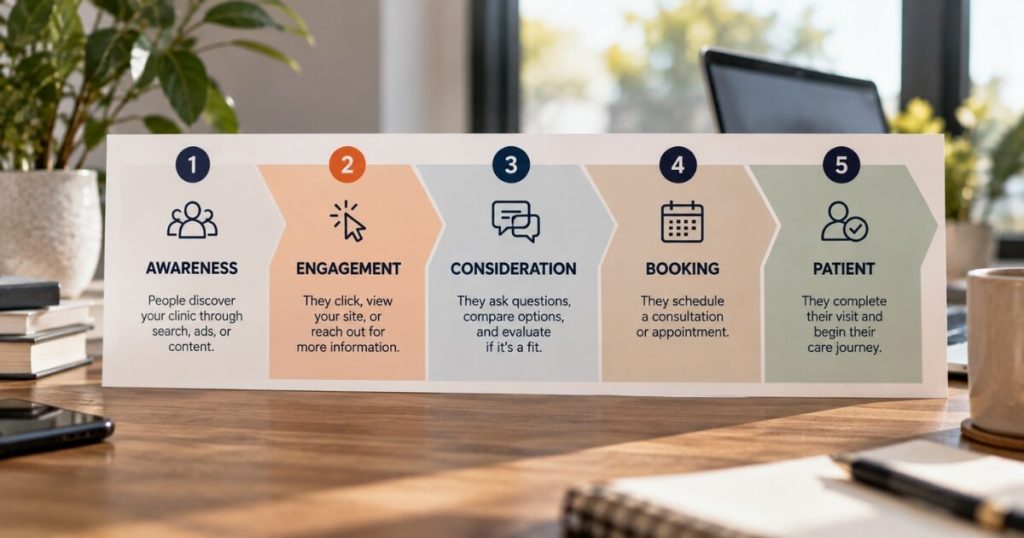
FAQ’s About Converting Website Traffic Into Cash-Pay Patients
How many new cash patients should a new website produce?
There’s no universal number.
However, this clinic booked 28 new cash patients in its first fully tracked month, on 70–100 clicks a day and 1,100 inbound calls — before fixing its conversion structure.
If your traffic looks like that and your cash schedule doesn’t, the website isn’t the problem.
What does a “dedicated cash-pay closer” actually do?
They own every cash inquiry end-to-end: answer or return the call, explain the offer, handle pricing questions, book the consult, and work the pipeline stages daily.
They do not cover the insurance front desk, and the insurance front desk does not field cash leads.
Is it worth pausing a marketing channel while you fix conversion?
Sometimes, yes.
This clinic paused one advertising line whose fulfillment backlog was clogging the calendar, freeing capacity for the recurring-revenue services.
More volume into a broken converter just makes the pile bigger.
Can a part-time employee run the cash line?
Yes, if the hours are protected and the training structure exists.
The coordinator in this story is part-time with three kids.
The fix wasn’t more hours alone — it was dedicated hours, product training, and separation from front-desk chaos.
What conversion rate should a cash-pay clinic aim for from leads to booked appointments?
Best-in-class is dramatic: one regenerative practice we work with books 79.4% of leads.
Most clinics don’t know their number, which is the first thing to fix.
You can’t improve a rate you don’t measure.
What’s the next step?
If your traffic and call volume are growing but the cash-pay schedule isn’t, you don’t have a marketing problem — you have a conversion-structure problem.
Hiring another provider will make it more expensive, not better.
Book a strategy call.
In 60 minutes we’ll map your lead flow from click to booked consult, find where the demand is dying, and design the dedicated-closer role for your team’s actual roster.