
Can a Virtual Assistant Read My Provider’s Chart Notes and Create the Patient Follow-Up Tasks?
We watched a clinic’s care coordinator do this by hand on a screen share: open the EMR, filter to the appointment date, check whether the patient had any future appointment, open the treatment plan note, and read it to find out what was due.
One patient had been seen on September 2. The note said blood draw in three weeks, follow-up in four.
It was October 7.
He was two weeks overdue on both, plus a medication pickup, and nobody knew.
Here’s the workflow we built instead.
Can a virtual assistant read my provider’s chart notes and create patient follow-up tasks?
Yes.
For most cash-pay practices, it’s the fastest fix available because the instruction set is three verbs: read the note, do what it says, create the task.
The workflow is deliberately simple.
After a visit, the provider completes the treatment plan note as they always do.
A trained assistant reads that completed note in the EMR and extracts what’s due and when.
Then the assistant creates a task in the CRM with the correct due date and assigns it to a named team member.
That’s it.
The assistant can also send the outreach text or email directly.
Escalate to a live phone call from an on-shore staff member only when the patient needs a real conversation.
They should sit in your internal team chat, not outside it.
An assistant who can ask, “this note says re-check in four weeks but there’s already an appointment on the 12th — should I still create the task?” is worth several times one who silently guesses.
There are two guardrails.
First, anything requiring clinical judgment stays with clinical staff.
This role transcribes a plan that a provider already made. It does not make one.
Second, decide deliberately, in writing, what the assistant may and may not communicate to patients directly.
Why can’t my EMR create the follow-up task automatically?
Because most EMRs can only trigger reminders off appointments that already exist.
The patients you’re losing are exactly the ones with no next appointment.
That’s the whole trap.
Your EMR is very good at reminding a patient about Thursday’s visit.
However, it is generally incapable of reading “blood draw in three weeks, follow-up in four” out of a free-text treatment plan and creating an obligation from it.
Multi-provider calendars make it worse.
Appointments booked under one provider often render oddly or not at all on another’s view.
The obvious wish is a structured field.
Imagine a checkbox on the visit form for “follow-up in 3 weeks / blood draw in 4 weeks” that fires an automation.
It’s the right long-term answer and worth asking your vendor for.
But it usually doesn’t exist today.
The workaround people reach for instead is a rule engine, which fails for a different reason.
Pull ten appointments from any given day and three go one way, three go another, three go a third, and one is a complete outlier.
That’s not a rules problem.
It’s a judgment problem at a very low level of difficulty — which is precisely the definition of work a trained human should do.
The best rule of thumb we have on this: give $40-an-hour work to $40-an-hour people and $20-an-hour work to $20-an-hour people.
Reading a note and creating a task is not $40-an-hour work.
But it is work.
And if nobody does it, your patients quietly age out of your practice.

What has to be true before this workflow will work?
Your provider notes have to be written the same way every time.
Standardized notes are the entire precondition.
If one provider writes “recheck labs in a month” and another writes a paragraph where the plan is embedded in the fourth sentence, no assistant — and no automation — can read it reliably.
The clinics where this works push hard on note consistency.
Use the same headings, the same place for the follow-up interval, and the same phrasing conventions.
That’s a clinical leadership project, not a marketing one.
It needs to happen before you hire.
The second precondition is a booking habit that reduces how often the workflow is needed at all: always book the next appointment from the current one.
A patient who leaves with a date on the calendar never enters the failure chain.
The chase workflow exists to catch the ones who don’t.
It doesn’t replace the discipline of booking at checkout.
How many patients can one patient care coordinator actually manage?
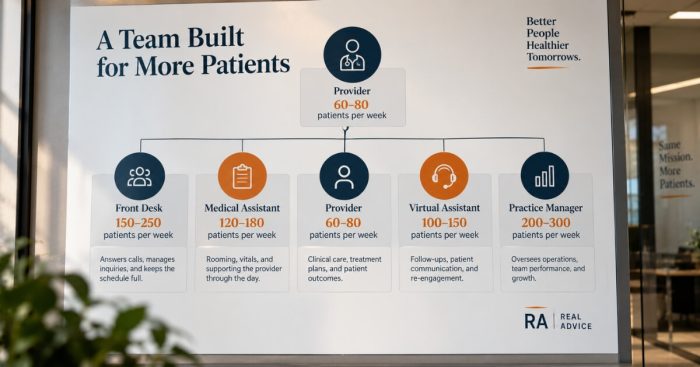
Around 150 as a real working ceiling, or up to about 250 when support roles absorb the administrative load.
That number comes from a clinic we know well.
An HRT practice we work with runs 250 active members at $1,000 a month plus roughly 300 additional à la carte patients, and its client service coordinator is maxed out at that 250.
That person owns account management and retention at roughly $80,000 a year.
The honest number for most practices is closer to 150.
They’ve stretched it because other roles exist around that person.
Here’s the full staffing picture at that scale, because owners consistently underestimate it.
There’s an office manager working five days a week.
A patient care coordinator handles scheduling, reception, and chart prep.
A client service coordinator owns account management and retention.
Then there’s a billing person and a phlebotomist or medical assistant.
If you’re running 400 patients and one person is doing scheduling, reception, chart prep, retention, and billing, you don’t have a follow-up problem.
You have a math problem, and no CRM will resolve it.
Practices building durable patient acquisition eventually discover that acquiring patients faster than you can service them just accelerates churn.
Should I hire another front desk person or bring on virtual assistants?
For administrative follow-up work specifically, offshore support gives you far more coverage per dollar.
Often, you can get around three full-time assistants for the cost of one additional in-office hire.
Full-time offshore support commonly runs in the range of $1,500 a month.
Specialized medical staffing agencies also place trained nurses who understand clinical vocabulary.
That’s a meaningfully different proposition from a general-purpose assistant. It matters for a role whose entire job is reading treatment plan notes.
There’s also a constraint nobody puts in the plan: desk space.
The clinic in this example physically could not seat another employee. Staff were already working in the IV room.
A remote hire has no such limit.
What should stay in the building: anything requiring a live medical conversation, compounding pharmacy calls, lab orders, and any moment where a patient needs to hear a local voice.
What can go remote: reading notes, creating tasks, sending routine outreach, chasing failed payments, reporting, and reconciliation.
One caution is worth stating plainly: don’t put your best communicator on this.
If the person patients love most gets moved into follow-up, patients will start asking for her by name.
She’ll be stuck there permanently, and you’ll have solved a task problem by creating a bottleneck.
In what order should I implement this?
Do the job yourself first, document it, film the training, then hire.
Never hire into an undefined role.
The sequence that works starts with having an existing in-house person perform the follow-up workflow manually for two to four weeks.
While they do it, write down every decision they make.
Then record screen-share training videos walking through the exact clicks: open the note, find the plan, create the task, set the date, assign the owner.
Only then should you hire.
Hand the new person the documentation and the videos on day one.
Write the role definition before the job posting.
It should cover four things: the role, its responsibilities, the requirements to do it, and the results it’s accountable for.
That document makes the difference between an assistant who processes twenty notes a day and one who asks you twenty questions a day.
The reason this order matters is simple.
A role you haven’t performed yourself cannot be described accurately.
A role described inaccurately produces a hire who fails through no fault of their own.
A pain management practice we work with grew monthly revenue by more than $40,000 while improving team retention — retention improves when people are hired into roles that were defined before they arrived.
FAQ’s About Using a Virtual Assistant for Patient Follow-Up
Can a virtual assistant create follow-up tasks from a doctor’s chart notes?
Yes.
A trained assistant reads the completed treatment plan note in the EMR and extracts what is due and when.
Then they create a task in the CRM with the correct due date and assign it to a named team member.
They can also send routine outreach directly.
The role transcribes a plan the provider already made. It never makes clinical decisions.
Why can’t my EMR automatically create a task from the treatment plan?
Most EMRs only trigger reminders from appointments that already exist.
The patients you lose are precisely the ones with no next appointment scheduled.
Free-text treatment plans also vary too much for a rules engine.
Pull ten appointments and you will find several different formats plus an outlier.
A structured follow-up field on the visit form is the right long-term ask for your vendor.
What has to be in place before a VA can run patient follow-up?
Standardized provider notes.
If follow-up intervals appear in different places and phrasings across providers, no assistant or automation can read them reliably.
Note consistency is a clinical leadership project that must be completed before the hire.
It should happen alongside the habit of booking the next appointment at checkout.
How many patients can one patient care coordinator handle?
Roughly 150 as a realistic working ceiling.
That can stretch to about 250 when other roles absorb scheduling, reception, chart prep, and billing.
A clinic running 250 active members plus several hundred additional patients typically needs an office manager and a patient care coordinator.
It also needs a client service coordinator focused on retention, a billing person, and a phlebotomist or medical assistant.
Should I hire in-office staff or virtual assistants for follow-up work?
For administrative follow-up specifically, offshore support typically delivers around three full-time assistants for the cost of one additional in-office hire.
It also has no desk-space requirement.
Keep live medical conversations, pharmacy calls, and lab orders in the building.
Move note reading, task creation, routine outreach, payment chasing, and reporting remote.
What’s the next step?
If a patient can finish a visit at your practice without booking the next one and nothing happens afterward, you already know the size of the leak.
You just haven’t counted it.
Pull twenty charts from six weeks ago and check how many have an overdue item nobody acted on.
On a 60-minute strategy call, we’ll map your follow-up chain from the end of the visit to the task nobody worked.
We’ll identify whether your constraint is note standardization, staffing math, or software.
Then we’ll lay out the document-then-hire sequence for your practice.