
How to Turn Your Clinic’s Best Patients Into Walking Billboards (The Top-Spender Audit and Premium Swag Playbook)
On a strategy call with a multi-location weight loss and hormone clinic we consult with, we skipped the usual ad-performance review and asked a different question.
Which five patients have spent the most money with us over the last six months — and been the least headache?
Because the answer to that question tells you who your real ideal patient is, where she came from, and how to get more of her.
Here’s the full exercise, plus the referral-engineering play we built on top of it.
How do I figure out who my clinic’s ideal patient actually is?
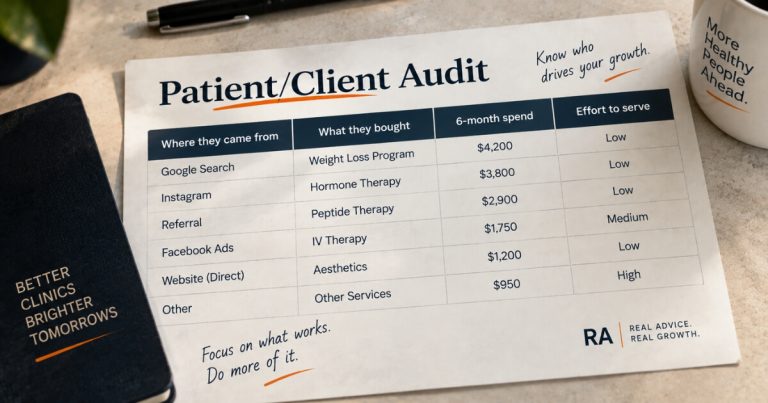
Run the top-spender audit: pull your top 5–10 patients by total spend over the last six months.
Then filter for the ones who were easiest to serve and profile them.
No names needed — just four facts per patient: where they came from, how they heard about you, what programs they’ve bought, and their total spend.
This clinic’s audit surfaced a sharply consistent picture.
They were women in their 40s and 50s, often moms with kids over 12. They were frustrated with conventional healthcare after years of “no answers” from their primary doctor.
The nurses’ words: “the most consistent, communicative… they’re just good patients.”
One had referred six or seven new patients herself.
Two of the biggest spenders were professionals who happily added every recommended support injection — “whatever you think is good for me.”
Marketing to everyone is expensive.
Marketing to her — the specific person your charts prove is your best patient — is how ad budgets get efficient.
That’s the difference between generic promotion and real GLP-1 & weight loss clinic marketing: the avatar comes from revenue data, not brainstorms.
Aren’t referrals just luck? How do you get more of them?
Referrals feel like a black box — “our best patients come from referrals.”
But they’re an engineering problem: give your happiest patients a reason and a way to start the conversation.
The insight came from this clinic’s own team:
“Every single one of my friends asks, how do I get on a GLP-1? Can I start today? People want it — they just don’t know how to get started. Anything that starts that conversation is invaluable. Someone sees it and they’re like, oh — are you on it?”
That’s the entire referral mechanism in one quote.
Your patient is already the proof.
The swag, the milestone shirt, the tumbler — those are conversation starters that let her tell your story without feeling like a salesperson.
The clinic that equips its patients to be visible gets the referral conversation started hundreds of times a month.
And it happens for the cost of good merchandise.
What makes clinic swag actually work instead of ending up in a drawer?
One rule: it has to be good enough that a patient with money would choose to use it.
The benchmark story we shared on the call was an orthodontics group in Pensacola that sold for around $100 million.
They gave every patient’s mom nice Nike swag — quarter-zips, hoodies, and polos.
Why the mom?
She makes the buying decision for braces.
Fifty dollars per family, and she wears it to the gym, the school run, and the grocery store.
Now everybody knows where her kid’s teeth got done.
The corollary: cheap swag is worse than none.
Bad pens get tossed.
Pens that write beautifully get stolen and asked about — “where’d you get this pen?”
A tumbler doesn’t need the name brand.
But it needs the size, style, and quality of the one patients already love.
Branding on junk tells the market you’re junk.
What swag fits a weight loss or hormone clinic specifically?
Match the merchandise to the patient’s actual daily rituals.
This clinic’s list wrote itself:
- An insulated premium tumbler — because GLP-1 patients already improvise with coolers and ice packs to store and travel with their syringes. The team literally advises patients to use an insulated cup at home. A branded, quality version solves a real problem the patient has every week.
- Milestone apparel — a “10 pounds down” club shirt or a 50-pound goal shirt. It celebrates the result, and as the team pointed out, it also feeds retention: “if you’re at 40 pounds down and you know one or two more months earns the shirt, you stick around.”
- A premium-patient tier — embroidered, nicer-fabric pieces reserved for top program members, so the best patients get visibly better treatment.
- A welcome box for every new program enrollment, so the biggest purchase of the patient journey comes with a moment worth talking about.
Note what this replaces.
This clinic spends $3,000–$4,000 a month on weight-loss ads.
Reallocating even a fraction of one month’s spend into gear your happiest patients carry daily is a bet on the channel that already produces your best patients.
The clinics that scale spectacularly do both.
NuLevel Wellness added $6,708,600 in one year by pairing multi-channel ads with an experience patients talked about — 3,727 new patients don’t come from ads alone.
How do I know if referral and swag investments are actually working?
The same way you judge any channel: track the source of every single patient, then calculate true cost per acquired patient.
On this same call, we pulled the 19 patients who booked from last month’s Google Ads.
Then we assigned the team to confirm who attended and spent.
That’s because cost per booked appointment is a vanity number until it becomes cost per revenue-producing patient.
Do the same for referrals and events.
This clinic worked one wedding-fair booth on a Sunday and left with two on-the-spot bookings and nine appointment requests.
They also handed out 1,500 business cards, which produced walk-in consult calls within days.
Every patient gets asked “how did you hear about us?” and the answer gets logged in a patient acquisition system that ties every booking back to its source.
When the audit shows referred patients out-spending and out-lasting every paid channel, the case for investing in your walking billboards makes itself.
And that’s exactly what this clinic’s top-spender exercise showed.
FAQ’s About Turning Patients Into Walking Billboards
What is a top-spender patient audit?
A simple exercise: list your top 5–10 patients by total spend over the last six months.
Then filter for the ones who were the least effort to serve.
For each, record where they came from, what they bought, and their total spend — no names needed.
The pattern that emerges is your true ideal patient profile, sourced from revenue instead of guesswork.
How do I get more referrals for my cash-pay clinic?
Equip your happiest patients to start conversations.
Most prospective patients — especially for GLP-1 and hormones — want in but don’t know how to get started.
Quality branded items a patient actually uses, such as a premium tumbler or milestone shirt, trigger the “oh, are you on it?” conversation.
That turns your patient’s results into your introduction.
Is clinic swag worth the money?
Only if it’s genuinely good.
The benchmark: an orthodontics group gave patients’ moms real Nike quarter-zips — $50 per family — because she makes the buying decision and wears it everywhere.
Cheap branded junk gets discarded and quietly damages the brand.
Premium items get used daily and advertise for years.
What swag works best for a GLP-1 weight loss clinic?
Items tied to the patient’s actual routine.
An insulated premium tumbler works because patients already improvise cold storage for syringes when traveling.
Milestone apparel, like a “10 pounds down” shirt, can double as a retention incentive.
A welcome box for new program members also ensures the biggest purchase comes with a shareable moment.
How do I measure word-of-mouth marketing?
Log “how did you hear about us?” for every new patient in the CRM.
Then review sources monthly next to spend and retention.
Compare true cost per revenue-producing patient across channels.
Referrals typically win on both lifetime value and headache factor, which is exactly what justifies investing in them deliberately.
What’s the next step?
If you can’t name your five best patients, where they came from, and what they’ve spent — or your marketing budget goes entirely to ads while your happiest patients walk around unbranded — book a strategy call.
In 60 minutes, we’ll run the top-spender audit with you.
We’ll define the ideal patient your revenue data actually points to and build the referral engine that multiplies her.