
What Should a Clinic Send When a Telehealth Lead No-Shows? (The 7-Day Reactivation Sequence, Copy-Paste Ready)
A booked telehealth consult that turns into a no-show isn’t a dead lead — it’s a warm lead with an awkwardness problem.
They already decided once.
We recently built the full reactivation system for a telehealth practice run by a double board-certified surgeon with 30+ years and 15,000+ procedures behind him.
The architecture works for any cash-pay vertical: a 7-day sprint built for people who will never reply, followed by a permanent low-pressure nurture.
Here’s the FAQ — with the actual messages.
What should a cash-pay clinic send when a telehealth lead no-shows their consultation?
A text message within 1–2 hours — not tomorrow, not a guilt trip, and not an email first.
Same-day contact roughly doubles rebook rates versus waiting until the next day.
SMS carries the sequence because unresponsive people still read texts even when they won’t answer calls or open email.
The first message does two jobs: normalize the miss and hand them the link.
Verbatim:
“Hi [First Name], it’s [Coordinator] from Dr. [Name]‘s office. We missed you for your video consultation today — no worries at all, things come up. Grabbing a new time takes about 30 seconds: [Booking Link].”
Never say “you didn’t show up.”
The lead already feels awkward.
Your job is to remove the awkwardness, not confirm it.
One force multiplier: if a call attempt happens right before the text, prepend “Just tried calling you —”.
A missed call followed by a text from the same number roughly doubles read-to-action rates.
That’s because the phone shows two touches from one sender.
Why should a no-show sequence be built for people who never reply?
Because the overwhelming majority of no-shows go completely silent — and a sequence designed for conversation dies on contact with ghosts.
Every message has to work without a response.
That means the booking link is always the action.
But twice in the 7 days, you deliberately flip the goal from “book” to “reply with one word.”
Day 1:
“Still want that 15-min call? A one-word reply is fine: ‘yes’ and I’ll help you find a time, or ‘not now’ and I’ll stop the reminders.”
Day 3 is the highest-response message in the entire sequence — a numbered multiple choice:
“Which is closest? 1 — Still want the call, life’s just been busy. 2 — Want it, but need evenings or weekends. 3 — Changed my mind. Just reply 1, 2, or 3.”
Ghosts who ignored four messages will send a single digit.
Any reply — even “3” — turns a dead lead back into a live conversation a coordinator can close by phone.
Note that the Day 3 text deliberately contains no booking link.
One message, one job.
This is the same discipline behind a regenerative practice whose inside-sales process converts 79.4% of leads into booked appointments: the system assumes silence and engineers the smallest possible next step.
What does the full 7-day no-show sequence look like, day by day?
Ten touches across five days of contact — front-loaded, then spaced.
Day 0 starts with SMS within 1–2 hours.
Then an email goes out 3–4 hours later to re-sell the value of the consult.
Day 1 sends the yes/no intent text.
Day 2 adds a live call attempt.
If the call goes to voicemail, leave a 10-second message:
“Nothing’s wrong, just making it easy to grab a new time — I’ll text you the link.”
Then immediately send that text.
Day 3 starts with the 1-2-3 multiple-choice SMS in the morning.
In the afternoon, send an objection-handling email answering the three questions everyone actually has: is this right for me, will I get a sales pitch, and how long will it take.
Day 5 sends a fresh-openings nudge with light social proof:
“Most people who miss their first appointment rebook within the week.”
It also includes an honest-urgency email:
“We’re keeping your file open for 48 hours.”
That message only runs if it’s operationally true.
Day 7 closes the loop explicitly:
“I’ll stop texting after today, promise — the link works anytime.”
Counterintuitively, the final text before silence gets outsized attention and converts.
A healthy rebook rate for this sequence is 15–30% within the 7 days.
Below that, the problem is usually speed on Day 0 or a booking link buried behind too many clicks.
How do I automate a no-show sequence without my team managing tags?
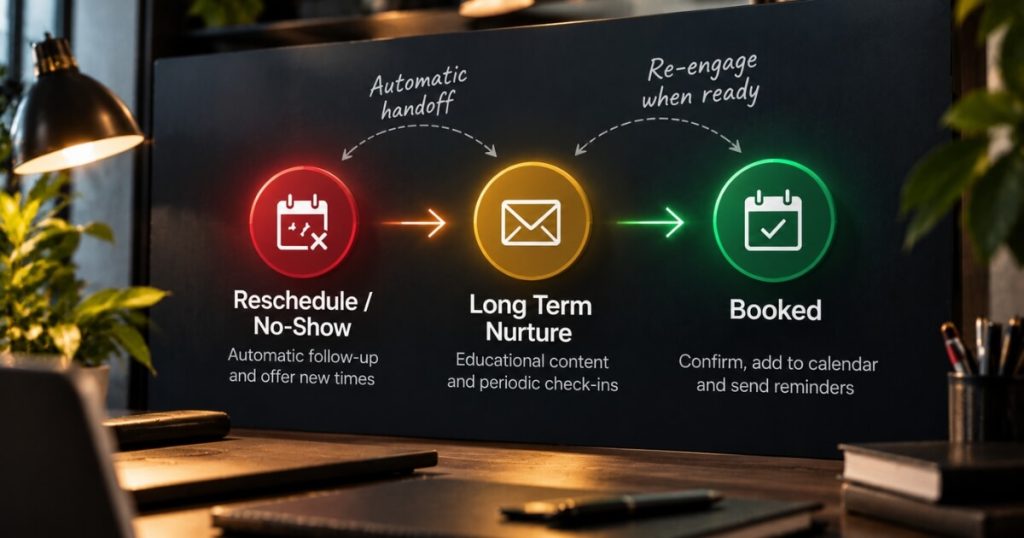
Make the pipeline stage the trigger.
No tags, no checklists — the sales team drags the card, and the right sequence fires.
Both workflows key off “opportunity stage updated.”
A calendar status change to No-Show or Cancelled moves the card to the Reschedule/No-Show stage automatically.
That starts Day 0 without anyone touching anything.
On Day 7 with no booking, the workflow’s final action moves the card to Long Term Nurture.
That stage change triggers the nurture workflow through the exact same mechanism a manual drag would.
Automation and humans use one control surface, so nothing desyncs.
The stops matter more than the sends.
There are four universal exits.
A new booking kills all pending messages in both workflows instantly. Nothing erodes trust faster than a reminder to book after someone booked.
Any stage change removes the contact from that workflow.
Any inbound reply pauses automation and creates a coordinator task. A human reply always outranks the next automated message.
Finally, STOP kills the channel immediately.
If you build nothing else correctly, build the stops.
This is the unglamorous plumbing of real patient acquisition — the system that catches revenue your ad spend already paid for.
What compliance rules apply to no-show texts from a medical practice?
Quiet hours, opt-out language, PHI minimalism, and carrier registration — all four, before the first send.
SMS goes out 9 AM–7 PM in the contact’s local time zone, Monday–Saturday.
TCPA quiet hours are the legal floor, and these windows are the courteous ceiling.
The first text in each sequence includes “Reply STOP to opt out,” and STOP is honored instantly everywhere.
Messages reference only that the person requested a consultation.
Never include conditions, assessment answers, or anything clinical because SMS and email are not secure channels. A text can appear on a lock screen at work.
Register the sending number for A2P 10DLC.
Also audit the booking URL itself.
If the link path names the treatment category, it undermines discretion and can trip carrier filters.
A neutral short-domain redirect fixes both and adds click tracking.
For sensitive verticals — men’s health, weight loss, aesthetics — this discretion standard isn’t optional.
It’s the difference between a text that gets read and one that gets a lead angry.
What happens to no-shows who never rebook after the 7 days?
They graduate to a permanent, low-frequency nurture — one email a week, one SMS every three weeks — and they keep converting for months.
These leads showed real intent once.
The practice still calmly present in month four wins the patient the pushy clinic lost in week two.
The email arc runs eight weeks — what actually happens on the call, three signs it’s time to talk to a specialist, a decision-focused patient story, myths, money, and FAQ.
Then it recycles with fresh angles.
Every email ends with the identical single CTA, so the action never has to be re-learned.
Benchmarks: a nurture list booking 1–3% of active contacts per month is solid, and SMS opt-outs should stay under 2% per send.
The same math powers bigger operations.
A weight-loss medspa we scaled added $6.7M in one year and 3,727 new patients, and volume like that only converts because the follow-up system behind the ads never lets a warm lead fall on the floor.
FAQ’s About Telehealth No-Show Reactivation Sequences
How fast should a clinic contact a telehealth no-show?
Within 1–2 hours of the missed appointment.
Same-day contact roughly doubles rebook rates compared to following up the next day.
The first touch should be an SMS that normalizes the miss and includes the booking link.
What rebook rate should a no-show sequence produce?
A healthy no-show reactivation sequence rebooks 15–30% of missed telehealth consults within 7 days.
Long-term nurture beyond that should book 1–3% of the active list per month, with SMS opt-outs under 2% per send.
Should no-show follow-up be SMS or email?
SMS carries the sequence — unresponsive leads still read texts even when they won’t answer calls or open email.
Email supports it with longer-form trust content: value re-sell, objection handling, and honest urgency.
A 7-day sprint uses roughly five texts, four emails, and one live call.
How do I stop automated messages when the lead books?
Make booking a universal exit.
A new appointment moves the pipeline card to a Booked stage, and both workflows remove any contact whose opportunity leaves their trigger stage.
Test this path before launch.
A booking reminder sent after someone booked destroys trust instantly.
Do no-show texts violate HIPAA?
Not if they’re written for a lock screen.
Reference only that the person requested or booked a consultation — never a condition, treatment category, or anything clinical.
Send inside 9 AM–7 PM local quiet hours, include STOP language, and register the number for A2P 10DLC.
What’s the next step?
If your clinic is spending money to book telehealth consults and losing a third of them to no-shows with nothing but a manual call behind them, book a strategy call.
In 60 minutes we’ll map your current pipeline stages, identify where booked revenue is leaking, and hand you the exact sequence architecture — triggers, stops, and scripts — for your vertical.
If it’s a fit, we build it with your team.