
How Small Process Changes Dramatically Increase Conversions at a Cash-Pay Clinic (The Booking-Rate Math Most Agencies Never Run)
When revenue stalls, most clinic owners reach for the marketing lever: more ad spend, a new campaign, a new agency. But the biggest revenue jumps we see rarely come from new leads. They come from small process changes to what happens after the phone rings — moving the inbound-call booking rate from 10% to 15% to 25%, on the way to booking 75% of qualified calls. Here’s the math, and the changes that move it.
Why doesn’t more ad spend fix a cash-pay clinic’s revenue problem?
Because if the clinic only books 10% of its inbound calls, most of the marketing budget is already being spent on patients who call and never book.
Think about what a 10% booking rate means.
For every hundred people who were interested enough to pick up the phone, ninety hung up without an appointment.
Pouring more budget into ads at that point doesn’t fix the leak — it feeds it.
The new leads enter the same broken process and exit the same way. Then the owner concludes the market is soft or the agency is bad.
Here’s the uncomfortable part: somebody who is only focused on making sure the ads are converting is never going to take the time to look at what you can do to increase the booking rate from an inbound call from 10% to 15% to 25%.
It’s outside their scope. It doesn’t show up in their dashboard, and fixing it doesn’t earn them more management fee.
That’s exactly why the biggest conversion wins at most clinics are sitting untouched in the call log, not the ad account.
What is the booking-rate math that makes small process changes so valuable?
Going from booking 10% of inbound calls toward 75% of qualified calls multiplies revenue on the exact same leads and the exact same ad spend.
Run the numbers on your own practice.
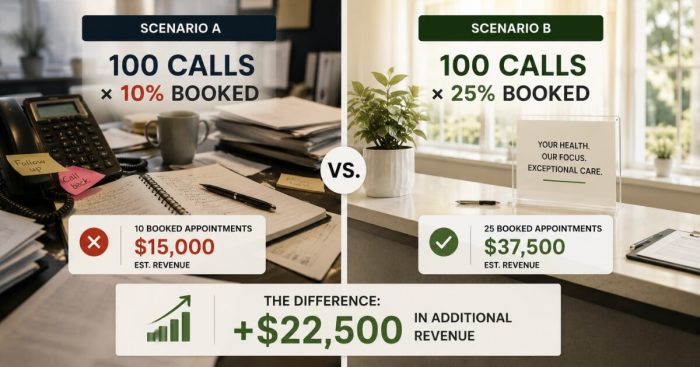
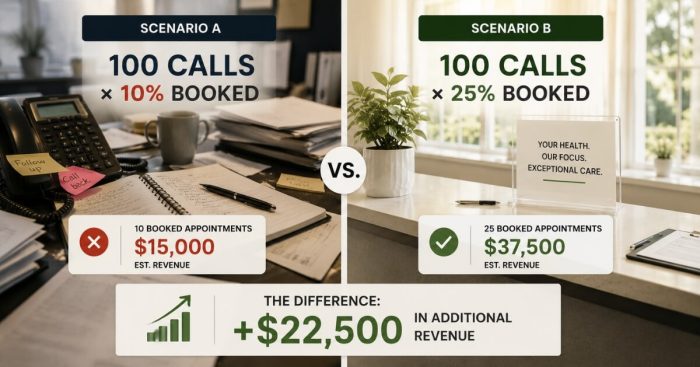
If 100 qualified, ready-to-book leads call in a month and 10 book, a process improvement that gets you to 25 bookings has produced 2.5× the new patients — with zero additional marketing dollars.
Get the process genuinely right and the ceiling is far higher.
If we can book 75% of the qualified inbound calls that come in, we’ve transformed the practice’s economics without touching the ad account.
Every improvement step is effectively free revenue.
And this isn’t a theoretical ceiling.
Orthobiologics Associates converted 79.4% of its leads into booked appointments with a disciplined inside-sales process.
That’s proof that a mid-70s-or-better booking rate on qualified inquiries is an achievable operating standard, not a fantasy benchmark.
The gap between your current rate and that standard is the cheapest growth available to your practice.
What small process changes actually lift an inbound-call booking rate?
Answer every call, run one written script, ask for the booking with payment on the call, and track the rate weekly.
Small changes — compounding results.
None of these are dramatic, which is exactly the point.
First, answer rate: a call that rings out at lunch is a booking rate of zero. So coverage and a same-hour callback rule come before anything clever.
Second, use a written script.
A front desk that greets, asks permission to ask questions, uncovers the caller’s two or three pain points, and frames value before price converts wildly better than one that answers whatever the caller asks and says, “call back when you’re ready.”
Third, close on the call.
Ask for the booking and take payment while the caller is still in the conversation — a patient with money committed shows up.
Fourth, measure it.
Define what counts as a qualified call, count them, and review the booking rate every week.
Each change is boring alone.
Together they’re a predictable patient acquisition system — and they’re why two clinics with identical ads and identical call volume can produce revenue numbers that differ by multiples.
Why doesn’t my marketing agency catch these conversion leaks?
Because most agencies are scoped, paid, and measured on ad performance — the leak lives in a part of the funnel nobody is accountable for.
An ad-focused agency’s job ends when the lead arrives.
Cost per lead looks great, the dashboard is green, and the monthly report ships.
Whether the front desk answered the call, what was said, and whether anyone asked for the booking — that’s “operations,” and operations is nobody’s line item.
The result is a structural blind spot.
The clinic is optimizing the cheapest 10% improvements in the ad account while a 150% improvement sits in the call process.
This is one of the most useful filters for evaluating outside help.
When you interview medical practice marketing consultants, ask one question: “What’s my inbound-call booking rate, and what would you do to raise it?”
A vendor will steer the conversation back to campaigns.
A real growth partner will ask to hear your calls before they touch your ads — because they know the fastest revenue in the building isn’t in the ad account.
How do I measure my clinic’s booking rate starting this week?
Count qualified inbound calls, count booked appointments from those calls, divide. Review it weekly next to your marketing numbers.
Keep the definition honest and simple.
A qualified call is a prospective patient inquiring about a service you offer, reachable in your service area — someone ready to book if the call goes well.
Wrong numbers and solicitors don’t count.
Price shoppers absolutely do. A price shopper who doesn’t book is a process failure, not a bad lead.
Track three numbers on a whiteboard or in your CRM: qualified calls this week, bookings from those calls, and the rate.
Then watch what the number does to your team.
The first week is usually sobering. But a measured booking rate turns “the front desk is doing fine” into a weekly score everyone can see — and scores move.
Pair the metric with call recordings.
Pull one call per week to review as a team, then attach the process fixes from above one at a time.
Clinics that run this loop typically don’t need a new marketing plan for a while.
The leads they already had were enough; they just stopped losing them.
FAQ’s About Increasing Inbound-Call Booking Rates at a Cash-Pay Clinic
What is a good booking rate for inbound calls at a cash-pay medical practice?
Booking 75% of qualified inbound calls is the operating standard to aim for.
Many clinics discover they’re booking 10–15% when they first measure. That means the fastest growth available is process improvement, not more leads.
Orthobiologics Associates sustained 79.4% lead-to-booking conversion with a structured process.
Why is raising the booking rate better than buying more leads?
Because it multiplies the yield on leads you’ve already paid for.
Moving from 10% to 25% booked produces 2.5× the new patients from the same call volume and the same ad spend.
The improvement also applies to every future lead.
What counts as a qualified inbound call?
A prospective patient in your service area inquiring about a service you actually offer — someone who would book if the call went well.
Wrong numbers and solicitors are excluded.
Price shoppers are included because losing them is a process failure.
What’s the first process change to make if my booking rate is low?
Answer rate first — every unanswered call is an automatic zero.
Then install one written phone script covering greeting, discovery questions, value-before-price framing, and asking for the booking with payment on the call.
Shouldn’t my marketing agency be handling this?
Most won’t — agencies scoped to ad performance stop at the lead.
Ask any prospective partner what your inbound-call booking rate is and what they’d do to raise it.
The answer tells you whether you’re hiring a vendor or a growth partner.
What’s the next step?
If you don’t know your inbound-call booking rate right now, that’s the finding — you may be one process change away from your best quarter without spending another dollar on ads.
Book a strategy call. In 60 minutes we’ll calculate your actual booking rate, listen to how calls are being handled, and map which process changes will move it first.