
Should the Provider Be Doing Sales Calls at a Cash-Pay Clinic? (The Opportunity-Cost Math Nobody Runs)
Most of the cash-pay docs we work with have the same problem. They see the patients. They build the treatment plans. And they sell the high-ticket packages. That’s why the business makes money — and it’s exactly why it can’t scale and the owner can’t step back. Here’s the math most provider-owners never run: what an hour of your time is worth in the treatment room versus on a sales call, and what your money model must look like before someone else can do the selling.
Should I, the provider, be doing my clinic’s sales calls?
Not permanently — because you are the most expensive salesperson your clinic could possibly put on the phone, even though you cost the payroll nothing.
In the early days, yes — nobody knows the treatment plans better, and there’s no one else to do it.
The trap is that it works.
The clinic makes money precisely because the provider sees the patients, builds the plans, and closes the packages. As a result, the arrangement never gets questioned.
However, the same fact that makes it work caps the business. Every hour you spend selling is an hour of clinical capacity the clinic can never bill.
Whether you should keep doing sales calls is a math question, not an identity question.
For almost every cash-pay clinic past its first year, the numbers below point to the same conclusion: the provider selling is a subsidy the clinic can’t see, paid out of the most valuable hours in the building.
What is an hour of provider time worth in the treatment room vs on sales calls?
In the treatment room, a provider hour at a cash-pay clinic is commonly worth $1,000–$1,500 in billable care.
On a sales call, it’s the most expensive sales hour in your market because a trained salesperson could have made that call instead.
Make it concrete with regenerative medicine, where pricing is clean.
Clinics we work with typically price PRP around $750 per joint, so a provider running two joint injections an hour produces roughly $1,500 an hour in the treatment room.
Now count the selling hours.
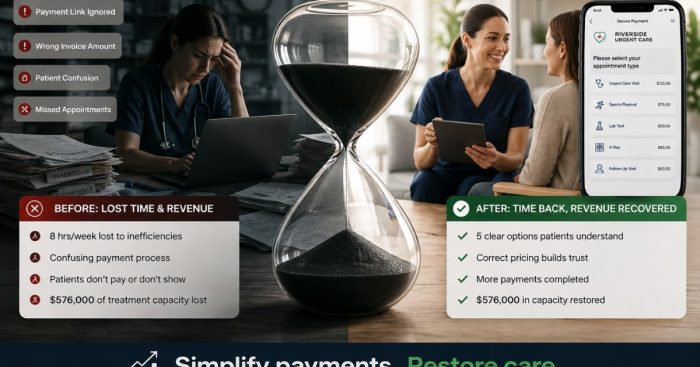
Between consult follow-ups, phone quotes, and “just checking in” calls, a provider-owner easily burns 8 hours a week on sales work — about 384 hours across 48 working weeks.
At $1,500 an hour of clinical capacity, that’s roughly $576,000 a year in forgone treatment capacity spent doing a job whose full-time salary is a small fraction of that number.
That’s the part nobody runs.
The provider on the phones looks free because no salary line appears.
However, the real comparison isn’t “provider sells for $0” versus “salesperson costs a salary.” It’s a salesperson’s salary versus half a million dollars of treatment-room capacity.
Keeping the provider on the phones is the most expensive staffing decision in the clinic. It just hides in hours instead of payroll.
Why doesn’t “getting more leads” fix the provider-as-salesperson problem?
Because more leads make it worse: every new lead is another demand on the exact same provider calendar that’s already the bottleneck.
This is the fix most owners reach for first, and it’s the wrong one.
If the provider is the sales team, lead volume isn’t your constraint — provider hours are.
Double the leads and either the provider spends even more hours selling, leaving fewer hours for treatment, or leads sit unworked and die.
Either way, revenue doesn’t double.
We see it constantly in clinics that bought “more marketing”: spend up, calendar jammed, collections flat.
A predictable patient acquisition system only compounds when the clinic can absorb the volume without routing every conversation through the provider — which is why we treat patient acquisition and sales capacity as one system, not two separate projects.
Fill the funnel before you fix the bottleneck, and you’ve paid to make the bottleneck more painful.
What money model lets a cash-pay clinic separate selling from treating?
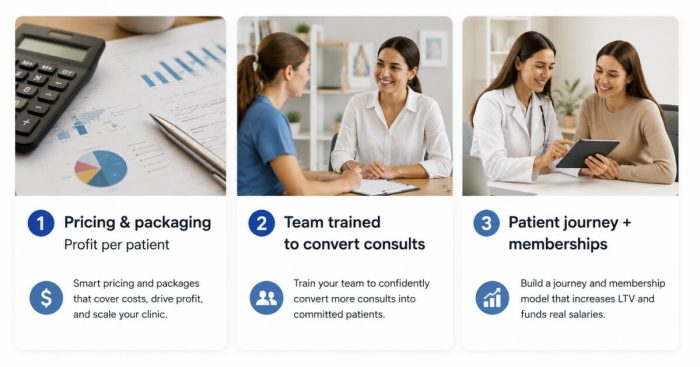
A three-part model: pricing and packaging that make each patient more profitable, a team trained to convert consults without the provider, and a patient journey plus memberships so lifetime value supports real salaries for real leaders.
Part one is pricing and packaging.
If margin per patient is thin, you can’t afford anyone to sell. The provider stays on the phones by financial necessity.
Profit per patient has to carry the cost of the people who acquire and convert that patient.
Most clinics we audit are underpriced and under-packaged: single sessions instead of programs, à la carte instead of outcomes.
Part two is conversion without the provider.
Patients don’t need the doctor to sell them. They need the doctor’s diagnosis and plan communicated with conviction.
That’s trainable.
The provider in that building spends those hours treating, not dialing.
Part three is LTV.
One-off transactions can’t fund a real org chart.
A designed patient journey — follow-on care, memberships, recurring programs — raises lifetime value until real leaders are a line item the model supports, not a leap of faith.
That’s the whole job: make the clinic profitable enough per patient that you can hire people as good as you (just less risk-tolerant than you), get out of the treatment room, and spend your time growing the business instead of plugging leaks.
How do I know if my clinic can afford to take the provider off sales calls?
Run one test: does the profit from the patients a dedicated seller would close each month exceed the cost of that seat?
If yes, you’re losing money every month you keep selling yourself.
If no, your money model — not your hiring budget — is what’s broken.
Work it from your own numbers: monthly consult volume, close rate, and average package value.
A full-time salesperson handles far more conversations than a provider squeezing calls between patients.
Keep their close rate conservative, even below yours. In most clinics, the additional volume carries the math.
Then add back the reclaimed treatment capacity — roughly 384 hours returning at treatment-room rates.
At that point, the comparison stops being close.
When the test fails — when margin per patient genuinely can’t support the seat — the answer isn’t “keep grinding the phones.”
Instead, fix pricing and packaging first.
A clinic that can’t afford a salesperson is underpriced, under-packaged, or both. No amount of provider hustle fixes broken unit economics.
What’s the first step out of being the provider AND the sales team?
Run the math and fix the money model before you change anything about who’s on the phones.
Step one is the opportunity-cost calculation above, using your real numbers: treatment-room hourly value, actual weekly selling hours, and margin per patient.
Most owners have never seen their own number.
Step two is pricing and packaging.
Restructure offers so each patient is profitable enough to fund the people who will eventually sell and manage without you.
Step three is capturing how you sell — what you say in a consult, how you present the plan, and how you handle “I need to think about it” — so conviction becomes an asset of the business, not a talent trapped in the owner.
Only then does moving the selling off your plate make sense.
Proof the sequence ends somewhere good:
That wasn’t a hiring stunt — it was a money model that could afford it.
If you’re weighing whether to build this yourself or bring in outside help, that’s exactly the build-vs-buy question our medical practice marketing work exists to answer.
FAQ’s About Providers Doing Sales Calls at a Cash-Pay Clinic
Is it a problem that I’m the best closer in my clinic?
It’s a compliment and a liability at the same time.
Being the best closer is expected because nobody has your conviction or your clinical authority.
The problem is structural.
If the best closer is also the only person who can deliver treatment, every sale costs the clinic treatment capacity, and the business can never produce revenue that doesn’t consume your hours.
The goal isn’t to become a worse closer.
Instead, make your close process trainable so it stops being trapped in your calendar.
What does an hour of provider selling actually cost the clinic?
Roughly the clinic’s treatment-room rate for that hour — commonly $1,000–$1,500 at cash-pay clinics.
Using a regenerative example, at around $750 per PRP joint, a provider doing two injections an hour produces about $1,500 an hour clinically.
Eight hours a week of provider selling is therefore in the neighborhood of $576,000 a year in forgone treatment capacity.
That’s why the “free” provider-salesperson is the most expensive seat in the building.
Won’t patients only buy from the doctor?
Patients buy the doctor’s plan, not the doctor’s phone manner.
In clinics that separate the roles, the provider still diagnoses and designs the treatment plan.
A trained team member then walks the patient through options, pricing, and scheduling.
One regenerative clinic we work with converts 79.4% of leads into booked appointments through exactly this handoff.
What patients actually require is clarity and confidence, and both are trainable.
Should I fix pricing before hiring someone to sell?
Yes — pricing and packaging come first, always.
If margin per patient can’t carry the cost of the person acquiring and converting that patient, a sales hire just adds payroll to a broken model.
Fix profit per patient, build recurring value into the patient journey so LTV supports real salaries, and then the hire funds itself.
Clinics that hire before the model supports it end up resenting the salary.
By contrast, clinics that fix the model first wonder why they waited.
How long does it take to get the provider off sales calls?
For most cash-pay clinics, one to two quarters once the money model supports it.
First, fix pricing and packaging.
Next, document how you sell.
Then transition conversations gradually rather than overnight.
The math step takes an afternoon.
Restructuring offers and transferring the sales conversations you’ve been improvising for years into a process someone else can run with conviction is what takes time.
What’s the next step?
If you’re the main provider and the entire sales team at your clinic, book a strategy call.
We’ll review your application and audit your clinic and current sales process before the call.
Then we’ll show up with your opportunity-cost number, the gaps in your pricing and packaging, and a few actionable items you can implement right away.