
Should I Include Lab Work in My Hormone Membership (and How Do I Price It)?
Hormone clinic owners agonize over whether to bundle lab work into the membership or charge for it separately — worried that including labs will crush their margin. The counterintuitive answer, from a hormone practice we’ve worked with for years, is that you should usually include it, precisely because most patients won’t use it. Here’s the FAQ on how to structure and price a hormone membership that patients happily pay for and that protects your margin.
Should I include quarterly lab work in my hormone membership?
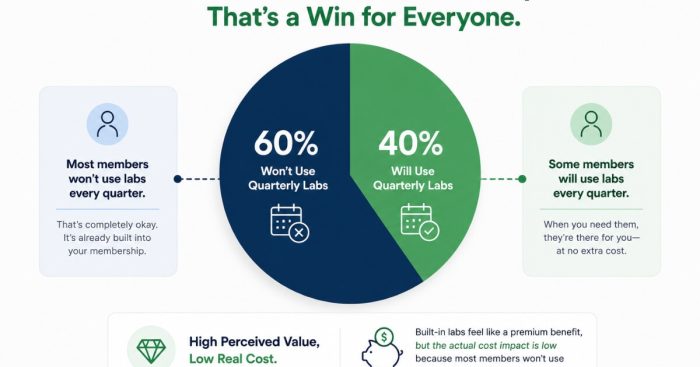
Yes, in most cases — because the perceived value is high while the real cost is low, since most members never actually use their quarterly labs.
This sounds backwards until you look at the utilization. At one hormone clinic we advise, only about 40% of members actually get their included labs done on schedule; the other 60% don’t.
As the owner put it, “saying that we have quarterly labs included is totally fine because we all know that the likelihood of somebody actually doing it quarterly is very low.” So promising quarterly labs costs you far less than it appears — you’re paying for the 40% who use it, while every member perceives the full value of “labs included.”
The bigger reason to include rather than itemize is emotional. Splitting a membership into “this is included” and “you have to pay extra for this” feels bad to patients and invites friction at every touchpoint.
Folding labs in — even if you nudge the base price up by $25 to $30 a month to cover it — creates a cleaner, higher-value offer. For a men’s hormone clinic marketing model, that simplicity is worth more than the itemized dollars.
Why does including meds and labs make a hormone membership actually sell?
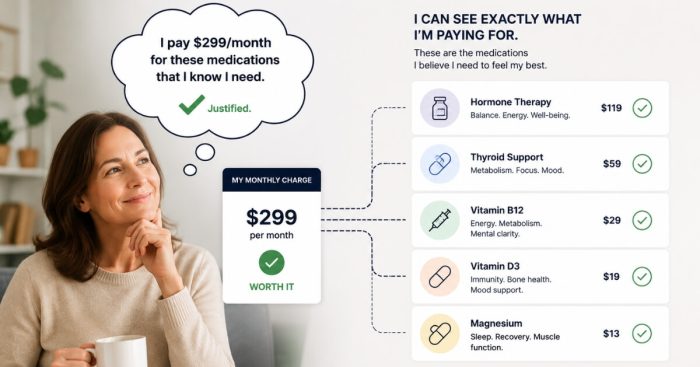
Because the perceived value of the program gets attached to something the patient believes they genuinely need — their medications — which justifies the monthly charge in their mind.
This is the core of why the model works. When the front-end lab work establishes that a patient truly needs hormone therapy, and their membership then delivers those medications, the patient mentally associates the charge on their card with a real need.
As the owner explains it, “when they pay for their membership, they receive the medications, and in their mind they associate the transaction with the need for medications, and it’s justified.” The membership stops feeling like a subscription and starts feeling like getting the treatment they need.
Labs reinforce that logic. Included follow-up labs signal ongoing medical oversight — you’re not just shipping product, you’re managing their health.
Stack meds, quarterly labs, follow-up visits, and a discount on everything else, and the membership becomes an obvious yes. This is the backbone of durable recurring revenue in functional medicine & longevity clinic marketing and hormone practices alike.
How should I price a hormone membership so patients say yes?
Anchor on a single monthly price with meds included, add a meaningful member discount on everything else, and offer a lower concierge tier for people who don’t need medications.
At the clinic we advise, the base hormone membership runs about $375 a month with medications included, plus a flat 10% member discount on every other product and service, and free shipping for members.
There’s also a roughly $250-a-month concierge tier for patients who want the care, labs, and team access but not the medications. On the front end, initial labs are around $550 and the initial consultation is about $350 — with that consult fee credited toward the first month if the patient enrolls, which lowers the barrier to starting.
The discount does quiet work. A member spending, say, $400 a month on an additional therapy saves $40 just by being a member — a concrete, recurring reason to stay enrolled.
It barely dents margin but “sounds good, feels good,” and gives your team a simple, trainable rule. Note that these are one clinic’s numbers in its market; your prices should reflect your costs, but the structure — meds included, labs included, discount on everything, consult credited to first month — travels well.
How do I raise prices at my hormone clinic without losing patients?
Raise the base modestly, tie the increase to a clear enrollment trigger, and accept that a slightly higher price screens out the chronic complainers.
The owner’s rule of thumb is blunt but accurate: “the more you charge somebody, the less they bother you.” Moving a base membership up by $50 a month — say from $375 to $425 — tends to price out the handful of patients who complain the most while barely affecting the ones who understand the value.
When a value-aware buyer hears the lab pricing, the reaction is “that’s a great deal for blood work,” not resistance.
Make the increase data-driven rather than arbitrary. A useful trigger is enrollment: once you’re netting a target number of new members over a set window, that’s proof the offer is strong enough to support a higher price.
Raising prices from a position of demand is very different from raising them out of desperation — and patients feel the difference.
Should peptide and HGH programs be their own membership or an add-on?
Make them member-gated add-ons priced à la carte, not separate memberships — patients balk at paying for a second “program” when they’re already under your care.
At the clinic we advise, the move was to drop standalone HGH/peptide memberships and instead sell those therapies per vial at retail, minus the standard 10% member discount, available only to patients who already hold a base membership.
The reasoning is honest: a hormone patient who’s already monitored doesn’t need a whole separate care package, they just need the medication. As the owner put it, “the only way to gain access to any of our HGH programs is by being a member” — which protects recurring revenue without making patients feel double-charged.
This keeps your offer clean: one base membership that carries the relationship, meds, labs, and oversight, with additional therapies layered on as discounted add-ons.
It also concentrates the monthly commitment that drives adherence and retention into a single plan rather than fragmenting it across competing programs.
How do I get hormone patients to actually complete their follow-up labs?
Accept that most won’t do them on a strict schedule, automate gentle reminders at the key intervals, and let motivated patients request extra draws.
The honest truth from the field: “getting people to actually get their labs done is freaking impossible” — some patients take a year to complete a six-month panel.
Fighting that with quarterly nagging wastes staff time and annoys patients. A better approach is to reach out proactively at the intervals that matter clinically — often around the 3-month and 9-month marks — and make additional labs available on request in between, rather than chasing everyone every quarter.
Automate it: a text or call at the key milestones and an email for the rest, so your team isn’t manually tracking every patient’s lab timing.
This is also why including labs works financially — you’ve promised the value, patients feel cared for, and the low real utilization keeps your cost down. This is the same clinic, Eternity Health Partners, that we grew from $1M to $4M a year with roughly 250 active members — the membership economics are exactly this disciplined.
FAQ’s About Including Labs in a Hormone Membership
Should I include lab work in my hormone membership?
Usually yes. The perceived value of “labs included” is high, but the real cost is low because most members — around 60% at one clinic we advise — never complete their quarterly labs.
Including labs (and nudging the base price up slightly to cover it) makes a cleaner, higher-value offer than itemizing labs as an extra charge.
Why do meds-included memberships convert so well?
Because the monthly charge gets mentally attached to something the patient believes they truly need — their medications.
When lab work establishes the need and the membership delivers the meds, the patient justifies the recurring charge as getting necessary treatment, not paying a subscription. Adding labs, follow-ups, and a discount on everything else makes it an obvious yes.
How do I raise hormone membership prices without losing patients?
Raise the base modestly and tie it to an enrollment trigger, like netting a target number of new members.
A slightly higher price tends to screen out chronic complainers while barely affecting value-aware patients — “the more you charge, the less they bother you.” Raising prices from demand feels very different to patients than raising them from desperation.
Should peptides and HGH be a separate membership?
No — make them member-gated add-ons sold à la carte with the standard member discount, available only to patients who hold a base membership.
Patients resist paying for a second “program” when they’re already under your care; they just want the medication. This protects recurring revenue while keeping the offer clean.
What’s the next step?
If you’re unsure whether to bundle labs into your hormone membership, how to price the plan, or how to raise prices without losing patients, that’s exactly the kind of structure we build with clinics every day.
Book a strategy call. In 60 minutes we’ll map a membership offer for your market — what to include, how to price it, and how to present it — so more patients enroll and stay, and your margin is protected.
If it’s a fit, we’ll build the offer and the pricing with your team.