
Should Your Cash-Pay Clinic Sell Peptides as a Second Membership? (Why We Killed a $475/Month Add-On)
A hormone clinic we consult for had a problem most cash-pay practices would love to have: existing members wanted more programs.
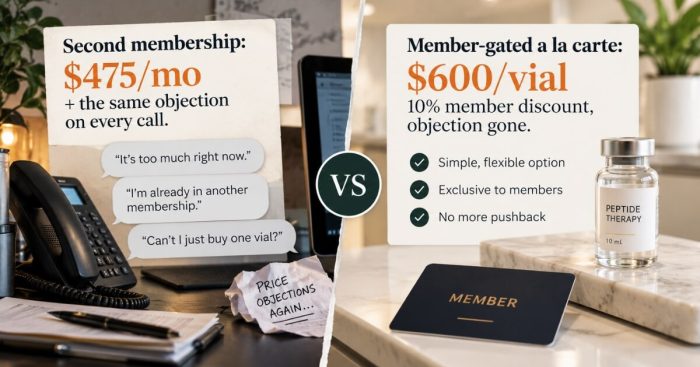
But every time the patient coordinator quoted the HGH secretagogue add-on — priced as its own $475-a-month membership — the same objection came back: “Why am I buying a whole other care package when I’m already a member?”
On a June consulting call, we killed the second membership entirely and rebuilt the offer as membership-gated a la carte pricing.
Here’s the FAQ on why that works, with the real numbers.
Should a cash-pay clinic sell peptides or HGH programs as a separate membership to existing members?
No. Never stack a second membership on top of a patient who is already paying you monthly.
The clinic in question runs 223 active patients and enrolls about 7 new members a month.
Its base hormone membership costs $375 per month, with medication included.
When patients asked about HGH secretagogue programs — ipamorelin and tesamorelin — the clinic sold them as separate add-on memberships.
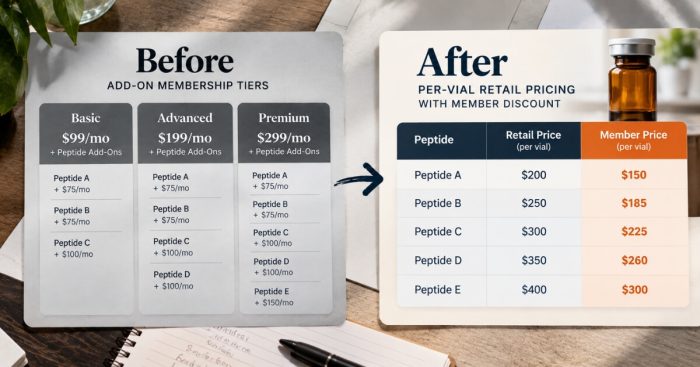
The older tiers added $445 or even $825 a month on top of the base membership.
As a result, a patient already paying $375 a month could receive a quote exceeding $1,200 in stacked monthly subscriptions.
The result was a sales objection that surfaced repeatedly.
The patient coordinator counted it coming up “definitely more than three times” in recent consultations.
For a 223-patient clinic, that’s a pattern, not an anecdote.
Patients weren’t saying the therapy wasn’t worth it.
They were saying the structure didn’t make sense.
They already had a care membership, so why were they being asked to buy another one?
Why do existing members push back on add-on program memberships?
Because a second membership asks them to re-buy things they already pay for — provider oversight, monitoring, and access — just to get a new medication.
From the patient’s chair, the base membership already covers “being taken care of.”
Labs, provider visits, monitoring, and messaging are what the $375 a month buys.
When the peptide program appears wrapped in its own membership, the patient hears something different.
They’re being asked to pay a second time for the wrapper, plus the medication.
The coordinator on our call framed the member’s question perfectly:
“Why do I need another program when I’m already being monitored under the male hormone therapy?”
And that question contained the answer that ended a month of pricing debate.
They don’t need another program.
They’re already on a membership with the clinic.
They just need their meds.
The moment you see it that way, the fix becomes obvious.
Stop selling the wrapper twice.
Instead, sell the medication a la carte and let the existing membership grant access to it.
We first tried the conventional fix: consolidating the add-ons into one cleaner $500-a-month program.
But members did the math instantly.
“That’s double what I’m paying right now.”
A consolidated second membership is still a second membership.
The objection is structural, and no amount of repackaging talks a patient out of structure.
What should you charge for peptide and HGH programs instead of a membership fee?
A la carte, at transparent retail unit pricing.
This clinic priced the vial at roughly $600 for a two-month supply.
That’s an effective $300 a month, billed every eight weeks.
The new pricing lands below the old $475-a-month add-on while feeling dramatically fairer.
That’s because it matches how the market already prices these therapies.
Most patients comparison-shop peptides against unit-based pricing.
They compare prices per vial, per prefilled syringe, or per month of supply.
Those comparisons come from telehealth sellers and, increasingly, from guys with booths at the local gym.
When your quote is a clean retail number instead of a subscription, you remove unnecessary friction.
Patients no longer have to translate “another monthly program” into “what am I actually getting?”
This is the same discipline we push across our peptide therapy clinic marketing work.
In a market flooded with cheap, unit-priced products, a cash-pay clinic doesn’t win by hiding its pricing inside memberships.
It wins by being the transparent, medically supervised option at a defensible retail price.
Won’t a la carte pricing destroy my recurring revenue?
No — as long as the recurring revenue lives in the base membership, not in the add-on.
This was the owner’s exact fear on the call, and it’s a legitimate one.
“That’s why our business is successful — it’s monthly membership. People stay committed if they know they’re paying for it monthly. Otherwise they just fall off, and we just lost that monthly.”
Recurring revenue is the reason membership-model clinics scale while one-off clinics stall.
But notice where the recurrence actually needs to sit.
The membership is the subscription.
The peptide is a product.
When you force the product to also be a subscription, you don’t necessarily get more recurring revenue.
Instead, you get objections, discounts, and cancellations of the thing you actually care about.
The clinic keeps its $375-a-month base membership.
About $100 of that goes toward medication costs, so the margin holds.
Meanwhile, the vial bills at $600 every eight weeks, just like any refill.
And the monthly relationship — the thing that compounds — stays intact.
We’ve watched this play out at scale.
An HRT clinic we grew from $1M a year to $4M a year built its entire engine on base memberships, not stacked add-on subscriptions.
How does membership-gating work for a la carte programs?
One rule: the only way to gain access to any of the clinic’s HGH programs is by being a member.
That single sentence does the work the second membership was failing to do.
Existing hormone members get a la carte access as a privilege of the membership they already pay for.
Meanwhile, a new patient who only wants peptides doesn’t get to cherry-pick.
They join the base tier first.
At this clinic, that’s a $250-a-month concierge membership for non-hormone patients.
It includes primary-care access, labs, and provider visits.
Alternatively, patients who need hormone therapy can join the $375 hormone membership.
So the funnel becomes simple: no membership, no access.
Membership first, then retail pricing on everything else.
The peptide program stops being a revenue stream you defend.
Instead, it becomes a reason patients join and stay.
That’s a patient acquisition asset.
The program does the recruiting, and the membership does the earning.
What perks make the base membership worth defending when programs go a la carte?
Stack visible, concrete perks: a flat 10% member discount on all products and services, free medication shipping, and the concierge care you’re already delivering anyway.
The 10% discount is the workhorse.
It applies to everything — peptides, diagnostics, supplements, and regenerative services.
That means every future purchase helps re-justify the membership.
For example, a member spending $400 a month on an additional therapy saves $40 a month just by staying a member.
It’s one rule and one billing code.
Your staff also never has to remember tier-specific discount tables.
Free shipping is the sleeper perk.
Members receive free medication shipping, while non-members pay shipping.
It costs almost nothing and creates one more noticeable difference between being in and being out.
And most clinics already deliver concierge-level service without highlighting it.
That includes same-week visits, direct messaging, and as-needed provider access.
Yet they often never mention those benefits on the membership card.
Write them down.
The final perk stack at this clinic reads:
- All medication ships free.
- Quarterly follow-up labs.
- As-needed provider visits.
- A 10% member discount on all additional services, peptides, and regenerative medicine.
That stack also unlocks family expansion.
Spouses and college-age kids can join at the $250 concierge tier.
That’s how strong men’s hormone clinic marketing turns one patient into a household.
When should a program stay its own membership?
When the product is genuinely premium, scarce, and price-insensitive — like pharmaceutical HGH.
The same clinic sells true pharmaceutical HGH as its own standalone membership at $1,100 a month.
And in the coordinator’s words, “no one bats an eye at $1,100.”
Nobody objects because nobody is comparison-shopping it against a gym-bag vial.
The buyer for pharmaceutical growth hormone is a different buyer with a different price anchor.
That’s the litmus test.
If the market prices a therapy by the unit, pay attention to how patients compare options.
When patients can quote a per-vial number from three competitors, sell it a la carte behind your membership gate.
However, a dedicated membership can still work when the therapy is premium, tightly controlled, and purchased by patients who value the program more than the price.
Structure follows the buyer’s anchor — not your revenue preference.
FAQ’s About Peptide Add-On Pricing at Cash-Pay Clinics
What is membership-gated a la carte pricing at a cash-pay clinic?
Membership-gated a la carte pricing means selling add-on programs like peptides and HGH secretagogues at transparent retail unit prices.
That might mean pricing per vial or per month of supply.
However, only active members can buy them.
The recurring revenue lives in the base membership.
For example, a clinic might charge $375 a month for a meds-included hormone membership or $250 a month for a concierge tier.
Meanwhile, add-on programs become member privileges instead of second subscriptions.
How much do cash-pay clinics charge for HGH secretagogue programs like ipamorelin or tesamorelin?
The clinic in this article settled on roughly $600 per vial.
One vial provides about a two-month supply, making the effective price $300 a month, billed every eight weeks.
That replaced add-on memberships priced between $445 and $825 a month on top of the base membership.
Market pricing matters here.
Most patients comparison-shop peptides against unit-based pricing from telehealth sellers.
Therefore, transparent per-vial pricing removes the friction that subscription framing creates.
Should I just lower the price when members complain about an add-on membership?
No. Lowering the price of a second membership doesn’t fix the objection.
That’s because the objection is structural, not financial.
When this clinic modeled a cheaper $300-a-month add-on membership, the math simply gave members the same program for less money.
Meanwhile, the “why do I need another program?” objection remained fully intact.
Instead, restructure the offer so members aren’t asked to re-buy monitoring and provider access they already pay for.
Does a 10% member discount on peptides and services hurt margins?
Not meaningfully — it converts a small slice of margin into retention.
A flat 10% member discount on all products and services is easy for staff to apply with a single billing code.
It also gives every future purchase a reason to stay a member.
On a $400-a-month therapy, the discount costs the clinic $40 while continuously re-justifying the base membership fee.
Pair it with free medication shipping for members, and charge non-members for shipping.
When should a cash-pay clinic raise its base membership price?
Tie the increase to a growth trigger instead of a calendar.
The clinic in this article kept its base membership at $375 a month.
Then, it established a rule: add 40 net new members in 60 days before raising the price to $425 for new members.
Momentum proves the market will bear the higher price.
And higher prices tend to attract patients who ask less of your team.
The more somebody pays, the less they bother you.
What’s the next step?
If your cash-pay clinic keeps layering add-on programs and your team hears “why do I need another membership?” during consultations, the problem isn’t necessarily your price.
It’s your structure, and it’s costing you enrollments every week.
Book a strategy call.
In 60 minutes, we’ll map your current membership and add-on stack.
Then, we’ll identify which programs should convert to membership-gated a la carte pricing.
We’ll also give you the exact perk stack and gating rules to protect your recurring revenue while making the change.