
Should Your Cash-Pay Medical Practice Add Telehealth? (Stop Treating In-Person Like a Religion)
Some clinic owners are terrified of telehealth.
“We’re a relationship practice.”
“We need to see them in person.”
“Telehealth feels cheap.”
Meanwhile, 7–8 figure GLP-1 and hormone clinics are doing entire consults by telehealth, shipping meds directly, running labs only when clinically needed — and building insane referral engines anyway.
Here’s the FAQ on adding telehealth without hurting the patient experience.
Should my cash-pay medical practice add telehealth visits?
For most cash-pay practices, yes — the clinics scaling fastest in GLP-1, hormones, and longevity already run large parts of their care by telehealth.
The proof is in who’s winning.
Seven- and eight-figure GLP-1 and hormone clinics do the entire consult by telehealth. They ship medications directly to the patient and pull labs only when clinically needed.
And the referral engines these clinics build are as strong as any brick-and-mortar practice’s.
Patients refer because the care worked and the experience was easy, not because they sat in a lobby.
You don’t have to convert your whole model.
You just don’t need to chain every dollar of revenue to a physical room.
Won’t telehealth destroy the patient relationship?
No.
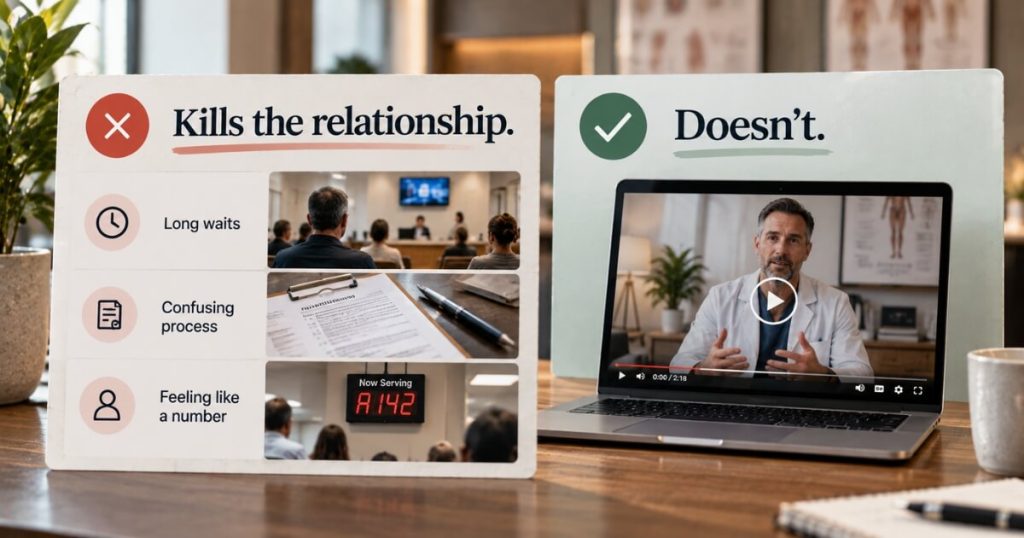
The relationship isn’t destroyed by Zoom — it’s destroyed by long waits, confusing processes, and feeling like a number.
“We’re a relationship practice” is the most common objection, and it confuses the medium with the experience.
A patient who waited 40 minutes past their appointment time, filled out the same form three times, and got passed between three staff members had a bad relationship experience — in person.
Meanwhile, a patient who booked online, got a warm 20-minute video consult that started on time, and had their meds arrive two days later feels taken care of.
Hospitality travels through a screen just fine.
Friction doesn’t care what building you’re in.
How do successful GLP-1 and hormone clinics actually structure telehealth?
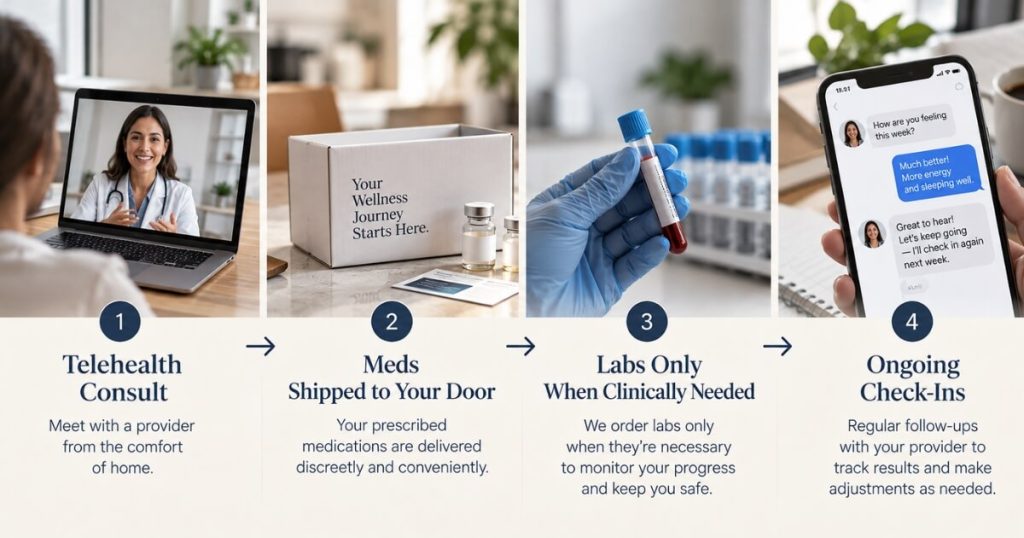
Three moves: the entire consult by telehealth, meds shipped directly, and labs only when clinically needed.
The pattern across the 7–8 figure clinics is consistent.
The consult — including the sales conversation — happens on video. That means the patient can do it from their desk on a lunch break.
Medications ship straight to the patient’s door, which turns refills into retention instead of another office visit.
Labs happen when the medicine requires them, not as a ritual. They’re drawn locally at a partner draw site where the patient lives.
That structure is exactly why telehealth-forward models dominate GLP-1 & weight loss clinic marketing.
The treatment is protocol-driven, check-ins are conversation-based, and nothing about the monthly rhythm needs a lobby.
What does telehealth actually do for the business side of a cash-pay practice?
Three things: it removes friction for busy people, opens your geographic market, and lowers overhead per patient.
Friction first: your ideal cash-pay patient — the busy 40-something professional — is exactly the person who won’t book a visit that costs them half a day.
But they will book a 20-minute video consult.
Geography second: a telehealth offering means your market is every state your providers are licensed in, not a 25-minute drive radius.
Overhead third: a telehealth visit consumes no exam room, no front-desk traffic, and no parking spot.
The margin per patient goes up while the price stays the same.
For hormone and TRT programs specifically, telehealth plus direct-shipped meds is the backbone of the modern membership model.
It’s the recurring-revenue engine at the center of men’s hormone clinic marketing.
How do I add telehealth without hurting the patient experience?
Hold the experience bar constant and change only the room: on-time starts, one clear process, and a named human.
The three relationship-killers — long waits, confusing processes, and feeling like a number — are the design checklist.
Video consults start on time, every time. It’s easier than in person since there’s no lobby stack-up.
The process from booking to meds-at-door is explained once, in plain language, and then just happens.
Every patient also has a named coordinator they can text — the person who books them, preps them, and follows up after.
Structured that way, telehealth doesn’t dilute a premium experience.
It often beats the in-person version of practices that never fixed their lobby.
An HRT clinic we work with runs a high-touch membership model at 250 active members paying $1,000/month — retention like that comes from patients feeling known.
That’s a systems outcome, not a building outcome.
Can I keep an in-person brand and still offer telehealth?
Yes — telehealth is a revenue lane, not an identity change.
Keep the flagship in-person experience for the patients and visits that benefit from it: initial physicals where you want hands-on assessment, procedures, and patients who prefer coming in.
Add telehealth lanes where they’re obviously better: follow-ups, med checks, out-of-town patients, busy professionals, and program check-ins.
Your brand stays “the practice that takes incredible care of people.”
The building becomes one of the places that happens instead of the only place.
The mistake isn’t choosing in-person or telehealth.
It’s treating in-person like a religion while competitors quietly take the patients who couldn’t — or wouldn’t — drive to you.
FAQ’s About Adding Telehealth to a Cash-Pay Practice
Do patients pay cash-pay prices for telehealth visits?
Yes — patients pay for outcomes and access, not square footage.
The 7–8 figure GLP-1 and hormone clinics charge full program pricing with the consult delivered entirely by video.
What patients won’t pay for is a confusing process, regardless of setting.
Which visit types work by telehealth and which need to stay in person?
Consults, program check-ins, med reviews, and follow-ups work well by video.
Keep in person anything requiring physical examination or procedures, as well as lab draws.
However, draws can happen at partner sites near the patient. They can also happen only when clinically needed rather than as a ritual.
Doesn’t telehealth make a premium practice feel cheap?
Only if the experience is cheap.
On-time starts, a named coordinator, meds at the door, and unhurried video time with the provider read as premium convenience — the same way private banking clients don’t visit a branch.
“Feels cheap” is a process problem, not a screen problem.
Can telehealth expand my practice beyond my city?
Yes — your addressable market becomes every state where your providers hold licenses instead of a drive radius.
Many cash-pay clinics add licenses state by state as demand appears.
Check licensure and prescribing rules per state, especially for controlled substances and testosterone.
Should telehealth visits be priced lower than in-person visits?
Generally no.
Price the program or membership, not the room.
Discounting video visits teaches patients the care is worth less through a screen — the opposite of the message.
If anything, telehealth improves your margin at the same price because it consumes no physical capacity.
What’s the next step?
If your growth is capped by exam rooms, drive radius, or your own consult calendar, telehealth is probably the cheapest capacity you’re not using.
Book a strategy call.
In 60 minutes we’ll map which visit types in your practice should move to video, what the booking-to-meds process should look like, and how to launch a telehealth lane without touching the in-person experience your current patients love.