
Should Your Cash-Pay Clinic Create a Signature Branded Program? (Why a Named Protocol Beats Selling Treatments One at a Time)
A functional medicine clinic we work with in Texas watched its new weight loss patients dry up — not because demand disappeared, but because every med spa in town and every telehealth site now sells the same medications, cheaper. Their answer wasn’t to cut prices. It was to package what they already do into a signature branded program built for one specific audience. Here’s the FAQ on when a named protocol makes sense, how to build one out of services you already offer, and how to validate it before you spend a dollar on ads.
Should my cash-pay clinic create a signature branded program instead of selling one-off treatments?
Yes — if any of your core services can be price-shopped online, a signature program is the highest-leverage move available because a named protocol built around your method and a defined outcome can’t be ordered from a website.
The Texas clinic’s owner put it bluntly on a recent call: “We’re not the only white horse anymore.”
Every competitor now carries weight loss medications. Patients can order tirzepatide online for less, and inbound inquiries shifted to single peptides.
The revenue math followed.
After two spike months, the clinic sat at $22K month-to-date at the halfway mark, against roughly $48K the month before.
That whiplash is the a-la-carte model working as designed. Every month starts at zero, and every sale becomes a price comparison.
A signature program changes what’s being compared.
Instead of “how much is your semaglutide,” the conversation becomes “what happens in the first 90 days of your program.”
Nobody else can answer that question because nobody else owns the program.
This is the recurring theme across our functional medicine & longevity clinic marketing work: the clinics that stop selling ingredients and start selling a named outcome stop competing on price.
Commoditization is not an excuse.
a weight loss med spa we helped add $6,708,600 in revenue in one year, with 3,727 new patients, in the most price-shopped vertical in cash-pay medicine proved the winners in a crowded market are decided by offer and positioning, not by the lowest sticker.
How do I build a signature program from the services I already offer?
Bundle the diagnostics, visits, and consumables you already sell into one named package with a defined arc.
In almost every case, you don’t need a new clinical service to do it.
The Texas clinic’s program stack is a good template because every piece already existed on their menu: a comprehensive lab panel (~$600) as the entry point, a health-strategy visit to review results, monthly provider check-ins, personalized AM/PM supplement packs shipped to the patient, and a $197/month maintenance tier to continue after the initial package.
None of that is new medicine.
The program is the packaging — one name, one enrollment decision, and one defined outcome.
The supplement piece deserves its own warning.
A supplement rep pitched this clinic on standalone subscription packs — personalized AM/PM packets at roughly a 40% margin, with a story about another practitioner collecting $13,000 a month in residual supplement income.
Tempting.
Our advice on the call was different: that’s stepping over dollars to pick up pennies.
If you’ve done the work to build an audience and attract a customer who is ready, willing, and able to pay you a couple hundred dollars a month for care, selling that person a supplement pack as the end product is a losing trade.
Instead, put the supplements inside the program.
They solve a real compliance problem because nobody wants to sort twelve pills into travel boxes, and they add margin to the program price.
Components support the program. They are not the offer.
How should I name and position a signature program?
Name it for the audience or the outcome — never the modality — and narrow it to one group of people whose pain points repeat.
The Texas clinic took its existing clinical method and renamed it for airline pilots.
In the owner’s words, “we just changed one word.”
The labs stayed the same. The protocol structure stayed the same. The supplements stayed the same.
However, the program was now aimed at an audience with brutally consistent pain points: erratic schedules, chronic jet lag, wrecked circadian rhythms, and poor sleep.
The founder’s husband is a pilot, which gave the program built-in credibility and a warm referral channel into that community.
Modality names — “peptide therapy,” “IV drips,” and “medical weight loss” — invite comparison shopping because every competitor uses the same words.
Audience and outcome names create a category of one.
You are not inventing new medicine when you do this.
You are narrowing the conversation until you’re the only clinic in it.
Which services should stay a la carte instead of going into a signature program?
Anything patients want to sample rather than commit to.
At most clinics right now, that means peptides.
When this clinic’s lead sheet shifted, most inquiries were for peptides and hormones.
The peptide buyers behaved nothing like program patients.
In the owner’s experience, they’re on and off, they don’t stay, and when the clinic floated membership billing the reaction was, “Wait, I don’t want to do a membership — I just want to try this peptide.”
Some of those buyers still spend up to $1,500 a month. Others vanish after one vial.
Forcing that behavior into a program structure kills the sale.
The right architecture is a front door and a house.
Let the trending, sample-friendly service — the BPC-157 inquiry or the single vial — come in a la carte.
Then move patients who get results into the signature program, where the relationship and the recurring revenue live.
This is the same sequencing we use across peptide therapy clinic marketing engagements.
Peptides are a phenomenal demand source and a lousy foundation because a-la-carte buyers rent your revenue instead of building it.
How do I validate a signature program before spending money on ads?
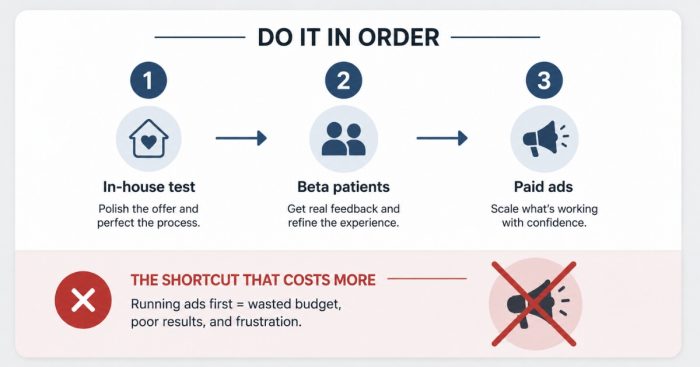
With an in-house test and two to three beta patients with measurable outcomes — before you write a single ad.
On that October call, the owner was ready to launch ads for the new pilot program.
We pumped the brakes.
We asked whether someone taking the program’s supplement regimen would feel a measurable difference within a week.
The honest answer was, “I’m not sure.”
That’s a no-go because perceived likelihood of results is what people pay for.
As we told her, if they know for sure they’re going to feel better, they’ll pay more money.
The validation sequence we assigned was simple.
First, test the protocol in-house. The founder’s pilot husband became patient zero, and the results were tracked for a case study.
Second, recruit two to three beta patients organically at a reduced rate in exchange for data and testimonials.
Third, and only then, turn on paid traffic, budgeting $40–$50 a day because a new offer needs enough spend to test creative and copy properly.
The beta outcomes aren’t just proof. They’re the ads themselves.
“How this pilot went from sleeping three hours a night to eight” is a better ad than anything a copywriter will ever invent, and you can only run it if you did the beta work.
How do I launch and sell a signature program once it’s validated?
Founder-led content aimed at the niche, one flagship patient story, and a short discovery call as the entry point.
A niche program launches through a person, not a logo.
For the pilot program, the plan is the founder’s personal social channels. She’s connected to the pilot community, and the flagship story is her own husband: “I treated my husband because he was always jet-lagged.”
She also hired a social media person to film content on-site.
She summarized the decision perfectly: “It’s amazing when you pay someone for accountability how it actually happens.”
The entry point stays small — a 10–15 minute discovery call — so a cold prospect can raise their hand without committing to a full workup.
Make sure the follow-up machine is ready before launch traffic hits.
This same clinic lifted its lead-to-scheduled rate from 22% to 42% in one month by making lead follow-up the first task of a named staffer’s morning. Our benchmark is 50%.
Demand can scale fast once the machine works.
A signature program gives that demand somewhere profitable to land.
FAQ’s About Signature Branded Programs for Cash-Pay Clinics
What is a signature branded program at a cash-pay clinic?
A signature branded program is a named, productized package that bundles your diagnostics, provider visits, consumables, and coaching into one enrollment decision with a defined outcome and time arc.
It’s sold under a brand name you own instead of as itemized services.
Patients buy “the program,” not a menu of treatments.
As a result, the sales conversation shifts from price to outcome.
Do I need new equipment or new services to create a signature program?
No.
A functional medicine clinic we work with in Texas built its pilot-focused protocol entirely from services already on its menu — labs, strategy visits, monthly check-ins, and supplement packs.
The clinic simply renamed its existing method for the new audience.
In the owner’s words, “we just changed one word.”
The program is packaging and positioning, not new medicine.
Should supplements be sold separately or inside a signature program?
Inside the program.
Standalone supplement subscriptions run roughly a 40% margin and turn a patient worth a couple hundred dollars a month into a $149 pack buyer.
That’s stepping over dollars to pick up pennies.
Inside a program, personalized AM/PM packs improve patient compliance, add margin to the program price, and give patients a tangible monthly touchpoint.
How many beta patients do I need before running ads for a new program?
Two to three beta patients with measurable, documented outcomes, enrolled organically at a reduced rate in exchange for data and testimonials, plus an in-house test of the protocol first.
If you can’t confidently say what result a patient will feel and when, you’re not ready to advertise it.
How much ad budget does it take to launch a signature program?
Plan on $40–$50 a day.
A new offer needs enough consistent spend to test creative and copy against a narrow audience.
However, it should only receive that budget after beta patients have produced a provable result you can build the ads around.
What’s the next step?
If you’re a cash-pay clinic owner selling treatments one at a time in a market that’s getting cheaper by the month, book a strategy call.
In 60 minutes we’ll map which of your existing services belong in a signature program, what to name it and who to aim it at, and the beta-to-ads launch sequence for your specialty — so the next dollar you spend on marketing sells something nobody can price-shop.