
Scaling a Cash-Pay Medical Practice Through Team, Systems, and Owner Leverage (When to Hire and Why Overstaffing Pays)
Most clinic owners got into business for time freedom and financial freedom — and ended up owning a job that consumes both.
Scaling out of the day-to-day is a worthwhile goal and a hard one.
The path runs through three things: the team you hire, the systems you build, and the leverage you create by training people until they don’t need you.
Here’s the FAQ, including the revenue benchmarks for when to hire another provider.
How do I scale a healthcare business without being trapped in the day-to-day?
By deliberately building owner leverage: hire ahead of comfort, document how the practice runs, and train your team until they stop needing you for routine decisions.
Service businesses trap their owners because the owner is the best provider, the best closer, and the only person who knows how everything works.
Every new patient adds hours to the owner’s week, so growth makes the trap tighter.
The way out isn’t working harder inside the machine.
Instead, it’s spending money and time on the three levers that let the machine run without you.
First, another provider absorbs clinical volume.
Next, written systems ensure quality doesn’t depend on memory.
Finally, training helps your people improve instead of escalating every decision.
That’s not a luxury for big practices.
It’s the mechanism of scale itself.
The more you can train your people and the better your people get, the less they need you.
And the less they need you, the more of your week goes to the work that actually grows the practice.
When should a cash-pay practice hire another provider?
Around $100K a month in revenue — and again around $150K to $200K a month.
Those are the benchmarks we give owners.
At roughly $100K a month, a cash-pay practice can usually support a second provider.
At that point, the owner’s clinical load is often the bottleneck holding growth flat.
At roughly $150K to $200K a month, the same math supports the next provider.
Owners who wait for the hire to feel “safe” usually wait a year too long.
That’s because the fully booked owner is exactly the person who has no capacity to absorb the growth the practice is already generating.
Hiring at these benchmarks means hiring before you’re drowning.
That way, you still have the bandwidth to train the new provider properly and hand off patients deliberately instead of in a panic.
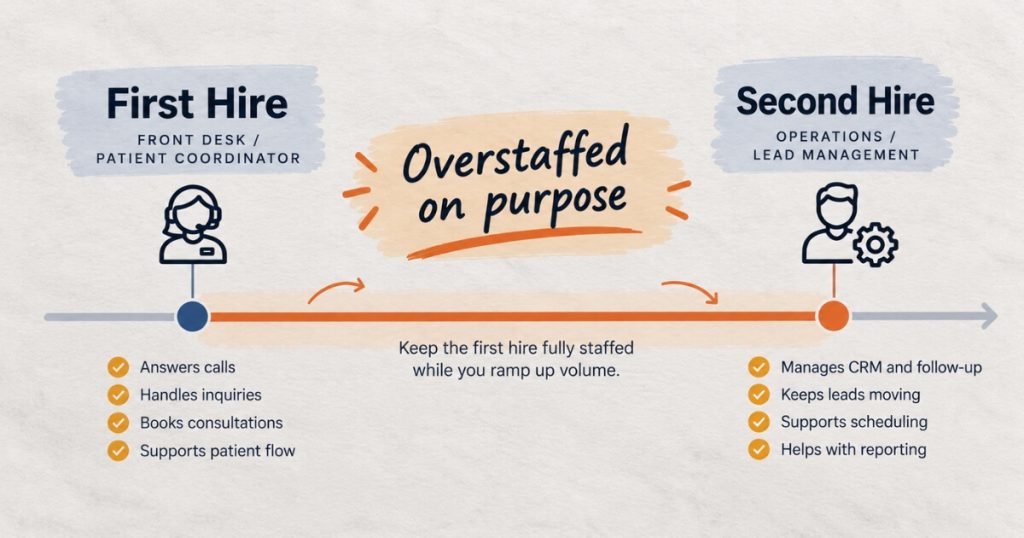
Is it a mistake to be overstaffed while scaling a clinic?
No — a period of deliberate overstaffing is one of the best investments a clinic owner can make.
It feels wrong on the P&L for a quarter or two.
But even if you’re overstaffed for a period of time, buying yourself out of the day-to-day function of the business is a good investment.
That’s because it converts your hours from fulfillment into improvement.
Better systems, better customer satisfaction, better fulfillment, and better patient results become the focus.
And when the owner works on those improvements, everything grows a lot faster.
The improved operation converts more of the demand that marketing produces.
The comparison most owners make is “new provider salary versus current profit.”
However, the right comparison is “new provider salary versus the value of the owner’s freed hours.”
An owner spending 30 reclaimed hours a week on systems, offer design, and growth strategy is worth far more to the practice.
That’s more valuable than the same owner grinding through appointments.
What systems free a clinic owner from daily operations?
Documented processes for every recurring decision, a CRM that runs follow-up automatically, and a weekly numbers review.
Those three carry most of the weight.
Written processes mean quality stops depending on the owner being in the room.
A CRM means no lead or patient follow-up depends on anyone’s memory.
Meanwhile, the weekly numbers review keeps the owner in command of the practice without staying in the building.
That review should cover cost per acquired patient, conversion, revenue per patient, churn, and net new patients.
This is the same operational sequencing we walk through in our medical practice marketing engagements.
That’s because marketing only compounds when the operation behind it can absorb the volume.
The proof that it works at the brand level too: Dr. Joy Kong, one of the most recognized names in regenerative medicine, hired four additional doctors, built a YouTube presence around the team and the science rather than herself, and now runs a clinic that doesn’t need her in the schedule.
Owner leverage isn’t just an operations play.
Done right, it survives even a famous founder stepping back.
How does training my team create leverage in a medical practice?
Training is the compounding lever: the better your people are, the less they need you — and the less they need you, the faster everything grows.
Untrained staff generate escalations.
Every question routes to the owner, so headcount adds cost without adding leverage.
Meanwhile, trained staff generate capacity.
They handle routine cases, follow the documented process, and bring the owner only the genuine exceptions.
That’s the difference between a team that multiplies the owner and a team that merely surrounds the owner.
Practically, training means three habits:
- Document the decision the first time it recurs.
- Review real cases with the team weekly.
- Let people own outcomes — with the numbers reviewed openly — instead of tasks.
Clinics that do this find the owner’s involvement shrinking naturally, month after month, without a single dramatic handoff.
Does removing the owner from operations slow down growth?
The opposite.
Practices usually grow faster after the owner steps out of daily fulfillment because the owner’s attention shifts to the levers that compound.
The growth didn’t happen despite the owners stepping back.
It happened because stepping back freed them to work on the offer, the team, and the systems.
Those are the things that scale — instead of the appointments, which don’t.
If you’re unsure whether your practice is structurally ready for that transition, that’s exactly the kind of question worth putting in front of experienced medical practice marketing consultants.
Do that before you spend another dollar on lead generation.
Order of operations is most of the game.
FAQ’s About Scaling Through Team, Systems, and Owner Leverage
At what revenue can a cash-pay practice afford another provider?
Around $100K a month in revenue is the benchmark where a second provider typically becomes affordable and necessary.
The next hire usually comes around $150K–$200K a month.
Hiring at these points — before the owner is completely maxed out — leaves bandwidth to train the new provider properly.
What does “owner leverage” mean in a medical practice?
It’s the ratio between the results the practice produces and the owner’s personal hours required to produce them.
Leverage rises when trained people, documented systems, and automation deliver outcomes that previously required the owner.
As a result, the owner’s time becomes available for work that compounds.
Should I hire before I feel ready?
Usually yes.
If revenue is at the benchmark and your calendar is the bottleneck, waiting until the hire feels comfortable typically costs a year of flat growth.
Deliberate, temporary overstaffing is an investment in the owner’s freed hours.
And those hours are worth more than the salary they cost.
What should the owner do with the time a new hire frees up?
Work on the business instead of in it.
Improve systems, customer satisfaction, fulfillment, and patient results.
Those improvements make every other part of the practice — including marketing — convert better.
That’s why everything grows faster once the owner steps out of daily fulfillment.
How long does it take to get an owner out of the day-to-day?
Typically 12–24 months of deliberate hiring, documenting, and training.
The pattern that works starts with hiring at the revenue benchmarks.
Then document every recurring decision and train the team weekly.
Finally, progressively hand off roles while reviewing five key numbers every Friday.
What’s the next step?
If your practice is at or past $100K a month and you’re still the bottleneck — every lead, patient escalation, and staffing question routing through you — book a strategy call.
In 60 minutes, we’ll map which hire comes first for your specialty and what to document before the hire.
We’ll also outline what your 12–24 month walk-out plan looks like.
It’s the same playbook behind an HRT clinic that grew from $1M to $4M while both owners stepped out of the day-to-day.