
What Questions Should I Ask Patients for a Testimonial at My Cash-Pay Clinic? (The 7-Question Interview That Writes Your Marketing for You)
Ask a happy patient to “tell us about your experience,” and you’ll usually get a warm but useless shrug: “Everyone’s so nice here!” Testimonials become real marketing assets only when the questions are engineered to produce them. Here is the exact 7-question patient testimonial interview we give cash-pay practices. You’ll also see what each question is secretly designed to extract.
What questions should I ask patients for a testimonial at my cash-pay clinic?
Ask these seven questions, in this order:
- How did you find us?
- What were your past healthcare experiences like before switching to us?
- What stood out the most about us during your first appointment?
- What was the obstacle that almost prevented you from choosing us as your provider?
- What are the biggest factors that make you happy that you chose us?
- What are the main reasons why you’d recommend us to other patients?
- What surprised you most about our practice?
Run the interview conversationally.
Whenever possible, record it on camera and let the patient talk.
Twenty minutes of answers to these seven questions will usually give you more usable marketing language than months of brainstorming.
After all, every sentence comes from the one voice your prospects trust most: another patient’s.
Why do these questions work better than “tell us about your experience”?
Because each question is engineered to produce a specific marketing asset instead of a generic compliment.
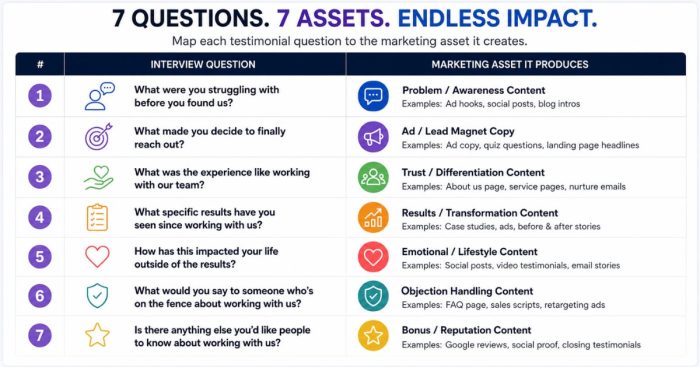
Here’s what each question actually extracts.
“How did you find us?”
This validates your marketing channels in the patient’s own words.
When a prospect hears, “I found them on Google after my knee kept me up at night,” your search presence gains third-party proof.
“What were your past healthcare experiences like before switching to us?”
This produces the before-state.
Patients naturally describe the rushed appointments, the seven-minute visits, and the unreturned calls.
As a result, your practice never has to criticize the healthcare system because your patients do it for you.
“What stood out the most about us during your first appointment?”
This uncovers your real differentiator.
Interestingly, it’s often different from what you’d expect.
Clinics assume patients will mention the doctor’s credentials.
Instead, patients often say, “Someone actually called me back the same day.”
“What are the biggest factors that make you happy that you chose us?” and “What are the main reasons why you’d recommend us to other patients?”
Together, these questions produce outcome language and ready-made referral scripts.
In other words, the exact words a happy patient uses to sell your clinic become the words your next ad should use.
“What surprised you most?”
Finally, this question creates the pattern interrupt.
It uncovers the unexpected, specific details—“They knew my name when I walked in”—that make a testimonial feel genuine instead of scripted.
Which testimonial question uncovers my patients’ real objections?
Question four:
“What was the obstacle that almost prevented you from choosing us as your provider?”
This is the most valuable question on the list.
Yet it’s also the one almost no clinic asks.
Every patient who said yes almost said no.
Some hesitated because of the price.
Others worried about the distance, questioned the cash-pay model, or doubted the treatment would work.
When a real patient says on camera, “Honestly, the cost almost stopped me—and then I did the math on what I’d spent going nowhere with my old doctor,” you now have the single most persuasive objection-handler in your marketing.
It names the objection your prospects quietly carry.
Then it resolves that objection in a voice they can’t dismiss as sales copy.
Collect ten answers to this question and you’ll have a map of the real barriers in your funnel.
You’ll also have recorded, authentic rebuttals to every one of them.
That’s material no copywriter can fabricate.
More importantly, it’s exactly the kind of proof-driven asset that separates working medical practice marketing from generic “5-star care” messaging.
How do I get patients to actually give a testimonial?
Ask personally, at the right moment—never through an automated blast.
The ask follows the same rule as referrals.
People do relationship favors for people, not for software.
Your provider or coordinator should ask face-to-face or by personal phone call:
“Your story would genuinely help people who are sitting where you sat six months ago. Would you share it?”
Timing does most of the work.
Ask at the results milestone.
That’s the visit where the patient sees improved labs, lower pain scores, or reaches their goal weight.
At that point, gratitude is at its peak, and the before-and-after story is still fresh.
For membership programs, around the 90-day mark works for the same reason it’s the right time for review requests.
Then make the process effortless.
Keep it to 15–20 minutes.
Record it during their regular visit.
Use a phone camera or another simple setup.
Send the questions in advance so nothing feels like an ambush.
Patients usually aren’t reluctant to help.
Instead, they’re reluctant to be inconvenienced or surprised.
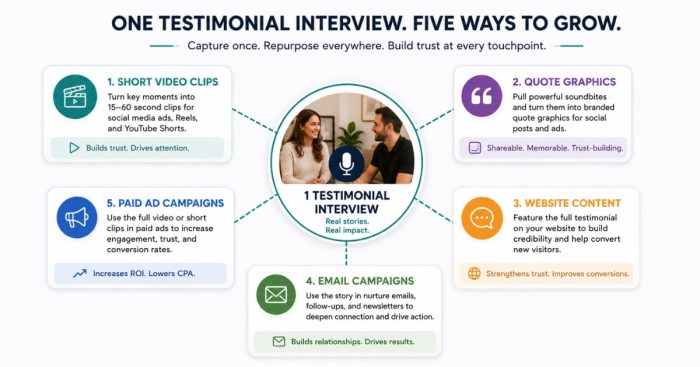
Where should I use patient testimonials once I have them?
Use them everywhere a prospect hesitates: ads, landing pages, nurture sequences, pre-consult follow-ups, and social content.
One 20-minute interview can be divided into assets for all five.
- The before-state and surprise answers become short-form social posts and ad creative.
- The obstacle answer becomes the objection-handling video in your nurture sequence. Send it to leads who go quiet after hearing the price.
- The differentiator answer belongs on your landing page beside the booking button.
- The recommendation answer becomes the closer in your pre-consult reminder—the last thing a lead watches before walking in.
- The full interview belongs on your website and YouTube as long-form trust-building content.
Video multiplies all of it.
Dr. Joy Kong built her position as the #1 stem cell expert on YouTube using exactly this insight.
In high-consideration medicine, recorded human faces and stories build trust at a scale text never will.
Your patients’ faces can do for your clinic what your own thought leadership does.
Often, they do even more because they have nothing to sell.
Testimonials are conversion infrastructure, not decoration.
Likewise, VYVE Wellness grew website leads 900% and inbound calls by 100+ per month in four months.
Growth like that gets protected by proof at every stage of the funnel, so the leads your marketing produces don’t stall at the moment of doubt.
Do I need consent to use patient testimonials in my marketing?
Yes.
Always get a signed release before publishing anything.
A patient talking about their own experience on camera is voluntary.
However, using that recording in your marketing requires written authorization.
The release should explain what was recorded, where it may appear (website, social media, and ads), and the patient’s right to withdraw permission.
Your practice attorney should approve the release template once.
After that, it becomes a routine part of every interview day.
Two practical rules will keep you safe and credible.
First, let patients speak only for themselves—their experience, their results, and their feelings.
You don’t need, and shouldn’t script, claims that a treatment produces the same outcome for everyone.
Second, never fabricate or “enhance” testimonials.
The entire value of this asset comes from the fact that it’s true.
In a trust-driven, high-ticket specialty, one exposed fake costs more than a hundred genuine testimonials.
FAQ’s About Patient Testimonial Questions and Interviews
Should patient testimonials be video or written?
Video first, whenever you can get it.
A real face and voice build trust that text simply can’t.
In addition, one video interview can easily be transcribed into written quotes for your website.
Reserve written-only testimonials for patients who decline being on camera but still want to help.
When is the best time to ask a patient for a testimonial?
Ask at the results milestone.
That’s the appointment where the patient sees measurable progress, such as improved labs, less pain, or reaching a goal weight.
For membership programs, around 90 days is usually ideal.
At that point, gratitude is high, and the before-and-after contrast is still clear.
What if a patient freezes up on camera?
Run the interview as a conversation instead of a performance.
Send the seven questions ahead of time.
Keep the provider or coordinator they already know in the room.
Also remind them there are no wrong answers because everything gets edited.
The questions simply invite them to tell the story of their own life.
Once they begin answering “what was it like before,” most patients forget the camera is even there.
How many patient testimonials does my clinic need?
You need enough to cover every core service line and each major objection.
For most cash-pay clinics, that’s five to ten strong interviews, refreshed a few times each year.
One great, specific testimonial used in five places will outperform twenty vague testimonials that nobody watches.
Can I edit what a patient said?
Yes, but only for length and clarity.
Cutting pauses and tangents is perfectly fine.
However, never change the meaning.
Likewise, never splice words together to create a claim the patient never made.
Doing so destroys both the testimonial and your credibility.
When you’re unsure, show the patient the final cut.
Most will gladly approve it—and often share it themselves, giving you free distribution.
What’s the next step?
If your clinic has happy patients but no system for turning them into marketing—no interview process, no proof library, and no testimonial sequence in your follow-up—book a strategy call.
In 60 minutes, we’ll map your patient-proof pipeline.
We’ll identify who to interview first, how to run the seven questions, and exactly where each answer belongs in your ads, landing pages, and nurture sequence.