
How Do I Promote a Patient Appreciation Event at My Clinic? (One Newsletter, a Mass Text, and QR Check-In That Tracks Every Referral)
A longevity and hormone practice in New York planned its first FriendsGiving — a patient appreciation event, not a lead-gen stunt.
On the planning call, the owner guessed he had 700 contacts. The CRM said 850, with 428 emails, plus about 100 more emails stranded in the EHR.
That gap is the whole story: most clinics own an audience they’ve never once written to.
Here’s the FAQ on turning an existing patient list, one newsletter, and a QR code at the door into tracked referrals and booked consults.
How do I promote a patient appreciation event without an ad budget?
Send your existing list. All of it. That’s the budget.
This clinic’s plan cost almost nothing: an email newsletter to all 428 addresses and a mass text to the full list.
It was the first time either channel had ever been used.
Before sending, they merged the ~100 emails trapped in the EHR into the CRM via CSV export.
After all, a list you can’t send to is a list you don’t own.
If you’ve never emailed your patients, your first newsletter isn’t “content marketing.”
It’s an invitation with a date on it, which is the easiest email a clinic will ever write.
An event built on the existing list also compounds differently than cold acquisition.
Every attendee is a patient or a patient’s guest, which makes it a retention and referral engine.
That’s the highest-margin layer of medical practice marketing and the one most clinics never systematize.
Should I text or email my patient newsletter?
Both — but expect the text to win.
“Text will probably get a better open and read rate.”
The practical setup from this call: the CRM (they use GHL) can mass-SMS the entire list.
The sending limit was raised on the call itself, and the CRM can even attach an MP4.
The owner’s instinct was right: record a 30-second personal video.
“Hey guys, we’re having a FriendsGiving next week…”
Then attach it because “video content is better than text.”
The email newsletter carries the details, while the text carries the attention.
Same event, two channels, one afternoon of setup.
How do I track who actually shows up to my clinic’s event?
QR check-in at the door: “scan here first before entering.”
The form collects name, email, phone — and the question that turns a party into a referral system:
“Who are you coming with?”
Every guest who isn’t yet a patient enters your CRM attached to the patient who brought them.
Add raffles to make check-in feel like a prize entry instead of paperwork.
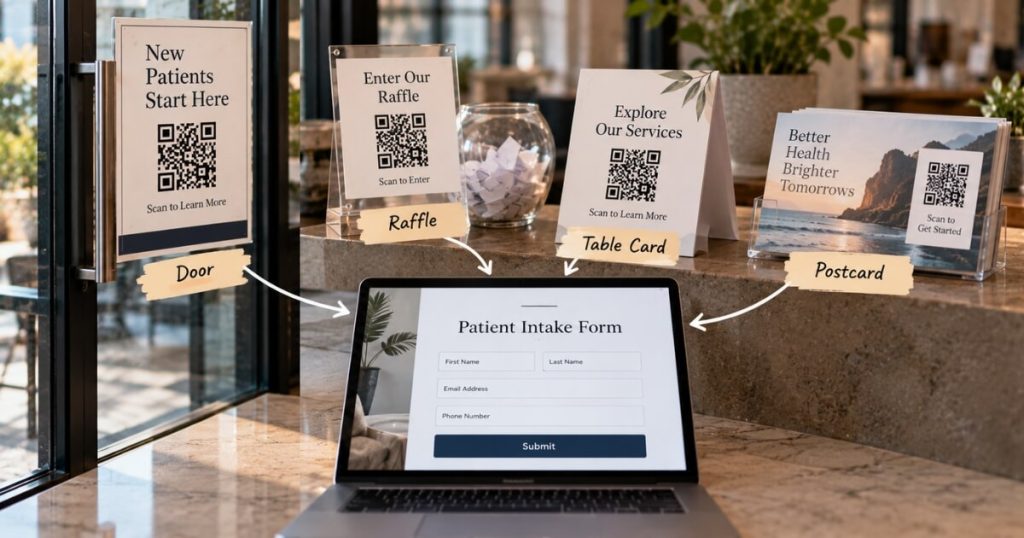
The technical trick worth stealing: ONE form, MANY QR codes.
Each QR code points to the same form but carries its own source tag — door, raffle table, postcard, front-desk flyer.
After the event, you know not just who came, but which touchpoint got them there.
That’s the same source-tagging discipline you’d want on every marketing channel, applied to a Tuesday-night party.
What offer should I run at a patient event?
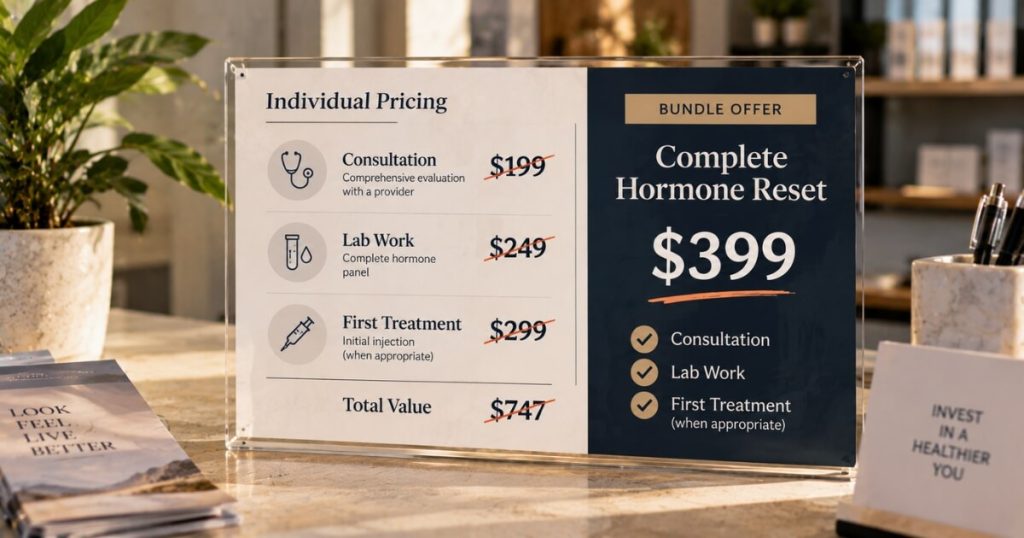
A visibly discounted bundle with the real price showing.
This clinic ran its $299 consultation package at $199, event only.
The bundle included blood work, a body composition scan, and a grip-strength test.
People in this market already pay $50 for the body scan alone, which makes the $199 all-in price feel like theft.
Presentation matters as much as the math.
The team debated “$100 off” and rejected it.
As one owner put it, “$100 off” makes people wonder how expensive the base thing is.
Meanwhile, “$299 struck through to $199” shows exactly “how much you’re getting for” the money.
Why grip strength?
It’s “a proxy of your overall strength” linked to all-cause mortality — a near-zero-cost test with real perceived value in a longevity offer.
A functional medicine practice we work with grew website leads 900% and added 100+ inbound calls a month in 4 months on the strength of offers built exactly this way.
High perceived value, real clinical substance, priced to say yes tonight.
Can my clinic advertise free blood work or free consults?
Check your state first.
In New York and New Jersey, “free labs” is off the table because the lab has to bill the patient.
This came up when the team explored follow-on offers.
“Free low-T testing” — a staple offer in many states — is misleading advertising where the lab must bill the patient directly.
Free consults were also rejected over liability concerns.
The workaround: price the entry point low instead of claiming free.
A $99 consult was the debated number.
If your clinic is brick-and-mortar competing against telehealth-only players, lean into it.
This team’s positioning line was “we need to show our roots: our office, our team.”
An in-person event is the one marketing asset a telehealth competitor cannot copy.
Does direct mail still work for medical practices?
It can — as a volume game with a strong offer, a purchased targeted list, and a dedicated tracking number.
One team member had run direct mail successfully before, and her rules were consistent.
“It’s really about the offer.”
People keep a postcard that promises something they want.
You can buy zip-code or even occupation-targeted lists, such as firefighters for one campaign.
Every piece also carries a dedicated tracking phone number plus a QR code so responses are attributable.
Same discipline as the event: no channel without a source tag.
FAQ’s About Clinic Patient Appreciation Events
How many contacts does a typical established clinic actually have?
More than the owner thinks.
This owner guessed 700, but the CRM held 850, plus ~100 emails stranded in the EHR.
Audit your list before assuming you need ads.
The cheapest audience you’ll ever reach is the one you already own.
What should the event offer include at a longevity or hormone clinic?
A bundled package of things patients already value individually.
This clinic bundled blood work, a body composition scan (worth $50 standalone locally), and a grip-strength test.
The package normally cost $299, but event attendees could get it for $199.
Why show the original price instead of saying “$100 off”?
Because a discount without an anchor invites suspicion about the base price.
Meanwhile, “$299 → $199” displays the value received.
The team chose the strikethrough presentation deliberately.
How do I capture referrals at an event without being pushy?
The check-in form does it silently.
Asking “who are you coming with?” links every guest to the patient who invited them.
No pitch is required at the door.
The follow-up sequence afterward does the selling.
Is a patient appreciation event a lead-gen event?
No — and that’s why it works.
Community lead-gen events chase strangers.
An appreciation event deepens existing relationships and lets referrals arrive as guests, pre-warmed by the person they trust.
What’s the next step?
If your clinic has hundreds of patients you’ve never emailed and no referral system beyond hoping, an appreciation event is the cheapest test of both.
Everything above — list merge, newsletter, mass text, QR source-tagging, and the offer — sets up in a couple of weeks.
Book a strategy call.
In 60 minutes we’ll audit your actual list size, design the event offer for your services and state rules, and build the check-in flow that turns attendance into pipeline.