
The Verbatim Outbound Lead-Nurture Call Script for Cash-Pay Clinics (What to Say When a Lead Inquired but Never Booked)
Every cash-pay clinic is sitting on a pile of leads who filled out a form, asked about a treatment, and then went quiet. They didn’t say no — they just never booked. Here’s the verbatim outbound call script we hand to patient coordinators for exactly those leads: the tone rules, the opener, the pause, and the one diagnostic question that gets a lead to tell you why they never scheduled.
What should my team say when they call a lead who inquired but never booked?
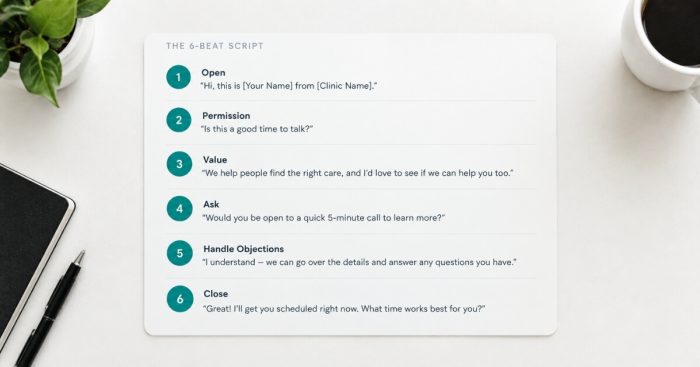
Run a six-beat script: confirm the name, introduce yourself and the clinic, pause, remind them of their request, ask “Does that ring a bell?” — then ask one diagnostic question about why they never scheduled.
Here’s the verbatim script — originally built for a healthcare company’s outbound nurture team, genericized so any cash-pay clinic’s patient coordinator can run it word for word.
You: “Hi, is this [first name]?”
Them: “Maybe — who’s calling?” (Or just “yes.” If it’s a hard no, say: “Sorry — I’m looking for [first name].”)
You: “This is [your name] with [clinic name].”
PAUSE.
Them: “Okay…” or “What can I do for you?”
You: “The reason for my call today is I saw you had requested more information from us about [treatment or program]. Does that ring a bell?”
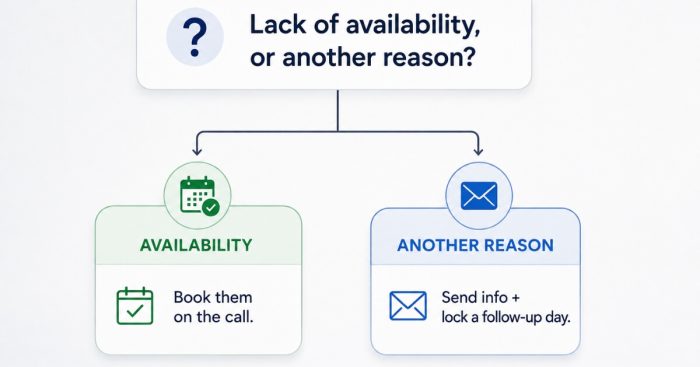
If yes or “kinda”: “Great. I noticed you weren’t able to schedule a consultation with us — was that because of a lack of availability, or another reason?”
If no: “Okay, not a problem — would you like me to send you some more information about how we help people with [condition or goal], and follow up with you?”
If the blocker was availability: book them right there on the call.
If they wanted more information first: send it — and lock in a specific follow-up day before you hang up.
That’s the whole script. No pitch, no feature dump. It’s engineered to do two jobs: lower the lead’s guard and surface the real reason they never booked.
The rest of this article explains why each beat exists. A script your team doesn’t understand is a script they’ll abandon the first time a lead goes off-book.
Why do tone and tempo matter more than the words on an outbound nurture call?
Because the lead can hear your intent before they process a single word you say. The original script opens with two coaching notes before any dialogue — the two notes most clinic teams skip.
Tone is your voice inflection and enunciation. It either disarms the person on the other end or keeps their guard up.
A flat, scripted-sounding read says “sales call” within one sentence. As a result, every answer after that gets shorter.
Tempo is your pace and energy, and the lead senses both through the phone. The rule from the source script is blunt: do not rush, or they will rush you off the phone.
Coordinators rush because they’re nervous or have 40 dials to make. The lead hears that rush as “this person wants something from me” — and hangs up.
Most clinics spend thousands a month on medical practice marketing to generate the lead, then burn it in the first ten seconds of a rushed, flat-toned call.
Instead, have your coordinator read the script out loud ten times before the first dial — slower and warmer than feels natural. Half the objections never materialize.
How do I open an outbound call to a warm lead without sounding like a telemarketer?
Say your name and the clinic’s name — then stop talking. The PAUSE is written into the script as its own line, and it’s the most counterintuitive beat in the whole call.
Telemarketers barrel straight from the introduction into a pitch because they’re terrified of silence. Pausing signals a normal human conversation instead.
As a result, the lead fills the gap with “okay” or “what can I do for you?” — an invitation to state your reason for calling. Now you’re answering their question instead of pushing a pitch.
Then comes the reason line: “I saw you had requested more information from us about [treatment]. Does that ring a bell?”
Three things are happening in that sentence.
First, it reminds the lead that they started this — this is a returned call, not a cold call.
Second, “does that ring a bell” is a low-pressure memory jog. It’s softer than “do you remember filling out our form?”, which lands like an accusation.
Finally, it hands the lead an easy, honest answer no matter what their memory does. Yes, kinda, and no each have a scripted next move, so your coordinator is never stranded.
What one question gets a lead to tell you why they never booked?
“I noticed you weren’t able to schedule a consultation with us — was that because of a lack of availability, or another reason?” That single sentence is the engine of the entire script.
Look at what it does. It states the fact neutrally — “you weren’t able to schedule,” not “you didn’t book,” which sounds like blame.
Next, it offers a binary: availability, or another reason. Binary questions are easy to answer on the spot. This one is deliberately lopsided because “another reason” is a wide-open door that lets the lead admit the real blocker without shame: price worries, a spouse to consult, nerves about the procedure, or plain forgetting.
Whatever comes back, you have your play.
Lack of availability → open the calendar and book them on the call.
Another reason → the objection is now on the table, on the lead’s own terms. Respond with information and a scheduled follow-up instead of a debate.
Most leads who never booked were never a no. They were an unanswered question. This is the sentence that asks it.
What do I say when the lead says the inquiry “doesn’t ring a bell”?
“Okay, not a problem — would you like me to send you some more information about how we help with [condition], and follow up with you?” You never argue with a lead’s memory, and you never end the call without permission for the next touch.
“Not a problem” instantly defuses the awkwardness — the lead braced for a pushy correction and got agreement instead.
Because the offer that follows costs them nothing to accept, most people say yes. That single yes changes everything downstream: your next email, text, or call is now a permissioned follow-up the lead asked for, not an unsolicited chase.
This is where booking rates are actually won — not on the first connect, but on the disciplined follow-through after it.
A regenerative medicine clinic we work with converts 79.4% of its leads into booked appointments, part of $309,590 in cash-pay revenue generated in 10 months without paid ads. That number is not a charisma stat.
Instead, it’s what happens when every lead gets a scripted call, a diagnostic question, and a permissioned follow-up — no exceptions, no “they’ll call back if they’re serious.”
How does this nurture call script fit into my clinic’s follow-up system?
This is the live-answer script — the piece most clinics are missing. It sits between your speed-to-lead process for brand-new inquiries and your reactivation work on months-old lists. Run it on any lead who asked about a treatment in recent days or weeks but never picked a time.
A script alone isn’t a system, though.
Someone has to own it — a patient coordinator with a protected daily call block, a list of every inquirer who hasn’t booked, and a number they report every week: nurture calls made, conversations had, consultations booked.
The clinics that grow fastest treat these calls as one motor inside a predictable patient acquisition system — lead capture, rapid first contact, live nurture calls, and scheduled follow-up, all measured.
The upside is bigger than most owners assume because volume compounds the math.
At that volume, the difference between winging the nurture call and scripting it is dozens of consultations a month from leads you already paid to generate.
FAQ’s About Outbound Lead-Nurture Calls for Cash-Pay Clinics
Who should make outbound lead-nurture calls at a cash-pay clinic?
A dedicated patient coordinator or inside-sales person — not the provider, and not whoever happens to be free at the front desk.
A provider calling feels high-pressure to the lead and burns clinical hours. Meanwhile, a front-desk person squeezing dials between check-ins rushes the tempo, which is exactly what the script warns against.
Instead, assign the calls to one accountable person with a protected daily call block.
How soon should we call a lead who inquired but never booked?
Call brand-new inquiries within minutes, then move non-bookers into this nurture script within a few days.
The script’s “I saw you had requested more information from us” line works best while the inquiry is recent enough to actually ring a bell — days to a few weeks out, not months.
Older lists need a different reactivation approach.
Should we bring up pricing on the nurture call?
Not proactively.
The call has one goal: diagnose why they didn’t book and schedule the next step.
If the lead raises price directly, answer honestly. Then bridge to the consultation, where cost can be discussed against their actual case instead of in the abstract.
What if the lead doesn’t answer the phone?
Leave a short voicemail referencing their request, send a text with the same “you’d asked for more information — want me to send it over?” framing, and keep them in your follow-up cadence.
However, don’t read the whole script into a voicemail — its diagnostic question only works in a live conversation.
How many attempts should we make before giving up on a lead?
Keep going until they book, say no, or opt out.
Most clinics quit after one or two attempts, which is why their “dead” lead lists are full of bookable patients.
Instead, make sure every touch ends the way this script ends every branch: with permission for the next one.
What’s the next step?
If your CRM is full of leads who inquired and never booked, you don’t have a lead-generation problem — you have a follow-up problem, and it’s the cheapest problem in your clinic to fix.
The script above is the fix for the live-answer moment. The rest is ownership, cadence, and weekly numbers.
Book a strategy call. In 60 minutes we’ll audit how your team handles the leads you’re already generating, adapt this script to your treatment mix, and map who on your team should own the daily call block — so the next lead who “never booked” becomes next week’s consultation.