
What Operational Fixes Actually Grow a Cash-Pay Clinic? (CRM Pipelines, Delegation, and a Mapped Patient Journey)
When a cash-pay clinic wants to grow, the instinct is to buy more marketing. But the fastest gains usually come from fixing operations — the unglamorous systems that let you convert, retain, and serve the patients you already attract. This is the FAQ on the operational improvements that actually move the needle, drawn from a real clinic strategy session where the biggest win of the quarter wasn’t a new ad campaign; it was a CRM pipeline and a discovery-call flow that booked a new provider “faster than we’ve ever booked a new doctor.”
What operational fixes actually grow a cash-pay clinic?
Start by removing the bottlenecks around your senior staff and mapping your patient journey — those move the needle faster than any new marketing campaign.
Growth stalls in operations more often than in marketing.
When your office manager is buried in routine tasks and your patients are confused about how your clinic works, more leads just pile onto a system that can’t convert or serve them well.
The highest-leverage fixes are structural:
- Delegate routine work down so senior staff focus on high-value activities like patient follow-up.
- Install a CRM pipeline that automates reminders and follow-ups.
- Run a daily team huddle for accountability.
- Map the patient journey so patients understand what to do.
In one clinic, simply delegating supply ordering to team leads freed the office manager entirely for higher-leverage follow-up work.
None of that requires a bigger ad budget, and all of it makes every marketing dollar work harder afterward.
This is the operational backbone beneath any real medical practice marketing — the clinics that grow fastest fix the machine first, then feed it.
Fix operations, and the leads you already generate convert and stay at a much higher rate.
How do I book out a new provider faster at a cash-pay practice?
Route new-patient interest through a CRM pipeline plus free discovery or pro-bono calls before the paid consult — it fills a new provider’s calendar dramatically faster.
Adding a provider only helps if you can fill their schedule quickly; an empty new provider is an expensive liability.
The fix that worked here was a CRM pipeline (GoHighLevel) paired with a pro-bono discovery-call flow that warms and books new patients efficiently.
The clinic’s own reception reported booking a new doctor “faster than we’ve ever booked a new doctor,” and the same flow immediately booked the next provider’s first discovery call into a signup.
The system, not luck, made the difference.
The lesson generalizes: don’t just hire a provider and hope demand finds them.
Build the intake pipeline that routes leads to the new provider with a low-friction first step, and their calendar fills fast.
It’s the same logic that makes a booked-out practice scalable — a clean pipeline is what lets you add capacity and immediately put it to work rather than carrying an underutilized hire.
How do I free up my office manager and delegate the right things?
Push routine tasks down to team leads so your office manager can focus on high-value work like patient follow-up — then add a VA to own the repeatable coordination.
Your most capable operator is usually your biggest bottleneck because everything routes through them.
The fix is deliberate delegation:
- Have the lead nurse order clinical supplies.
- Have the medical assistant order supplements.
- Have reception order office supplies.
This way, your office manager isn’t the funnel for every routine task.
That frees them to own patient follow-up — a genuinely revenue-generating activity — instead of drowning in logistics.
Once the follow-up process is mapped, hire a virtual assistant to act as a virtual patient care coordinator handling refills, texting, and coordination.
The principle is that your best people should do the work only they can do, and everything else should be delegated or automated.
Most clinics under-delegate, keeping senior staff on tasks a team lead or a VA could own, which caps how much the senior person can contribute to growth.
Deliberate delegation is one of the cheapest ways to add capacity to a cash-pay clinic — you’re not hiring more, you’re freeing the people you have to do higher-value work.
What should a CRM pipeline for a cash-pay clinic actually do?
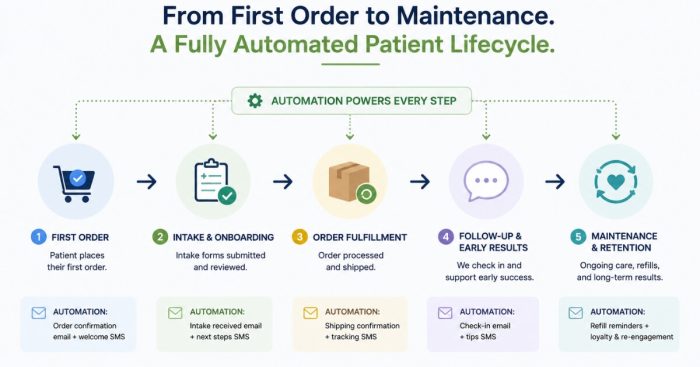
Automate the recurring touchpoints that keep patients moving and buying — for a medication or membership model, that means an automated stage-by-stage pipeline for refills and follow-ups.
A CRM is not just a contact database; used well, it’s an automation engine.
A useful example is a monthly medication-pickup pipeline with stages like:
- First order completed
- Due for second order
- Second completed
- Due for third
- Maintenance
Automations move patients between stages on a time delay, send “you’re due for your next order” messages, and auto-follow-up if a patient hasn’t advanced — with a VA managing the exceptions.
That turns retention and re-orders from something a busy team forgets into something the system does reliably.
The payoff is that the revenue you’ve already earned stops leaking.
Patients who would otherwise lapse get nudged at the right moment.
Patients who stall get caught.
Build the pipeline stages to match your actual patient flow, wire the automations, and put a VA on top of it.
It’s one of the highest-return operational investments in a cash-pay clinic because it protects recurring revenue automatically, which is the foundation of durable patient acquisition economics.
Should I run ads or build a brand first?
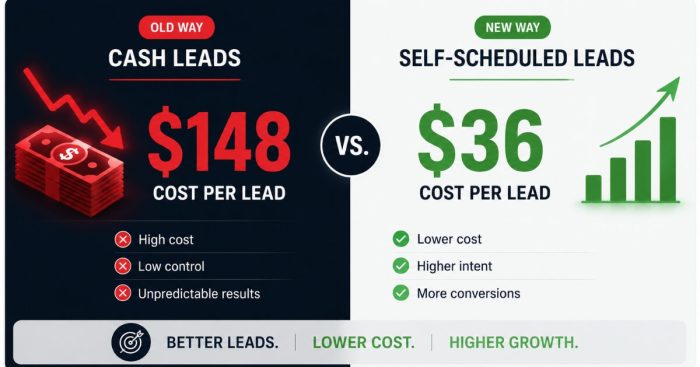
Build a seeded brand first — ads convert far better and cost far less on top of an established brand than they do for a clinic with no presence.
A clinic with a real social presence pays dramatically less for the same leads.
In one comparison, a better-branded, smaller clinic pulled leads for $6 to $8 while a much larger, less-branded chain paid $30 for the same channel.
That gap is the cost of skipping the brand step.
Before spending heavily on paid traffic, establish a genuine presence:
- Consistent content
- A real profile
- Providers who show up on video
Putting a provider on video is especially powerful, and not only for leads.
Even if the content generated zero new leads, it raises your close rate because prospects who’ve seen your provider teaching treat them as an authority and take their recommendations more seriously in the consult.
It also makes hiring easier, drawing providers and nurses to a clinic that looks established.
Build the brand, then let ads amplify it — pointing paid spend at a no-name clinic is how you end up paying $30 for what should cost $8.
How do I get more of my best patients without adding new channels?
Double or triple down on the channels already producing your ideal patients rather than chasing new ones — the goal is “more of the exact patient we’re already bringing in.”
Most clinics already have channels that work — often referrals, Google Business Profile, and Google Search.
The mistake is neglecting those to chase a shiny new platform.
Instead, intensify what’s proven:
- Launch a public referral or affiliate program (even a modest payout, like $100 per referred patient who starts, motivates advocates).
- Increase your Google Business Profile posting frequency.
- Consider temporarily increasing your blog and SEO output for a few months.
Each of these deepens a channel that already converts your best patients.
This is lower-risk and faster than learning a new channel from scratch.
You know these sources produce your ideal patient, so more volume from them means more of exactly the right patient.
Save the experimental channels for after you’ve maximized the ones already working.
Concentration beats scattering when you’re trying to grow a cash-pay clinic efficiently.
How do I fix a confusing patient experience at my clinic?
Map the patient journey and give patients written guidance because a single dense consult leaves them overwhelmed and unsure how to interact with your clinic.
Patients frequently leave a thorough first consult confused about visit types, how to order, and what happens next — and a confused patient is a patient who lapses or under-buys.
The fix is to map the journey and remove the ambiguity:
- Build front-desk discovery-call scripts that cover the date, purpose, length, next steps, and price of each visit.
- Create a patient-education folder with the plan and simple “how to be a good patient” documents.
Do this before layering on more marketing or building your CRM automations because everything downstream depends on the patient understanding the path.
A daily team huddle reinforces it.
A short standup covering wins, key stats, and open issues creates dedicated space for the operational work that otherwise never gets a slot.
Clarity for the patient and rhythm for the team are cheap to implement and compounding in effect.
When patients know what to do and your team has a cadence to run the clinic, conversion and retention both rise without spending a dollar more on leads.
FAQ’s About Operational Improvements at a Cash-Pay Clinic
What should I put in my clinic’s content?
Answer the exact questions your patients already ask you in consults — those are the highest-converting, easiest topics.
If patients keep asking “tirzepatide vs. semaglutide,” make that a video.
You don’t need high production; a phone, decent lighting, and authentic personality outperform polish, and the content doubles as authority that raises your close rate and helps recruiting.
How much should I pay for a patient referral?
A modest, clear incentive works — something like $100 per referred patient who actually starts care is enough to motivate advocates without eroding your margins.
The point is to make your referral program public and easy so happy patients and team members actually use it.
Referred patients are cheaper to acquire and easier to close than cold leads, so even a real payout usually pays for itself.
Should I run daily team huddles?
Yes — a short daily huddle covering wins, key stats, and open issues gives operational work a dedicated place it otherwise never gets.
It builds accountability, surfaces problems early, and keeps the team aligned on the numbers that matter.
It costs fifteen minutes and consistently improves execution, which is why high-performing clinics protect it.
Do I really need a VA patient care coordinator?
Once your follow-up and refill processes are mapped, a VA coordinator is one of the highest-ROI hires you can make.
They handle the repeatable coordination — refills, texting, follow-up nudges — that protects recurring revenue but doesn’t require an in-person clinical role.
Map the process first so the VA has a clear playbook, then hand them the pipeline to run.
What’s the next step?
If your clinic feels stuck, the fix is probably operational, not promotional.
Delegate routine work to free your best people, install a CRM pipeline that automates retention, map the patient journey so patients aren’t confused, double down on the channels already producing your ideal patients, and build a brand before you scale ads.
Each of these makes the leads you already have convert and stay — and makes every future marketing dollar work harder.
On a strategy call we’ll audit your operations — delegation, CRM, patient journey, and channel mix — and show you which fix will unlock the most growth first.
It’s the same systems work behind clinics like an HRT clinic we grew from $1M to $4M a year by building the machine before scaling the marketing.