
The One-Page Monthly Worksheet That Shows Which Part of Your Cash-Pay Practice Is Breaking (One KPI Per Function)
Most cash-pay practice owners can tell you whether revenue is up or down. However, very few can tell you which of the six functions of the business caused it. This is the one-page worksheet we fill out with clients every month: six functions across the top, a 1-to-5 score for each, one KPI per function, and last month’s scores underneath—all pulled from a real client session with the exact numbers.
What is the one-page worksheet that diagnoses a cash-pay practice each month?
A six-column grid:
- Lead Gen
- Lead Nurture
- Conversion
- Delivery
- Referrals/Testimonials
- Upsell/Resell
Under those columns, add four rows:
- This month’s score (1–5)
- The KPI that justifies the score
- Last month’s score
- Notes
That’s the entire tool.
Every dollar a practice earns moves through those six functions in order.
First, a stranger becomes a lead through Lead Gen.
Next, that lead becomes a booked appointment through Lead Nurture.
Then, the appointment becomes a paying patient through Conversion.
After that, the patient receives a great outcome through Delivery.
Meanwhile, satisfied patients generate Referrals and Testimonials.
Finally, they continue care through Upsell and Resell.
Revenue is the last number to move when something breaks.
Instead, it’s a lagging indicator of whichever function quietly slipped six weeks earlier.
The worksheet moves the diagnosis upstream.
Rather than asking, “Why is revenue soft?”, ask, “Which column dropped?”
More often than not, the answer becomes obvious within five minutes.
One page.
One meeting each month.
Every problem in the practice has an address.
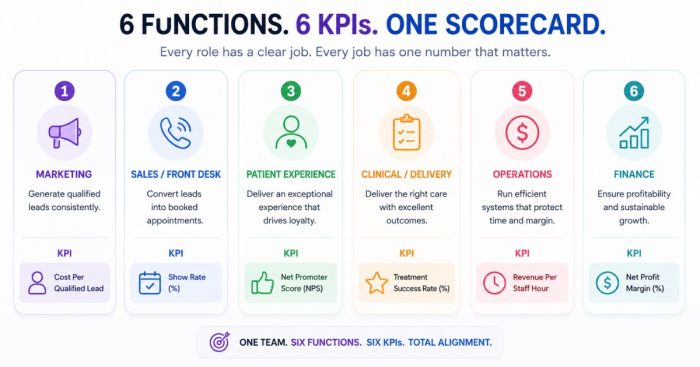
Which KPI belongs to each of the six functions of a cash-pay practice?
Use one KPI for each function.
Straight from the worksheet, those KPIs are:
- Cost per lead
- Booking rate and attendance rate
- Close rate
- Percentage of patients who achieved great results and left satisfied
- Testimonials and referrals generated
- Upsells and resells completed
Here’s the full mapping.
1. Lead Gen
Cost per lead.
Are strangers raising their hands?
If so, at what cost?
2. Lead Nurture
Booking rate and attendance rate.
How many leads scheduled?
Then, how many actually showed up?
3. Conversion
Close rate.
Of the people who attended, how many purchased a program, membership, or treatment plan?
4. Delivery
The percentage of patients who achieved great results and left satisfied.
This measures the clinical function in commercial terms.
5. Referrals/Testimonials
The number of testimonials collected and referrals received.
Delivery that nobody talks about remains delivery only your clinic knows about.
6. Upsell/Resell
Upsells and resells completed.
Are existing patients continuing into the next program or purchasing an additional service?
Keep the discipline simple.
Track one KPI per column.
Not five.
Otherwise, the worksheet becomes too complicated.
The moment it requires a data analyst, people stop completing it.
These six numbers form the backbone of patient acquisition and retention.
Everything else you measure simply comments on one of those six numbers.
How do I score each function from 1 to 5 without fooling myself?
Anchor every score to its KPI instead of to how the month felt.
A score of 5 means the KPI meets or exceeds your target.
It’s also a number you’d confidently show to someone buying the practice.
A score of 3 means the function works but still leaks.
You know the KPI.
Even so, you also know it should improve.
A score of 1 or 2 means the KPI is poor.
Worse still, you might not know the number at all.
That’s actually the most important scoring rule.
If you can’t state the KPI for a column, the score automatically becomes a 1 or a 2.
“I think our close rate is fine” isn’t a close rate.
Instead, not knowing is the finding.
It tells you the first fix is measurement rather than marketing.
Have the owner score the worksheet independently first.
Then compare those scores with the actual KPIs and with the person responsible for each function.
The gap between the owner’s instinct and the numbers is often diagnostic.
For example, owners regularly over-score Delivery because they see the wins inside the exam room.
At the same time, they tend to under-score Referrals because nobody is counting them.
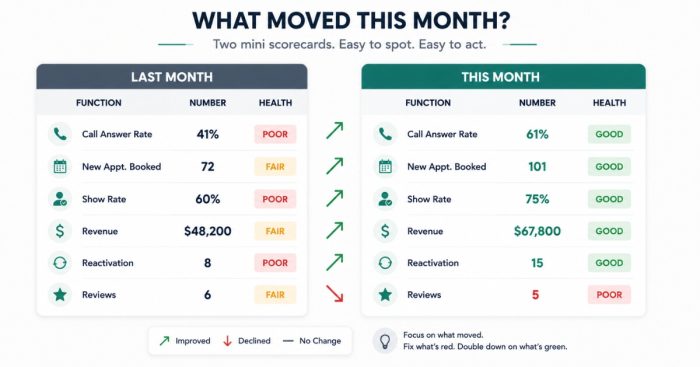
What do month-over-month movements on the worksheet actually tell me?
The pattern matters more than any single score.
In fact, a real client worksheet explains that better than theory.
Here’s an example from a client session in May 2021:
- Lead Gen: 3 → 5
- Lead Nurture: 4 → 2
- Conversion: 4 → 3
- Delivery: 4 → 5
- Referrals/Testimonials: 1 → 5
- Upsell/Resell: 4 → 4
Read those numbers like a story.
That’s exactly what they are.
Lead Gen jumped from a 3 to a 5.
At the same time, Lead Nurture dropped from a 4 to a 2.
That’s the classic success-breaks-the-next-stage pattern.
The campaigns worked.
Consequently, lead volume increased.
However, the follow-up process that handled last month’s volume could no longer keep up.
Booking and attendance rates slipped.
As a result, Conversion fell one point as well because the leads who reached the consultation arrived less nurtured.
Improving one function often places pressure on the function immediately after it.
The worksheet catches that during the first month.
By contrast, the profit-and-loss statement may not reveal it for an entire quarter.
The Referrals/Testimonials column tells a different story.
It climbed from a 1 to a 5 in a single month.
Nothing about the clinical care changed.
Delivery was already a 4.
Instead, the team simply started asking.
Referrals and testimonials are rarely a delivery problem.
Rather, they’re an asking problem.
That’s why this column can improve faster than any other part of the worksheet.
How often should I fill out the worksheet — and who fills it out?
Complete it once each month.
Schedule a fixed 60-minute meeting with the owner and everyone responsible for one of the six functions.
Monthly is the right cadence because most KPIs need enough volume to become meaningful.
A single week’s close rate at a small practice is usually just noise.
The worksheet complements your weekly dashboard.
It doesn’t replace it.
The weekly dashboard tells you whether the machine ran this week.
Meanwhile, the monthly worksheet shows which part of the machine needs rebuilding next.
Who attends the meeting matters just as much as when you hold it.
If your practice has assigned function owners, each person should bring the KPI for their area.
For example:
- the marketing lead owns Lead Gen
- the patient coordinator owns Lead Nurture and Conversion
- the providers own Delivery
Then each owner presents the KPI and explains the score.
That single monthly habit creates more accountability than any organizational chart.
It’s also how high-growth practices operate.
Elite Pain Doctors added $2,095,039 in revenue in just 10 months.
Growth like that comes from improving every function of the business, not from one lucky marketing campaign.
What do I do once the worksheet shows me a low score?
Fix one function each month.
Choose the lowest score that appears earliest in the patient journey.
Then leave everything else alone.
The biggest danger isn’t a low score.
Instead, it’s trying to fix everything at once.
An owner may see three columns scoring 3.
As a result, they launch five initiatives at the same time.
Thirty days later, all six columns perform worse because the team spent the month in meetings instead of improving the business.
Here, discipline wins.
Energy alone doesn’t.
Choose the single lowest score.
If two columns tie, fix the one that’s furthest upstream.
Every downstream function depends on the output from the one before it.
For example, a 2 in Lead Nurture hurts Conversion no matter how strong the sales script is.
Next, assign the improvement to the owner responsible for that function.
Set one 30-day KPI target.
Then score the worksheet again next month.
Some improvements involve a better process, such as a follow-up sequence for Lead Nurture.
Others require a stronger script for Conversion.
Still others depend on building a habit, such as consistently asking for referrals.
Although the tactics differ, they all share three qualities.
They’re specific.
They’re practical.
And they’re visible on one page 30 days later.
That steady, one-column-at-a-time approach is the real secret behind consistent medical practice marketing.
It isn’t one heroic campaign.
Instead, it’s six business functions that become a little stronger every month.
FAQ’s About the Six-Function Monthly Worksheet
What counts as a good overall score on the worksheet?
There isn’t a meaningful total score.
The worksheet is a diagnostic tool, not a report card.
A practice with five 5s and one 2 has a bigger problem than a practice with six 4s because the patient journey works like a chain.
Ultimately, the weakest function determines overall throughput.
What if I don’t know the number for one of the KPIs?
Score that function as a 1 or a 2.
Then make measurement itself the priority for the month.
Not knowing your booking rate or close rate is one of the most common discoveries during a first worksheet session.
Furthermore, installing proper tracking often uncovers quick wins by itself.
How is this worksheet different from a weekly metrics dashboard?
The difference is cadence and purpose.
A weekly dashboard monitors whether the business operated correctly this week.
Meanwhile, the monthly worksheet diagnoses which function needs rebuilding next.
Use both.
Operate the business weekly.
Then prioritize improvements monthly.
Who should own each function’s score?
The person responsible for that function every day.
The marketing lead owns Lead Gen.
The patient coordinator owns Lead Nurture and Conversion.
The providers own Delivery.
Until someone else is assigned, the owner should manage Referrals and Upsell.
If nobody owns a column, that’s a finding in itself.
Why did Referrals/Testimonials jump from a 1 to a 5 in the real example?
Because the team started asking.
Referrals and testimonials are rarely limited by care quality.
Delivery was already strong.
Instead, they’re usually limited by whether someone consistently asks.
Therefore, this column can improve faster than any other function on the worksheet.
What’s the next step?
If you can’t confidently identify which of the six functions is limiting your practice’s growth today, that’s already your diagnosis.
Book a strategy call.
In 60 minutes, we’ll complete the worksheet with you, attach real numbers to every column, and identify the one function to improve over the next 30 days.
You’ll also leave with a clear plan for fixing it.