
The Missing Piece Between Leads and Growth: The Three Conversion Rates Every Cash-Pay Practice Ignores
Most clinic owners have lived this: the ad account says the campaign is working — clicks, impressions, leads, a reasonable cost per lead — but revenue isn’t moving the way the dashboard says it should.
The missing piece between leads and growth isn’t more leads.
It’s conversion, in three specific places: your inbound calls, your paid-ad leads, and your existing patients.
Here’s the FAQ.
What’s the missing piece between leads and growth at a medical practice?
Conversion — measured in three places: the rate at which inbound calls become booked patients, the rate at which ad leads become paying patients, and the rate at which existing patients stay and buy again.
Leads are potential energy; conversion is what turns them into revenue.
A practice that improves all three conversion rates grows dramatically without spending another dollar on traffic.
That’s because the same lead flow produces more booked appointments, more paying patients, and more repeat revenue.
That’s the holistic view we take with every clinic: don’t just look at the ads numbers — look at the whole machine.
If we can improve your conversion rate on inbound calls, improve your conversion rate on paid ads, and improve your conversion rate on retained, existing patients, we can grow the business overall.
Not just the ad account.
This is why two clinics with identical ad budgets end up in different worlds.
One converts 30% of calls and loses patients after visit two.
The other converts 70% and keeps members for years.
Same leads. Completely different businesses.
Why isn’t cost per lead the right way to judge my marketing?
Because cost per lead measures the ad account, not the business.
And it quietly pushes accountability for revenue back onto you.
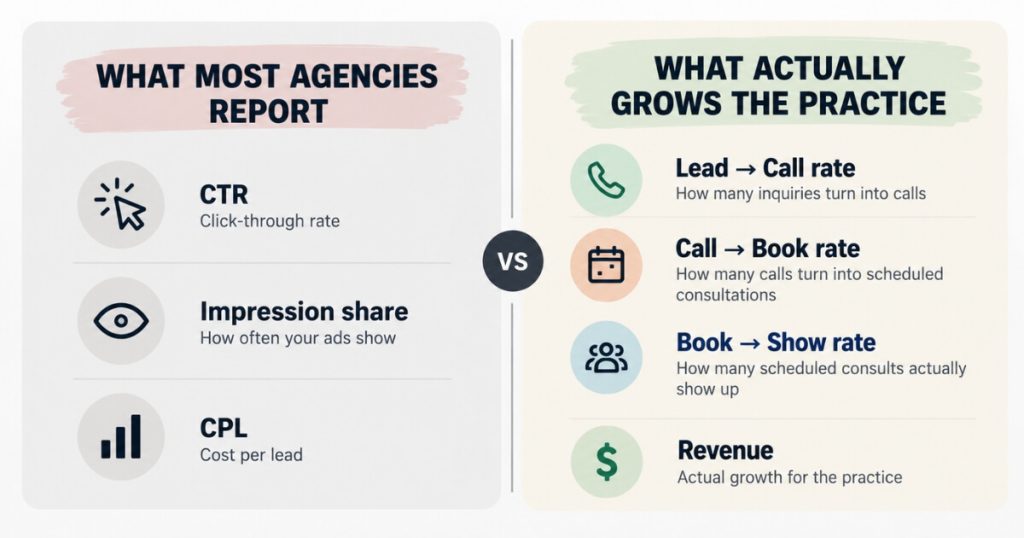
Here’s how most agency reporting works:
“You’re getting this click-through rate, this impression share, this many leads — here’s your cost per lead.”
Then the results get pushed back to the owner.
If revenue didn’t grow, well, the leads were delivered, weren’t they?
The ad metrics were fine, so the problem must be yours.
That reporting isn’t wrong.
It’s just incomplete in a way that hides the real story.
A $40 cost per lead means nothing until you know what a lead becomes.
If your front desk converts 25% of inquiries and your competitor converts 60%, their “expensive” $80 leads produce patients at nearly half your real cost.
The metric that matters is cost per acquired patient.
And that number lives downstream of the conversion rates most reports never mention.
How do I improve the conversion rate on inbound calls?
Treat the phone as a sales channel: script the call, track the outcome of every inquiry, and coach to the recording — not the vibe.
Most clinics have no idea what their call conversion rate is.
That’s because nobody logs what happens after “thanks for calling.”
Start there.
Every inquiry gets an outcome in the CRM — booked, follow-up scheduled, or lost with a reason.
Then give the front desk a simple structure.
First, capture contact details.
Next, connect to what the caller actually wants.
Finally, close for the appointment rather than “sending some information.”
The clinics that do this typically find that call conversion — not lead volume — was their cheapest growth lever all along.
It’s a core part of building a patient acquisition system that converts demand instead of leaking it.
How do I improve conversion from paid-ad leads?
Speed and follow-up.
Respond in minutes, not hours, and chase every lead through a scheduled sequence instead of one polite attempt.
Paid-ad leads are colder than inbound calls — they clicked an ad, they didn’t look you up.
So they convert on responsiveness.
A lead texted back within five minutes is dramatically more likely to book than one called the next morning.
After the first touch, conversion comes from cadence.
That means a structured sequence of calls, texts, and emails over days, not a single voicemail.
This is system work, not heroics.
Automation handles the timing, while the front desk handles the conversations.
Done properly, the numbers get remarkable.
Elite Pain Doctors added $2,095,039 in revenue in 10 months.
And the difference wasn’t just lead flow.
It was a machine that converted the flow into consultations and treatments instead of letting it decay in an inbox.
How do I grow revenue from existing patients?
Build retention into the model: scheduled follow-ups, reactivation campaigns, and programs that give patients a reason to stay.
That’s because existing patients are your highest-converting audience.
The third conversion rate is the one agencies never report because it has nothing to do with ads.
What percentage of your existing patients stay, return, and buy the next appropriate service?
Acquisition gets all the attention.
But a patient who already trusts you converts at rates no cold lead ever will.
Follow-up visits after treatment, membership structures, and database reactivation for lapsed patients all raise lifetime value.
That quietly lowers what you can afford to spend acquiring the next patient.
If your practice has years of patient records and no reactivation system, that database is the cheapest revenue you’ll ever generate.
The clinics that treat existing patients as a channel — not a completed transaction — grow overall, not just from paid ads.
What should I expect from a marketing partner if leads aren’t turning into growth?
A partner who audits all three conversion rates and takes responsibility for revenue — not one who reports ad metrics and hands the problem back to you.
The test is simple: does the reporting conversation start with click-through rate, or with cost per acquired patient and revenue?
A partner who looks at the business holistically will tell you when the ads are fine and the calls are the problem.
Even though the calls aren’t “their department.”
That’s the difference between buying ad management and buying growth.
It’s also the first thing to probe when evaluating medical practice marketing consultants.
Ask them what they’d measure besides the ads.
If the answer doesn’t include your call conversion and your existing patients, they’re selling you leads, not growth.
FAQ’s About the Missing Piece Between Leads and Growth
Why do more leads not translate into more revenue at my clinic?
Because leads only become revenue through three conversion points: inbound calls, ad-lead follow-up, and existing-patient retention.
A weakness at any of them silently absorbs the extra volume.
Doubling leads into a 25% call conversion rate mostly doubles your losses.
What conversion rate should a cash-pay clinic target on leads?
Well-run cash-pay practices convert far more than half of qualified leads into booked appointments.
For example, Orthobiologics Associates converted 79.4% of leads into bookings with a disciplined follow-up system.
If you’re converting under a third, conversion is a bigger growth lever than lead volume.
Is cost per lead a useless metric?
No — it’s a fine input metric for comparing campaigns.
It’s just not a success metric.
Judge marketing on cost per acquired patient and revenue, which depend on the conversion rates downstream of the ad account.
A low CPL with poor conversion is more expensive than a high CPL with strong conversion.
Which of the three conversion rates should I fix first?
Inbound calls, usually.
It’s the highest-intent traffic you have.
The fixes — scripting, tracking, and coaching — cost almost nothing, and improvements show up in revenue within weeks.
Then tighten paid-lead follow-up speed and cadence.
Finally, build the existing-patient retention system.
How do I know if my agency is reporting the right things?
Ask one question: “What’s my cost per acquired patient this month?”
If they can’t answer — or steer the conversation back to click-through rate and impression share — they’re managing the ad account, not the growth.
The reporting should connect ad spend to booked, paying patients.
What’s the next step?
If your lead reports look healthy but revenue is flat, the gap is almost certainly in one of the three conversion rates.
And finding which one takes about an hour.
Book a strategy call.
We’ll walk your numbers from click to call to booked patient to repeat revenue.
Then we’ll show you where the leak is and lay out the fix.
It’s the same holistic approach behind a regenerative practice that converted 79.4% of its leads into booked appointments and $309,590 in cash-pay revenue without ads.