
Message, Market, Media: Why Cash-Pay Clinics Pick the Wrong Marketing Channel First (And How to Fix It)
Most clinic owners build their marketing backwards. They start by picking a channel — “I want to run Facebook ads because Dr. So-and-so says he gets all his business from Facebook” — and then wonder why it doesn’t work. The order is the problem. The Message, Market, Media framework fixes it: define your message first, then your market, and only then choose the channel. This is the FAQ on that framework, drawn from the approach Real ADvice teaches, including how to match the right channel to the right treatment once you’ve done the first two steps.
What is the Message, Market, Media framework?
It’s the correct order for building any marketing campaign: define your message first, then your market, and finally the media (channel).
Most people do it in exactly the reverse order, which is why their marketing fails.
The framework is simple but almost universally ignored.
- Message is the result you get for people.
- Market is who you help best with that message.
- Media is where you go to reach that market.
When you follow that order, every decision downstream is grounded in something real.
You’re putting a resonant message in front of the right people on a channel where they actually are.
When you skip straight to media, you’re guessing.
Most of the time, that guess is wrong.
A common mistake is choosing a channel because someone else succeeded there.
For example: “I want Facebook ads because another doctor gets all his business from Facebook.”
That says nothing about whether your ideal patients are on Facebook or whether it’s the best place to reach them.
The Message, Market, Media framework keeps you from building your entire medical practice marketing strategy on a borrowed assumption.
Get the order right, and the channel choice becomes obvious instead of a gamble.
Why is choosing your marketing channel first a mistake?
Because picking the media first means you’re committing budget to a platform before you know whether your ideal patients are even there.
You also don’t know whether it’s the best way to reach them.
“Dr. So-and-so gets all his business from Facebook” is a fact about his practice, not yours.
His ideal patient, his market, and his message may be completely different.
Copying his channel means borrowing the conclusion without understanding the reasoning behind it.
Maybe your ideal patient researches heavily on YouTube.
Maybe they search with high intent on Google.
Or perhaps they compare providers on TikTok.
In any of those cases, Facebook could be exactly the wrong place to interrupt them.
The deeper issue is that channel-first thinking skips the two decisions that actually determine success.
Without a clear message, your marketing has nothing compelling to say.
Without a defined market, you don’t know who you’re speaking to.
Choosing media first puts the least important decision first.
Instead, define your message and market first.
Then let the channel become the logical result of those two decisions.
How do I define my message?
Your message is the result you get for people — stated simply and specifically enough that the right person immediately understands the outcome you deliver.
Start with the transformation, not the treatment.
A strong message names the result.
For example:
“I build, grow, and scale patient-acquisition systems.”
That’s a clear outcome, not a list of services.
For a clinic, your message is the result your ideal patient gets, such as:
- More energy and confidence
- Relief from pain
- A body they feel good in
Express those outcomes in plain, outcome-focused language.
Your message is the foundation because everything after it flows from the result you promise.
That includes:
- Who you target
- Where you reach them
- What your marketing says
Get specific about the outcome because vague messages resonate with no one.
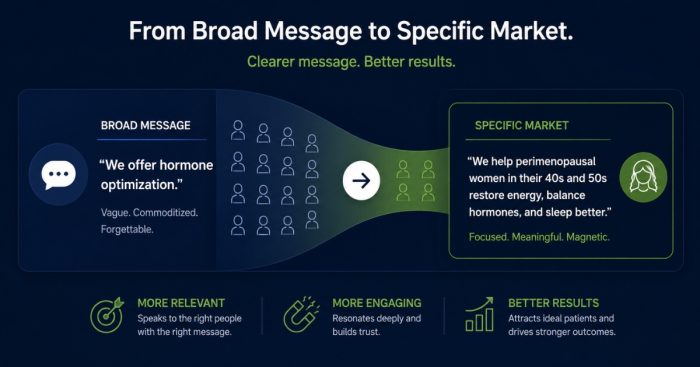
“We offer hormone therapy” is a service.
“We help you get your energy, focus, and confidence back” is a message.
The clearer the result you articulate, the more powerful your marketing becomes for the people who want that result.
That’s exactly why message comes first.
You can’t choose the right market or the right channel until you know what outcome you’re actually selling.
How do I define my market?
Your market is who you help best with your message — and niching down is what makes that message powerful to the exact right reader.
Once you know the result you deliver, ask a simple question:
Who do I help best with that result?
The answer narrows a broad message into a targeted one.
For example:
“I build, grow, and scale patient-acquisition systems.”
becomes
“I help cash-pay medical practices build, grow, and scale patient-acquisition systems.”
Adding the market — cash-pay medical practices — makes the message much more powerful to that reader because it’s clearly meant for them.
Niching down doesn’t shrink your opportunity.
Instead, it sharpens your resonance with the people most likely to buy.
This follows the same discipline as defining your ideal patient avatar.
The more specifically you know who you help best, the more your message connects.
A message aimed at everyone is weak.
A message aimed at a clearly defined market feels custom-made.
Knowing your market also tells you which channel to choose next.
Different markets spend time in different places.
You can’t choose the right media until you know exactly who you’re trying to reach.
That’s the hinge of the entire patient acquisition process.
How do I choose the right media (channel) for my market?
Match the channel to how your specific market behaves and searches.
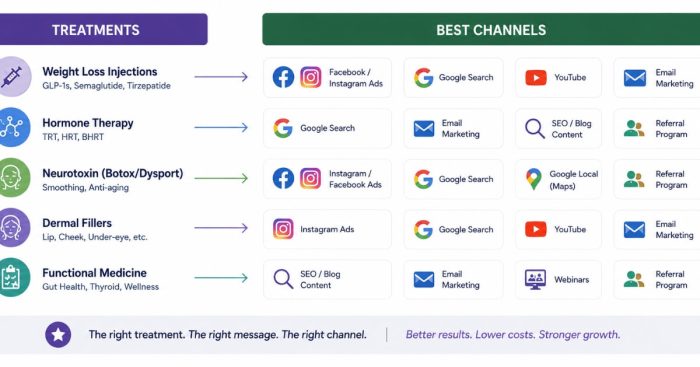
Different treatments and different patients spend time on different platforms, so the right media follows directly from your market.
Once your message and market are clear, choosing a channel becomes much easier.
For example:
- Hormone, TRT, and HRT patients typically do extensive research into their symptoms. Content-driven channels like YouTube work well, while Google and SEO compound over time.
- Pain patients with knee, shoulder, hip, or back problems often search in high-intent moments. Google generally delivers the highest-quality, fastest-responding leads and can convert around 50%, compared with roughly 15–20% from Facebook, depending on the market.
- Aesthetics patients are largely women comparing themselves to others. Instagram and TikTok fit this behavior, especially when paired with a strong offer and very fast follow-up.
- Weight-loss patients searching for semaglutide or tirzepatide by name respond well to Google when available, or YouTube with a free educational resource when Google isn’t an option.
The goal isn’t to memorize a list of platforms.
Instead, remember that the channel is an output of knowing your market, not an input you choose first.
A pain clinic and a medspa shouldn’t default to the same platform because their patients behave very differently.
Once you’ve defined your message and your market, the media often selects itself.
You can also consider underused channels such as radio and TV.
Those channels perform very well for certain markets, including neuropathy on TV or ED and TRT on conservative talk radio.
Why does Facebook show up so rarely in this — and when does it actually work?
Because Facebook isn’t the default best channel for most cash-pay treatments.
It performs well only when you have the team and speed needed to convert its lower-quality leads.
Facebook can still generate leads.
However, the quality is typically lower than intent-driven channels like Google.
Converting Facebook leads also requires faster and more consistent follow-up than most clinics can provide.
The platform tends to work best for clinics with a large team of care coordinators or receptionists who can respond immediately and work every lead aggressively.
That’s generally not feasible for a clinic under roughly $100k a month.
Without that operational capacity, Facebook’s cheaper leads often become expensive through wasted effort.
This is why Facebook rarely becomes the answer when you work through the Message, Market, Media framework.
It’s a great platform for the right operation.
It’s simply the wrong default for everyone else.
The framework protects you from making that mistake.
Rather than copying the platform a competitor talks about, you choose the channel your actual market uses and your actual operation can support.
Message comes first.
Market comes second.
Media comes last.
Every time.
FAQ’s About the Message, Market, Media Framework
Which channel is best for hormones, TRT, and HRT?
Content-driven channels, led by YouTube, work best, with Google and SEO compounding over time.
These patients spend significant time researching their symptoms before making a decision.
As a result, consistent educational content reaches them effectively.
YouTube also gains traction faster than waiting for SEO alone.
Radio, especially conservative talk radio for TRT and ED, is another underused channel that performs well for this market.
Which channel is best for pain patients?
Google is the best choice in most cases.
Pain patients search in high-intent moments, and Google delivers the highest-quality, fastest-responding leads.
Conversion rates can reach around 50%.
Although it isn’t the cheapest channel because insurance companies, law firms, and pain clinics compete for those terms, the lead quality often justifies the cost.
Facebook can supplement with lower-quality leads that convert at roughly 15–20%.
TV also performs well for conditions like neuropathy.
Which channel is best for aesthetics and medspa?
Instagram and TikTok are usually the strongest choices.
The market is largely women comparing themselves to others, which aligns naturally with those platforms.
Lead with a strong dollars-off offer.
Then be ready to call new leads quickly.
Aesthetics patients are shopping for a commodity, and they reward speed and trust.
This is one of the clearest examples of the market dictating the channel.
Is Facebook dead for cash-pay clinics?
No.
However, it isn’t the default winner many clinic owners assume it is.
Facebook works well for clinics with a large team that can follow up immediately and consistently.
That generally means practices above roughly $100k a month.
For most smaller clinics, the lower lead quality and heavier follow-up requirements make higher-intent channels a better fit.
Choose Facebook because your market and operation support it—not because a competitor uses it.
What’s the next step?
If your marketing isn’t working, check the order you built it in.
Most clinics choose the channel first and then try to force a message and market onto it.
Reverse the process.
Define the result you deliver first (message).
Next, define who you help best (market).
Finally, let those two decisions determine which channel to use (media).
Follow that order, and the channel stops being a gamble.
Instead, it becomes the obvious choice.
On a strategy call we’ll work through your message, your market, and the exact channels your ideal patients actually use so you stop copying someone else’s Facebook results and start reaching your own market where they are.
It’s the same framework behind clinics like an HRT clinic we grew from $1M to $4M a year by matching the right message and market to the right channels.