
Why Are My Men’s Hormone Clinic’s Leads Falling Through the Cracks? (Speed-to-Lead, Call Logging, and the Pipeline Fixes That Stop the Leak)
A men’s hormone clinic rarely has a lead-generation problem. It has a lead-leakage problem—leads that arrive, sit, and quietly die because nobody owns them, the inbound calls never get logged, and the follow-up is too slow to matter. The clinic feels like it needs more leads when it’s actually losing a chunk of the ones it already paid for.
This is the FAQ on stopping that leak, drawn from a two-location TRT practice where the fastest-responding clinic converted leads its busier sibling was losing—without spending an extra dollar on ads.
Why are my TRT or men’s hormone clinic’s leads falling through the cracks?
Leads fall through the cracks when nobody owns the pipeline and entire lead sources remain invisible.
The pattern is surprisingly common.
A lead comes in, gets automatically routed based on something like a phone area code, an appointment is scheduled, and then the process simply stops.
Unfortunately, many pipelines end at “appointment booked.”
Without additional follow-up stages, nobody becomes responsible for moving the lead forward.
At the same time, some leads never enter the CRM at all.
For example, inbound phone calls often go unlogged.
As a result, the pipeline appears healthy while quietly leaking opportunities.
In one men’s hormone clinic, roughly 2 out of every 15 leads disappeared this way.
That translated to approximately 10% lead leakage despite strong demand.
The solution isn’t buying more leads.
Instead, assign one person to own the pipeline, build meaningful follow-up stages, log every lead source, and remove genuinely dead opportunities from the pipeline.
Once that happens, active leads become much easier to identify and work.
That operational discipline forms the foundation of effective men’s hormone clinic marketing.
How fast should I follow up with a new patient lead at a cash-pay clinic?
Immediately.
Call or text new leads the moment they arrive.
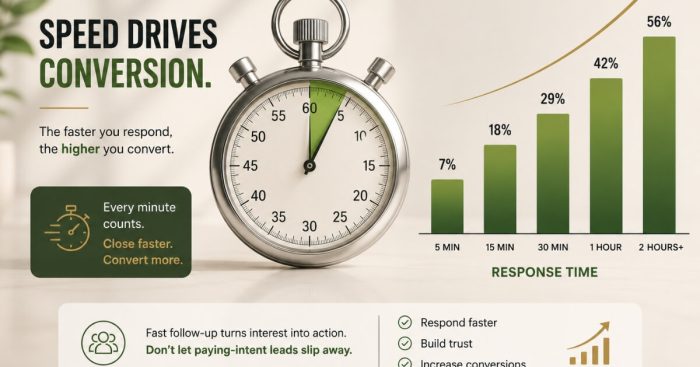
Speed-to-lead is often the biggest difference between clinics that consistently convert and clinics that quietly lose opportunities.
For example, one clinic owner kept a laptop open at home so he could call website leads the instant they appeared.
As a result, he converted roughly 5 out of every 15 leads into paying members.
Meanwhile, the busier sister clinic allowed leads to sit untouched and lost many of those same opportunities.
A lead contacted within two minutes behaves very differently from one contacted two hours later.
By the time slower clinics finally call, many prospects have already cooled off or booked elsewhere.
Fortunately, the tools required are both simple and inexpensive.
To improve response time:
- Install your CRM mobile app.
- Turn on push notifications.
- Enable text notifications.
- Create a “customer replied” notification so every response reaches you immediately.
Whoever responds first usually wins the patient.
Therefore, build a system that makes near-instant responses possible every single time.
Are my inbound phone-call leads invisible in my CRM?
Probably.
If your team isn’t intentionally logging inbound phone calls, you’re almost certainly losing some of your highest-quality leads.
For example, one clinic discovered that approximately 40 inbound phone-call leads every month never entered the CRM.
Without those records, there was no follow-up, no nurturing, and no visibility into a significant source of demand.
Phone callers are often even higher-intent than website form submissions because they’ve already taken the extra step of calling.
Failing to capture those leads creates two problems.
First, you lose potential patients.
Second, you lose valuable reporting data.
Fortunately, the solution doesn’t require new software.
Instead, it requires consistent training and accountability.
Every inbound phone call should become a CRM lead.
From there, staff should assign the same pipeline stages and follow-up process used for every web lead.
Once those calls become visible, your true lead volume finally becomes accurate.
Likewise, your conversion metrics become much more reliable.
Instead of guessing how marketing performs, you’ll know exactly which channels generate patients.
How do I keep leads from getting lost in my pipeline?
Start by assigning one person to own pipeline movement.
Then build follow-up stages that extend beyond “appointment booked.”
Finally, log every lead source and remove truly inactive opportunities so active leads remain easy to find.
One of the biggest mistakes clinics make is allowing the pipeline to stop after the appointment is scheduled.
When patients don’t immediately book, they have nowhere else to go.
Instead, create additional stages such as:
- Contacted
- Following Up
- Reactivation
Next, assign one specific person to move every lead through those stages.
Without clear ownership, opportunities naturally fall through the cracks.
Just as importantly, clean the pipeline regularly.
Archive stale leads that have gone unanswered for months so they no longer hide the prospects worth contacting today.
At the same time, automate your first response so every new lead hears from your clinic immediately, even before a team member becomes available.
A pipeline with clear ownership, meaningful stages, clean data, and automated first contact consistently converts more leads into appointments.
That’s also the operational backbone of patient acquisition.
What conversion rate should I expect from a free testosterone test to a paid membership?
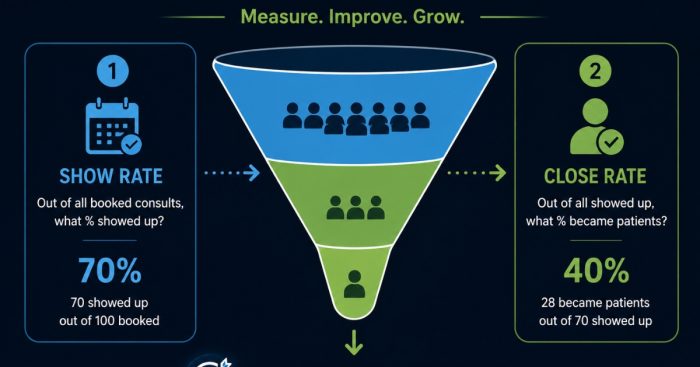
Expect roughly 8 out of 10 patients to become members once they complete their full in-person laboratory visit.
For most clinics, the bigger opportunity isn’t the consultation itself.
Instead, it’s getting more booked patients to actually show up.
For example, one established men’s hormone clinic converted about 78% of in-person new-patient visits into memberships.
However, only about 62% of people who booked a free testosterone test actually attended the appointment.
When you look at the entire funnel, that meant roughly half of all free-testosterone leads ultimately became members.
Read those numbers carefully.
The consultation close rate was already strong.
The biggest opportunity was improving the show rate before the consultation ever happened.
That’s exactly where speed-to-lead, appointment reminders, and a credit-card-on-file policy create meaningful improvements.
Track the funnel in two separate stages:
- Show rate
- In-person close rate
Doing so makes it much easier to identify where patients are dropping off.
For many well-run men’s hormone clinics, the issue isn’t closing qualified patients.
Rather, it’s getting qualified patients through the front door.
That’s encouraging because improving show rate is usually much easier than fixing a weak sales conversation.
We’ve seen this type of recurring-membership model compound at an HRT clinic we grew from $1M to $4M a year.
Should I raise my membership price to grow revenue, or fix the leak first?
Fix the leak first.
Recovering lost leads creates new revenue without introducing pricing risk.
By contrast, raising prices beyond what your market will accept often slows growth.
For example, one men’s hormone clinic normally charges $150 per month.
For more price-sensitive blue-collar patients, the clinic offers a discounted $125 membership to encourage enrollment.
The same clinic also tested $200 and $250 monthly memberships.
Neither price attracted buyers.
That result clearly showed the market—not the clinic—determined the pricing ceiling.
Meanwhile, the clinic continued losing roughly 10% of its leads because of pipeline leakage.
Recovering those existing opportunities represented a far safer growth strategy than increasing prices.
Follow the sequence:
- Plug the pipeline leak.
- Log every lead source.
- Improve speed-to-lead.
- Assign ownership of the pipeline.
- Grow using the leads you’re already generating.
Only after the funnel is performing consistently should you begin testing higher prices.
Even then, rely on real market feedback instead of assumptions.
In many markets, accessible pricing combined with higher volume outperforms premium pricing with fewer buyers.
Operational improvements almost always produce faster, more predictable growth than pricing experiments.
FAQ’s About Stopping Lead Leaks at a Men’s Hormone Clinic
Who actually converts best at a cash-pay men’s clinic?
Blue-collar and skilled trade workers often convert more consistently than lawyers, physicians, or executives.
Many of these patients depend on physical performance to earn a living.
As a result, they often view hormone optimization as an investment in their income rather than an optional expense.
For example, one clinic’s referral engine began with a plant project manager overseeing approximately 140 employees.
High-trust, blue-collar patients like that frequently become exceptional referral sources.
How many leads do I actually need to hit my new-member goal?
Start with your conversion rate and work backward.
For example, one clinic targeting 80 new members each month with an 80% in-person close rate needed approximately:
- 96 new-patient visits
- 200–250 leads per month
- About six new-patient visits each day, four days per week
That calculation only works when every lead source is properly logged.
Otherwise, your conversion numbers become misleading.
What notifications should I turn on so I never miss a lead?
Enable push notifications and text notifications inside your CRM mobile app.
In addition, create a “customer replied” notification that’s filtered to the assigned user.
That setup alerts the appropriate team member the moment a prospect responds.
For example, if someone replies, “Wednesday works,” the assigned coordinator knows immediately instead of discovering the message hours later.
The goal is simple: every reply should reach a human within seconds.
Should I route overflow leads to a less-busy location or use telehealth?
Yes.
When one location reaches capacity, route overflow patients to another clinic with availability.
Likewise, offer telehealth combined with local laboratory testing whenever travel becomes a barrier.
Many men prefer completing laboratory work close to home or work instead of driving long distances.
Meeting patients where they are helps recover opportunities that a single busy location would otherwise lose.
Available capacity elsewhere in the business shouldn’t cost you patients.
What’s the next step?
If your men’s hormone clinic feels like it needs more leads, first examine the leads you already have.
In many cases, slow follow-up, unlogged phone calls, and weak pipeline management are the real problems.
Instead, improve your speed-to-lead.
Log every lead source.
Assign one person to own the pipeline.
Then remove inactive opportunities so your team can clearly focus on the leads that still matter.
Once those systems are in place, your existing lead volume often converts far more effectively.
During a strategy call, we’ll audit your pipeline and evaluate your current follow-up speed.
Then we’ll identify exactly where leads are leaking and show you how to recover them before spending another dollar on advertising.
It’s the same operational approach behind a clinic where we lifted website leads by 900% and added 100+ inbound calls a month.