
Why Isn’t My Med Spa Getting Patients From Google Despite Hundreds of Reviews? (The Broken-Listing Problem)
In August 2026 we audited a Long Island med spa run by a genuinely skilled solo nurse-practitioner injector: 282 Google reviews at 4.6 stars, published pricing, and a blog publishing twice a month.
And she was invisible.
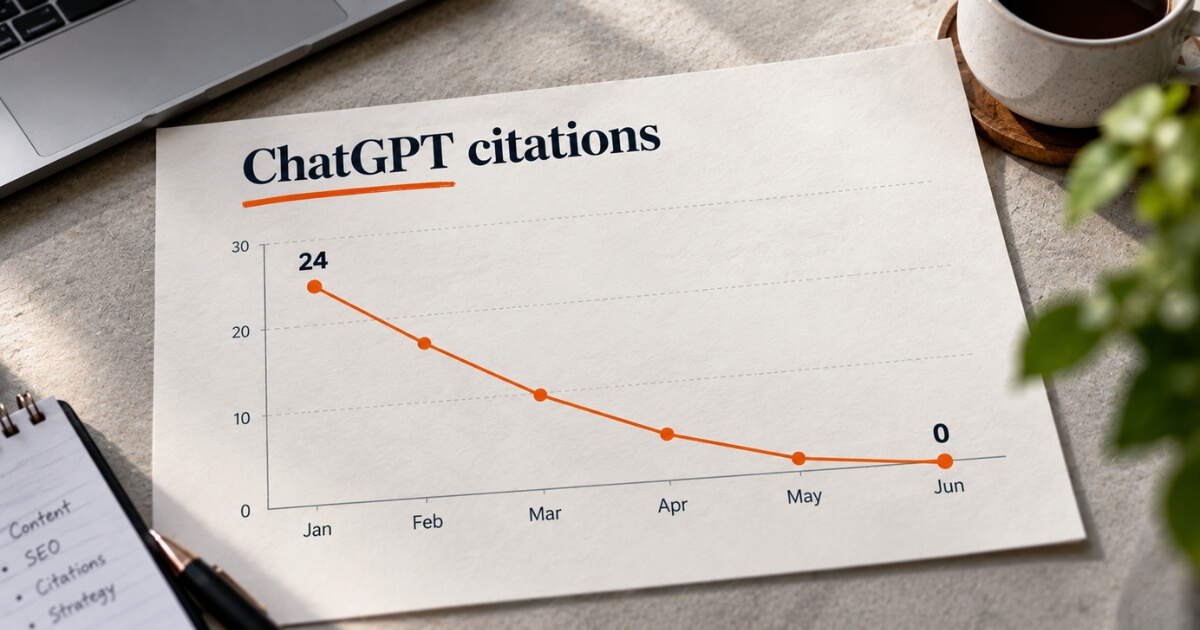
She ranked dead last in her own category’s map results, below clinics with 2 and 8 reviews. Organic traffic had been cut in half, while ChatGPT citations dropped from 24 to zero.
The practice wasn’t the problem.
Her Google universe was.
Here’s the FAQ every med spa owner should read before spending another marketing dollar.
Why isn’t my med spa getting patients from Google when I have hundreds of reviews?
Because reviews only work when Google trusts your location data.
If your addresses, phone numbers, and listings contradict each other, Google stops trusting all of it.
The med spa we audited had three different answers to “where is this business?”
The website advertised one address.
Meanwhile, the only live Google listing — the one holding all 282 reviews — sat at a second address on a residential street.
Google categorized it as “Weight loss service” instead of “Medical spa.” It also had no hours and no owner photos.
Then a third listing, at a former storefront location, showed “Permanently closed” in red directly under the brand name.
A review moat pinned to the wrong address is like a vault in a building you moved out of.
The asset exists.
Nobody can reach it.
What does an inconsistent name, address, and phone number actually cost a med spa?
Rankings that defy the review math — and a map pack your competitors own while you pay the bills.
In the town search for med spas, this practice didn’t appear at all.
Competitors with 73, 127, and 141 reviews filled the pack while a rival bought sponsored Maps placement on top.
In the category Google actually filed her under, she ranked eleventh — dead last — below a clinic with 2 reviews.
She out-reviewed almost every med spa in her town and lost to nearly all of them.
The damage compounded quietly.
Two different phone numbers appeared on the same homepage.
A specials page had zero specials.
The membership page had said “coming soon” for ten months.
And a seasonal offer sat there eleven months stale.
Every inconsistency makes a small withdrawal from the trust account — with Google and with patients.
This is why the first module of any serious med spa marketing engagement is a NAP consistency sweep, not an ad campaign.
How does a broken Google listing affect whether ChatGPT recommends my med spa?
Directly.
Six months before our audit, ChatGPT was citing this med spa 24 times.
At the time of the audit: zero.
AI engines recommend local practices off Google’s location data and review mass.
When Google’s data about you is self-contradicting — three addresses, two phones, a “permanently closed” flag under your brand — the AI engines don’t average it out.
They drop you from the answer.
Her Google AI Mode citations fell 38 in the same window.
Nothing was blocking the crawlers.
The site was fully readable.
ChatGPT simply stopped choosing to cite a business whose basic facts wouldn’t reconcile.
In the AI era, this is the new scoreboard.
When a prospective patient asks “best med spa near me” inside ChatGPT or Gemini, the practices with clean, consistent location signals are the answer.
Everyone else doesn’t exist.
Why is my med spa’s SEO traffic falling even though my agency publishes blogs every month?
Because publishing volume without strategy ranks you for the wrong things — and content without conversion is a library, not a funnel.
This practice’s agency was publishing on schedule: 95 posts, twice a month, right up to the audit.
Meanwhile, organic traffic fell from roughly 1,200 to 602 visits a month — cut in half in six months.
Keywords in the top three also dropped from 94 to 41.
Worse, the #1 traffic driver was national, zero-buying-intent trivia about the cheapest service on her menu.
At the same time, high-volume local money terms slipped away.
The autopilot tells were everywhere.
A holiday-themed post went live in February.
A “tired after winter” post appeared in late June.
Another 7,300 junk backlinks appeared in six months while domain rating went down.
And 22% of crawled pages returned errors.
Contrast that with what disciplined local content does.
Same tactic category.
Opposite outcome.
The difference is whether anyone is steering.
How do I fix a fractured Google Business Profile for my med spa?
One listing, at the real address, with the right category — and carry your reviews with you.
Do it in that order, before any marketing spend.
The sequence we prescribed starts with consolidating to a single Google Business Profile at the true address.
Set the primary category to “Medical spa.”
Then add hours, 20+ real photos, and a booking link.
Handle the move as an address change on the existing listing so the 282 reviews move with it rather than becoming orphaned.
Second, run the NAP sweep.
Use one name, one address, and one phone number across the website, the site’s schema code, Yelp, and every directory.
And fix both numbers on the website.
This practice’s own homepage code claimed a different address than its Google listing. That fed the contradiction to Google in machine-readable form.
Third, unblock the conversion basics.
This site’s robots.txt was blocking its own before-and-after gallery — the single highest-converting content a med spa has.
Only after fixing the foundation do ads make sense.
Pouring ad spend into a broken Google universe is renting traffic for a store with no cash register.
Done right, the moat starts working.
Those 282 reviews beat nearly every competitor in her market the moment Google can see where the business actually is.
That’s the boring, unglamorous core of medical practice marketing that agencies selling “content packages” skip.
FAQ’s About Med Spa Google Business Profile Problems
Can I move my Google reviews to a new address?
Yes — if you change the address on your existing Google Business Profile, the reviews stay with the listing.
Creating a brand-new listing at the new address and abandoning the old one is what orphans reviews.
Always update, never duplicate.
Why does my med spa rank below clinics with fewer reviews?
Usually because your location data is inconsistent or your primary category is wrong.
A listing categorized as “Weight loss service” won’t win “med spa” searches no matter how many reviews it has.
Conflicting addresses across your website, listing, and directories also erode Google’s confidence in showing you at all.
Does my website’s schema markup affect my Google Maps ranking?
Yes.
Schema is machine-readable data that Google reads directly.
If your website’s code claims one address and your Google Business Profile claims another, you’re feeding Google two contradictory answers about where you are.
Those contradictions suppress local visibility.
How do I know if ChatGPT recommends my med spa?
Ask the engines what they suggest for your service and town.
Then track citations with an SEO tool that monitors AI answers.
AI assistants build local recommendations from Google’s location data and review mass.
So a clean, consistent profile is the prerequisite for showing up.
Should I run ads before fixing my Google listing?
No.
Ads into a fractured Google universe and a broken booking flow waste most of their spend.
Prospects may click the ad, then Google you and find a “permanently closed” listing or the wrong address.
They don’t book.
Fix the listing, the phones, and the booking path first.
Then ads compound.
What’s the next step?
If your med spa has real reviews and real skill but the patients aren’t coming from Google — or you suspect your agency’s monthly report is hiding a foundation problem — book a strategy call.
In 60 minutes we’ll audit your Google universe live: listings, categories, NAP consistency, schema, and what the AI engines currently say about you.
You’ll leave with the fix list in priority order, whether or not we ever work together.