
What Does It Cost to Acquire a Liposuction Patient From Google Ads?
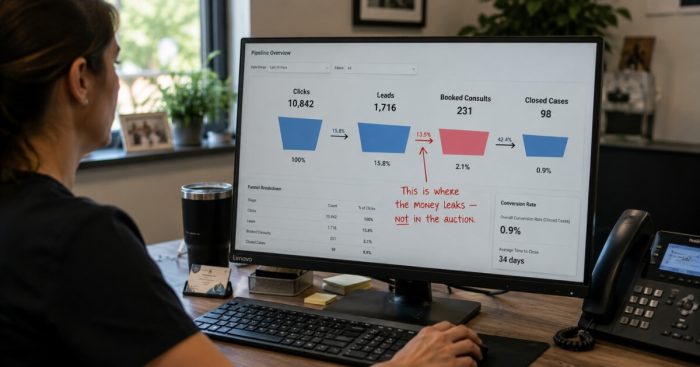
At one cash-pay practice we work with, a liposuction lead from Google Ads cost $88.54. A booked consultation cost $447. Same campaign, same month, same patients — one number is roughly five times the other, and almost nobody asks why. The gap between those two figures is where most practices quietly lose the argument about whether paid advertising works, because they are looking at the cheap number and making decisions with it. Here’s what a liposuction patient actually costs to acquire, and how to judge whether your own number is any good.
What does it cost to acquire a liposuction patient from Google Ads?
At Everest Regenerative Medicine in West Fargo, North Dakota, HD Lipo leads came in at $88.54 per lead and $447 per booked consultation.
Across the nine-month tracked engagement, the campaign produced 201 FUNsculpting leads.
Do the division yourself: $447 ÷ $88.54 is roughly five.
That is arithmetic on the two published costs, not a leads-to-booked ratio the practice reported. However, it implies something on the order of five leads for every consultation that landed on the calendar.
Nothing about that implied ratio is a Google Ads failure.
On those numbers, the ads did their job five times over. Four of those five people called or filled out a form, and then something between the inquiry and the appointment did not hold.
The temptation is to quote $88.54 in a partner meeting and let everyone feel good.
For a high-ticket cash-pay procedure, that sounds like a bargain against almost any ticket you can name.
But you cannot treat a liposuction lead. You can only treat a liposuction patient who shows up.
On the arithmetic above, the difference between $88.54 and $447 represents money spent reaching people who raised their hand but never made it to a chair.
That spend is real whether or not you count it.
One caveat before you anchor on the figure: $88.54 is specific to this treatment, this market, this practice, and this stretch of time.
West Fargo is not Scottsdale. HD Lipo is not GLP-1 weight loss. November does not price like June.
What travels between practices is the method — the two-number discipline — not the number itself.
Why is cost per booked consultation the number that decides whether the campaign works?
Because a lead is a request and a booked consultation is a commitment. Only one of the two can be converted into revenue.
Cost per lead is the number every agency quotes because it is the number an agency can move alone.
Better keywords, tighter match types, a stronger landing page, and a cleaner offer all belong to whoever runs the account.
Cost per booked consultation is a shared number.
It moves only when the ads, callback speed, front desk script, reminder sequence, and follow-up all move together.
That is exactly why it tells you the truth.
Watch what happens when you optimize the wrong number.
A campaign that cuts cost per lead by widening targeting can raise cost per booked consultation. The extra leads may be less serious and show up less often.
The report looks better, but the practice is poorer.
The reverse can happen too. A tighter campaign may push cost per lead up while improving show rate enough to cut the booked-consult cost sharply.
Track only leads and you cannot tell those situations apart.
That is why patient acquisition has to be measured to the appointment, not just to the form fill.
And the gap is almost always a follow-up gap, not an ad gap.
At a different practice we work with, Orthobiologics Associates converted 79.4% of leads to booked on organic traffic with zero ad spend.
That rate shows how high the leads-to-booked step can go, at least when the traffic is organic rather than paid.
My own read is that this step is a process someone owns, not a fixed law of nature.
Before you fire your ad manager, find out what happens in the minutes after a form comes in.
What close rate and ticket size does a $447 booked consultation need to be profitable?
It needs a consultation-to-case close rate and a collected ticket whose product comfortably exceeds $447.
And “comfortably” means several multiples, not a squeaker.
Run it as a single sentence of arithmetic with your own numbers in it.
Cost per booked consult, divided by your close rate, gives you your true cost per acquired case.
If you book at $447 and close half the consults you see, every paying liposuction patient costs $894 in ad spend.
Close a third and it is roughly $1,340. Close one in five and it is about $2,235.
Those figures are illustrations built from your own close rate, not results from any practice.
The point is that the acquisition cost you actually live with depends as much on the sales conversation as on the auction.
Now put the ticket next to it.
Liposuction is usually sold in packages or staged sessions. Therefore, the figure you compare against is total collected per case, not the deposit.
Against a case that collects in the low four figures, a 33% close rate is survivable and a 20% close rate is not.
Against a case that collects several thousand, even a soft close rate leaves room.
Most practices buying med spa marketing find that they have never measured how many consultations turn into cases.
They have no denominator, so they argue about the numerator.
Then add the part nobody puts in the spreadsheet.
A liposuction patient who has a good experience is a candidate for hormone therapy, a membership, or the next stage of the same treatment.
That patient can also refer the friend who asked where she had it done.
Still, underwrite the campaign on the first transaction while you are starting out.
Just know you are being conservative on purpose. Judging strictly on transaction one can kill campaigns that become profitable over a year.
How do you work the math backwards from your own procedure price?
Start with what a case collects. Then decide what percentage of that you will spend to acquire it.
Those two numbers set the maximum you can pay for a booked consultation.
Do it in this order.
Take your average collected revenue per liposuction case. Use actual collections, not list price, after discounts and unredeemed packages.
Next, multiply that figure by the share of revenue you are willing to spend on acquisition.
For a cash-pay procedure with real consumable and staff costs, ten to twenty percent is a reasonable place to start the conversation with your accountant.
That gives you your allowable cost per acquired case.
Multiply it by your consultation-to-case close rate, and you have your ceiling for cost per booked consultation.
Then multiply by your leads-to-booked rate. That gives you the cost per lead you can afford.
This chain runs in the opposite direction from how most practices think.
Owners start at the ad platform and ask, “Is $88.54 a good cost per lead?”
There is no answer to that question by itself.
The answer only exists once you have worked backwards from your own collected ticket.
When you do, you may find your allowable cost per lead is far higher than what you are paying. In that case, the correct move may be to spend more.
Sometimes the math reveals the opposite.
At your current close rate and ticket, the procedure may not be profitable to advertise until the sales process improves.
Both answers are useful. Neither is visible from the ad platform alone.
Once the ceiling exists, it ends the monthly debate.
Every campaign either sits under it or it does not. Instead of arguing about whether marketing works, you can identify which of the four inputs needs fixing.
That is a much shorter meeting.
When should you increase your Google Ads budget?
Only after cost per booked consultation is known, stable across at least a couple of months, and sitting under the ceiling your own math produced.
Never increase budget on the strength of a good cost per lead alone.
That sequencing is exactly what happened at Everest.
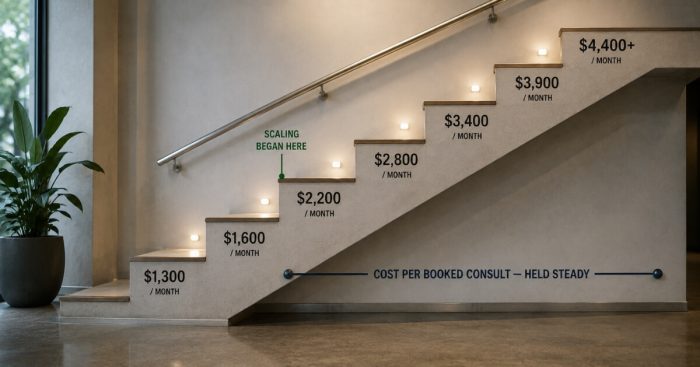
The liposuction campaign started at $1,300 per month and scaled past $4,400 per month — more than triple.
However, the scaling followed the measurement. It did not precede it.
Once the practice knew what a booked consultation cost and saw that the number held, adding budget became mechanical rather than a leap of faith.
Nine months produced 201 FUNsculpting leads.
The full breakdown sits in the Everest Regenerative Medicine case study covering $1.44 million collected in 9 months.
Those results reflect Real ADvice’s work and the practice’s own clinical and sales execution together. The campaign did not close a single case by itself.
Scaling before the number is stable is one of the most expensive mistakes in cash-pay clinic advertising.
Budget increases are an amplifier.
Point them at a funnel that books one in five leads, and you buy more of the same leak. The rate may even get slightly worse because the incremental impressions can be less qualified.
Point additional budget at a funnel with a defensible booked-consult cost, and the extra spend behaves more predictably.
The practical version is simple.
Hold budget flat until you have enough booked consultations to trust the average. Watch the number over two consecutive months.
Then raise spend in increments rather than doubling it. After each increase, check whether the booked-consult cost has drifted.
If it rises and stays up, you may have found the ceiling of the demand available at that price in your market.
At that point, the next gains come from the sales process rather than the budget.
You can’t scale a practice you can’t measure.
Is $88.54 a good cost per lead for liposuction?
There is no universal answer. A good cost per lead depends entirely on your consultation-to-case close rate and what a case actually collects at your practice.
Against a high-ticket cash-pay procedure, $88.54 reads as cheap.
That is precisely the trap.
The same campaign that produced an $88.54 lead also produced a $447 booked consultation. The second figure decides whether the spend survives contact with your calendar.
A practice with a strong front desk and firm follow-up process can pay well over $88.54 a lead and still be comfortably profitable.
By contrast, a practice that lets inquiries sit until the afternoon can pay far less and still lose money. The leads it bought never turned into appointments.
So run the test on your own figures rather than ours.
Take the collected revenue per liposuction case. Then multiply it by the share of revenue you are willing to spend on acquisition.
Next, divide back through your close rate and your leads-to-booked rate.
If that math produces an allowable cost per lead well above $88.54, your number is good. You are probably underspending.
If it produces something below $88.54, the number was never the problem.
Instead, the problem sits somewhere between the form fill and the chair.
How long before you know whether a liposuction campaign is working?
Long enough to accumulate enough booked consultations to trust the average.
That is a count, not a date on the calendar.
Practices that judge a campaign on two weeks of cost-per-lead data are reading noise.
A high-ticket procedure books in small numbers. Therefore, a single strong week or a single dead one can move the average far more than it should.
Decisions made on that swing are effectively coin flips with a budget attached.
The Everest figures come from a nine-month tracked engagement that produced 201 FUNsculpting leads.
That is enough volume for $88.54 and $447 to mean something rather than simply reflect a good fortnight.
The discipline is simple, even when the patience is not.
Hold the budget flat and let cost per booked consultation settle over two consecutive months.
Then make the scale-or-stop decision based on that figure rather than the cost per lead that moves every week.
If the booked-consult cost sits under the ceiling your own economics produced, you have a campaign worth feeding.
If it sits above that ceiling, you have a follow-up project to run before touching the budget.
Ready to find out what a booked liposuction consult actually costs you?
This is for the practice owner who can quote a cost per lead from memory but has no idea what a booked consultation costs.
The gap between those two numbers is far more often a show-rate and follow-up problem than an advertising problem. Yet that gap remains invisible from inside the ad platform.
On a 60-minute strategy call with Real ADvice, we run the arithmetic using your actual figures.
We look at what your liposuction or HD Lipo case collects. Then we examine what happens between a form submission and a booked appointment.
Next, we calculate how many consultations turn into cases and what that makes your true allowable cost per lead.
From there, we compare your current campaigns against that ceiling.
We also determine whether the constraint sits in the ads or the follow-up. Finally, we work out what a defensible budget for the next ninety days looks like.
If the math says you should not be advertising this procedure yet, we will tell you that on the call.