
The Inbound vs. Outbound Phone Intro Script for a Cash-Pay Clinic (The Only Part That Changes, Word for Word)
Clinic owners tend to treat inbound calls and outbound follow-up calls as two different skills that need two different scripts. They aren’t. In the working script an IV therapy clinic in Maui uses, the entire difference between an inbound call and an outbound call is the first few lines — everything after the intro is identical. Here’s the verbatim intro for both, and why the call converges on the same question either way.
What’s the difference between an inbound and an outbound call script at a cash-pay clinic?
Only the introduction changes.
After the first 20 seconds, both conversations become the same call.
The IV Therapy Maui script this article is based on states it clearly:
“The only difference between inbound and outbound script is this intro.”
During an inbound call, the caller already knows why they called.
Your job is to learn who they are.
On an outbound call, you already know who they are.
Instead, your job is to remind them why you’re calling.
Once both people know who’s speaking and why, the conversation reaches the same discovery question.
From there, both calls follow the same path toward a booked appointment.
That distinction matters operationally.
It means you don’t need to train two different scripts.
You train one call structure with two different entry points.
As a result, a front desk team member or patient coordinator who understands the shared body of the call can confidently handle:
- Brand-new inquiries
- Missed-call callbacks
- Website leads
without changing playbooks.
That’s exactly the consistency required before scaling a predictable patient acquisition system instead of hiring more people to improvise.
What should my front desk say word for word when calling a web lead?
First, confirm you’re speaking with the right person.
Then anchor the conversation to the action they already took.
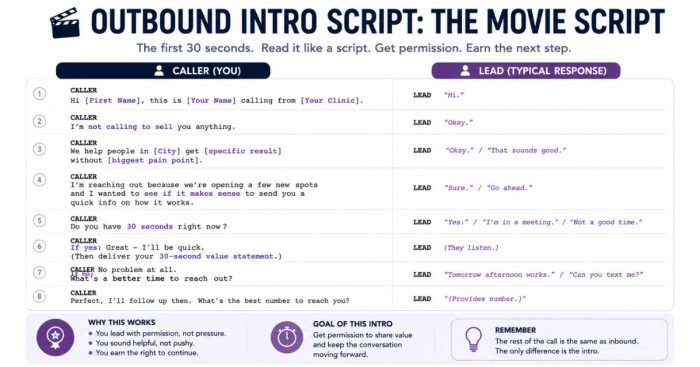
Here’s the outbound introduction, adapted directly from the IV therapy clinic’s script:
“Hello, is this _______?”
The person will usually answer:
- Yes
- No
- “Who is this?”
Then continue with:
“Hello, this is ________ with [Your Clinic], I understand you had requested an appointment on our website — is that right?”
That single sentence accomplishes three things:
- It identifies who you are.
- It reminds the lead they initiated the conversation.
- It asks a simple yes-or-no question they’ll usually confirm.
The patient filled out the form for a reason.
By anchoring the conversation to “you requested an appointment,” you immediately bring that reason back into focus before resistance has time to develop.
What should my front desk say when answering an inbound call?
Greet the caller.
Identify the clinic.
Then ask how you can help.
Before anything else, learn the caller’s name.
The inbound introduction is equally straightforward:
“Hello, this is ________ with [Your Clinic], how may I help you today?”
“I want to set up a consultation with you guys.”
“Oh wonderful — who am I speaking with?”
“My name is ________.”
“Hi _______, nice to meet you.”
At first glance, the script almost seems too simple.
That’s intentional.
The caller explains their reason for calling almost immediately.
Rather than jumping into services or pricing, the person answering simply learns the caller’s name and begins using it.
From that moment forward, the conversation becomes personal.
It is no longer simply a transaction between a customer and a business.
That shift in tone matters.
Whether someone is purchasing a $200 IV drip or a $3,000 treatment program, they’re buying from someone they trust.
Not from a price list.
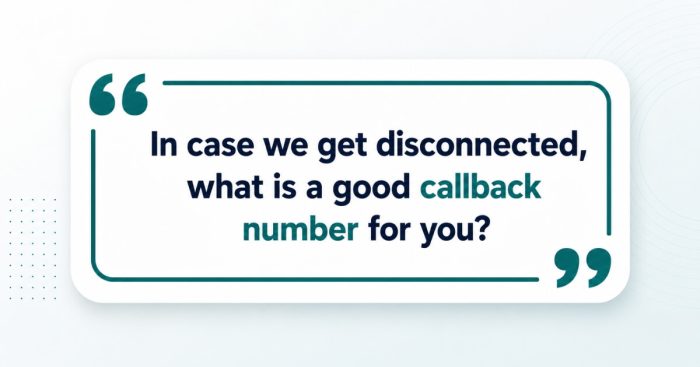
Why should you ask for a callback number in the first minute of the call?
Because asking,
“In case we get disconnected…”
captures contact information without creating sales pressure.
It also completes the first step of Capture, Connect, Close.
The exact script says:
“In case we get disconnected, what is a good callback number for you?”
The caller shares their number.
Then the front desk simply replies:
“Okay great, thank you for that.”
Very few people refuse that request.
After all, it’s presented as protecting the caller’s time rather than building your marketing database.
Once you have the number, however, the opportunity doesn’t disappear.
If:
- The call drops
- The patient needs time to think
- A decision-maker isn’t available
you can reconnect instead of hoping they call back.
Every effective inside-sales system we implement follows the same discipline:
- Capture contact information first.
- Build the relationship.
- Close only the next step.
A regenerative clinic using that approach converted 79.4% of its leads into booked appointments — $309,590 in cash-pay revenue in 10 months without paid ads.
The callback question is only one sentence.
However, what it protects is far more valuable.
What question moves the call from small talk to a booked appointment?
One simple question:
“So tell me, what’s going on? How can we help?”
After the introduction—regardless of whether it was inbound or outbound—the script always converges on this open-ended question.
The note that follows it in the original script may be the most important sentence in the entire document:
“They’ll talk about their ailments and they’ll admit to wanting and needing help.”
That’s how a cash-pay phone call works.
You don’t begin by pitching.
Instead, you ask one open question and let the caller explain why they reached out.
They may describe:
- Fatigue
- Dehydration
- Migraines
- Post-flight exhaustion
- Another health concern
By saying their problem out loud to a friendly person, they’ve already begun making the case for booking.
Your responsibility is simply to recommend the appropriate next step.
The truth is they called—or submitted the form—for a reason.
The facts already exist.
They want help.
The discovery question simply allows them to say it themselves.
Does this intro script work outside IV therapy—for hormone, weight loss, or wellness clinics?
Yes.
The introduction works across nearly every cash-pay healthcare vertical.
Only the discovery questions change.
Notice that neither opening script mentions IV therapy.
Instead, both introductions follow the same sequence:
- Identify yourself.
- Anchor the reason for the conversation.
- Learn the caller’s name.
- Capture a callback number.
- Ask what’s going on.
Whether you run:
- An HRT clinic
- A medical spa
- A functional medicine practice
- An IV therapy clinic
the first minute remains almost identical.
The only difference comes after the patient begins explaining their situation.
That’s why we treat the phone introduction as foundational infrastructure.
The experience those callers receive during the first minute isn’t accidental.
It’s a deliberate, documented system.
Not whoever happened to answer the phone.
If every member of your team answers calls differently, you don’t simply have a scripting problem.
You have a revenue consistency problem.
That’s usually one of the first systems we standardize inside a complete medical practice marketing strategy.
FAQ’s About Inbound and Outbound Clinic Phone Scripts
How fast should my clinic call a new web lead back?
Within minutes.
Not hours.
The outbound introduction works best while the lead still remembers completing the form.
When you say,
“I understand you had requested an appointment on our website…”
it should refer to something they did today.
Not something they barely remember from last week.
Who should run this script—the front desk or a dedicated patient coordinator?
Everyone who answers the phone should know the script thoroughly.
However, as call volume increases, outbound follow-up usually becomes the responsibility of a dedicated patient coordinator or inside-sales role.
The script is intentionally simple enough for both positions to use the same conversation structure.
What if the lead says “no” or “who is this?” on an outbound call?
Stay warm.
Then re-anchor the conversation.
Identify yourself.
Mention your clinic.
Finally, repeat the reason for the call:
“You had requested an appointment on our website—is that right?”
Most “Who is this?” responses are simply automatic screening habits.
They aren’t genuine objections.
The anchor statement resolves them naturally.
Should the script mention pricing in the intro?
No.
The introduction has only three goals:
- Establish your identity.
- Build trust.
- Capture contact information.
Discuss pricing only after the discovery question.
Once you understand what the caller actually needs, you can answer pricing appropriately.
Otherwise, quoting prices during the first minute turns a consultation into a comparison-shopping conversation.
Can I use this same structure for text and email follow-up?
Yes.
The anchoring principle still applies.
Reference the action the lead already took.
Then ask an open-ended question.
Even so, the phone should remain your primary communication channel.
A live conversation is where patients admit they want help.
Text messages and emails are best used for scheduling and maintaining visibility between call attempts.
What’s the next step?
If your clinic answers phones differently depending on who picks up—or if web leads sit untouched until the end of the day—book a strategy call.
In 60 minutes, we’ll:
- Map your current phone workflow.
- Identify where leads leak between the form submission and the booked appointment.
- Give your team a script structure they can begin using immediately.