
How Do I Make My GLP-1 Weight-Loss Program Actually Profitable? (Cross-Selling Past the Weight-Loss Cliff)
GLP-1 weight loss is the busiest front door in cash-pay medicine — and one of the least profitable, because most clinics harvest a few months of margin and then let the patient disappear. The clinics making real money on GLP-1 treat it as the beginning of a relationship, not the whole transaction. This is the FAQ on making a GLP-1 program actually profitable, drawn from a training built on watching this pattern across roughly 20 clinics: they take the ~$600 in profit from the first few months, do nothing after, and lose the patient at the 90-to-120-day cliff.
How do I make my GLP-1 weight-loss program actually profitable?
Stop treating GLP-1 as the whole business and treat it as the entry point — the profit comes from cross-selling that acquired patient into higher-margin care, turning a one-time ~$600 into $2,200 or more in kept profit in year one.
Here’s the trap most clinics are in:
- They charge $400 to $600 a month for the GLP-1 script.
- They collect roughly $1,600 to $2,400 over four months.
- They keep about $600 in profit.
- The patient falls off after 90 to 120 days.
Now they have to pay to acquire a brand-new patient to replace the one they just lost.
It’s a treadmill.
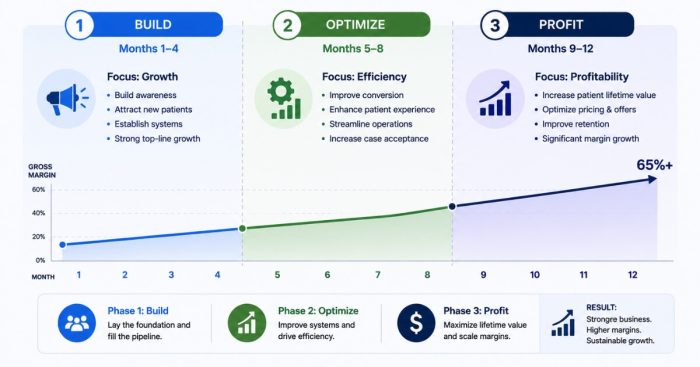
The clinics that win instead move the patient, at around month four, into higher-margin programs — hormones, peptides, or a concierge membership — where they keep far more per month and the patient stays for years.
Run the year-one math and the gap is stark: roughly $600 kept in the harvest-and-lose model versus about $2,200 kept in the cross-sell model, with no repeat ad spend to replace a lost patient.
Because the later phases carry better margins, the advantage compounds every year the patient stays.
The whole game in this business is GLP-1 & weight loss clinic marketing that maximizes lifetime value — you already paid to acquire them, so the profit is in what you do next.
Why do so many GLP-1 patients fall off after a few months?
Because most clinics do nothing with them after the first three or four months — there’s no next-step offer, so patients hit the 90-to-120-day cliff and leave.
The fall-off isn’t mysterious; it’s designed in by neglect.
A patient signs up to lose weight, the clinic fills the script for a few months, and then there’s no plan for what happens once they approach their goal or lose momentum.
With no reason to stay and nothing new offered, they drift off.
The clinic pockets its ~$600 and starts the acquisition treadmill over again.
Across roughly 20 discovery calls, this same enormous drop-off showed up again and again — nobody was doing anything with these patients.
The fix is to design the journey past the weight-loss phase before the patient ever reaches the cliff.
Retention isn’t something you scramble for at month four; it’s something you build into the program from the first consult.
When there’s a clear, valuable next step waiting — and the patient was told about it up front — the cliff becomes a transition instead of an exit.
Preventing the fall-off is worth far more than any new ad campaign because it’s revenue you’ve already earned the right to.
How should I price a GLP-1 program without racing to the bottom?
Don’t compete on the GLP-1 price itself — use it as a $400-to-$600-a-month front door and make your real margin on the next phase, letting lab work rather than a sales pitch drive the upsell.
The GLP-1 script is a low-margin, commoditized entry point.
If you try to win by being the cheapest, you’re in a race to the bottom against every telehealth company and clinic in your market.
So don’t.
Price the GLP-1 phase competitively as the front door, and design the profit into phase two — hormones, peptides, or concierge — where margins are better.
Build the lab cost (roughly $150 to $200) into the program price rather than billing it separately because those recurring labs are what create the upsell opportunity.
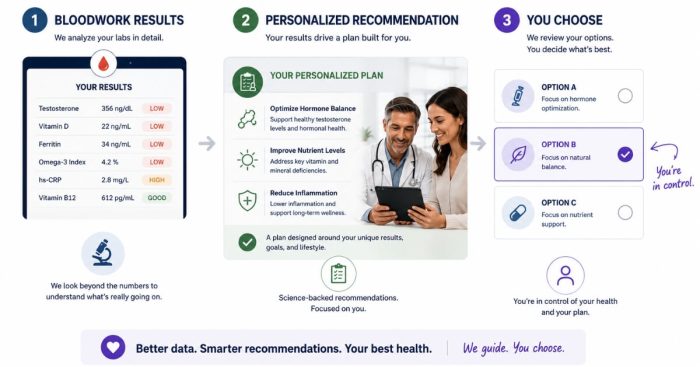
The key move is to let the labs do the selling.
Present the patient with options based on their bloodwork so the recommendation feels objective — “it’s not me trying to sell you, it’s the blood work.”
That reframes the decision as choosing between your services rather than between you and a cheaper competitor, which sidesteps price competition entirely.
When the data drives the next step, you’re not discounting to compete; you’re guiding care, which is both better medicine and better business.
What should I cross-sell GLP-1 weight-loss patients into?
Transition them at around month four into hormones, peptides, or a concierge membership — treatments where your margins are better, typically at $300 to $700 a month.
These are the natural, clinically sound next steps for a patient who has been losing weight:
- Optimizing hormones
- Adding peptides
- Moving into a comprehensive concierge relationship
They also happen to be higher-margin than the GLP-1 script, so you keep far more per month — on the order of $800 to $2,000 kept per phase versus ~$600 for the weight-loss phase.
You already paid to acquire this patient, so every additional program is close to pure lifetime value with no new acquisition cost attached.
If you don’t stock those medications, you’re not shut out.
Put the patient on a concierge program, transfer their standard care to you, and have them meet your NP or PA.
The point isn’t a specific product; it’s that the patient’s relationship with your clinic continues into higher-value care instead of ending at goal weight.
This cross-sell is where a GLP-1 program stops being a low-margin treadmill and becomes a genuinely profitable, high-LTV business — which is exactly what a functional medicine & longevity clinic marketing model is built to do.
How do I retain GLP-1 patients past the weight-loss cliff?
Build recurring lab work into the program and set the expectation at the first consult that you’ll re-test at month four — so each lab cycle creates a natural consult and a new offer.
Retention that works is structural, not motivational.
At the very first consult, tell the patient you’ll redo their labs at the end of month four, which pre-sells the next phase before they ever hit the cliff.
Then follow through:
- Redo labs at day 90.
- Hold a longer consult (around 60 minutes) to review the results.
- Transition them into the hormone, peptide, or concierge phase.
Repeat the lab-to-consult-to-offer loop again at months eight to twelve, and indefinitely after that.
Each cycle renews the relationship instead of letting it lapse.
That rhythm is what turns a weight-loss patient into a multi-year patient.
Because the labs are built into the price and expected from day one, there’s no awkward upsell moment — just the natural next step in ongoing care.
Many of these patients then stay for years, which is the entire point.
The clinics that retain past the cliff aren’t better at persuasion; they’re better at designing a journey where staying is the default and each check-in is a built-in opportunity.
How much more can I make per GLP-1 patient with an upsell model?
In year one, roughly $600 kept in the harvest-and-lose model versus about $2,200 kept in the upsell model — with no repeat ad spend to replace a lost patient, and a gap that compounds every year they stay.
The comparison is the whole argument.
Option one:
- Keep about $600.
- Lose the patient after 90 to 120 days.
- Pay again to acquire a replacement.
Option two:
- Keep meaningfully more across three phases in the first year.
- Benefit from the later hormone, peptide, and concierge phases carrying better margins ($800 to $2,000 kept each).
- Land around $2,200 in year-one kept profit.
- Avoid any re-acquisition cost.
You’re not just earning more per patient; you’re eliminating the cost of constantly replacing the ones who left.
And year one is only the start.
A patient retained into ongoing care stays for years, so the LTV difference keeps widening well beyond that first-year figure.
When you multiply this across your whole patient base, the difference between the two models is the difference between a busy clinic that stays flat and a profitable clinic that compounds.
Maximizing what you keep per acquired patient is the highest-leverage number in a GLP-1 business.
FAQ’s About Making a GLP-1 Program Profitable
Should I bill separately for lab work in my program?
No — build the roughly $150-to-$200 lab cost into the program price.
Absorbing it lets you re-test about every 90 days, and each test creates a fresh, low-pressure selling opportunity that converts patients into higher-ticket care.
Billing labs separately makes them feel like an add-on cost.
Building them in makes them a natural, expected part of ongoing care — and the engine of your cross-sell.
How do labs actually “sell” the next phase for me?
By making the recommendation objective.
When you present options based on the patient’s own bloodwork, the decision stops being “you versus a cheaper competitor” and becomes “which of your services fits my results.”
As the framing goes, “it’s not me trying to sell you — it’s the blood work.”
That neutral, data-driven presentation converts far better than a pitch because patients trust their own numbers.
What if I don’t stock hormones or peptides?
Put the patient on a concierge program instead.
Transfer their standard care to your clinic, have them meet your NP or PA, and keep the relationship going into higher-value, higher-margin comprehensive care.
The specific product matters less than continuing the relationship past goal weight — a concierge membership accomplishes the same LTV goal without requiring you to dispense those medications.
Isn’t GLP-1 basically a loss leader, then?
It’s better to think of it as a competitively priced entry point than a loss leader — you still make a modest profit on the weight-loss phase, but the strategy treats it as the front door to a much more profitable relationship.
The mistake is treating that front-door profit as the whole business.
Price it to win the patient, then make your real money on the higher-margin phases that follow.
What’s the next step?
If your GLP-1 program feels busy but not very profitable, it’s because you’re harvesting a few months of margin and letting patients fall off the cliff.
The fix is to design the whole journey:
- Price GLP-1 as the front door.
- Build recurring labs into the program.
- Set the month-four expectation up front.
- Transition patients into higher-margin hormone, peptide, or concierge care so they stay for years.
That’s the difference between keeping $600 and keeping $2,200-plus per patient.
On a strategy call we’ll map your GLP-1 patient journey and show you exactly where to insert the labs, the consults, and the cross-sell so your program becomes genuinely profitable.
It’s the same LTV work behind clinics like a weight-loss and medspa clinic where we added $6.7M in a year across 3,727 new patients.