
How Do I Know If I’m Scaling My Cash-Pay Clinic Too Fast?
Growth is the goal, but growth outrunning your operation is how good clinics quietly break. The warning signs rarely show up in the revenue number first. They show up in the patient experience, the team’s stress, and the retention that slowly erodes underneath a rising top line. This FAQ explains how to recognize when you’re scaling too fast, based on a clinic that learned the lesson the hard way. It grew into a high-volume, low-ticket customer-service nightmare where patients felt like a ticket number. The clinic eventually stepped back and rebuilt around experience instead of raw volume.
How do I know if I’m scaling my cash-pay clinic too fast?
The clearest sign is that the patient experience starts declining even while revenue continues climbing.
Common warning signs include:
- Patients begin feeling like a number.
- Your team becomes overwhelmed.
- Follow-up becomes inconsistent.
- Retention quietly starts slipping.
Scaling too quickly often looks healthy on a revenue report.
That is exactly what makes it dangerous.
Behind the scenes, the patterns are usually consistent.
Front-desk and clinical staff become too busy to provide a great experience.
Follow-up becomes rushed.
Patients leave slightly faster each month.
The atmosphere shifts from genuine care to:
“Let’s go. Next patient.”
One clinic described this stage bluntly.
Its membership model had become “low ticket, high volume.”
Patients no longer felt cared for.
They simply felt like another number.
If that sounds familiar, your clinic is probably growing faster than your systems and team can support.
The answer is not to stop growing.
Instead, make sure your:
- Operations
- Patient experience
- Retention systems
grow alongside patient acquisition.
That difference separates sustainable growth from growth that eventually collapses.
It is also why sustainable scaling is really a medical practice marketing consultants conversation about the entire business—not simply the top of the marketing funnel.
Why does scaling too fast break the patient experience?
Rapid growth increases workload faster than your systems and staff can handle it.
Eventually, there is no time left to deliver the experience that actually creates revenue.
When patients grow faster than capacity:
- The front desk stops welcoming people and starts processing them.
- Providers stop connecting and start rushing.
- Patients immediately notice the difference.
People came expecting personalized care.
Instead, they experience a conveyor belt.
That becomes especially dangerous in cash-pay medicine.
Patients pay out of pocket.
They can leave whenever they choose.
A mediocre experience quickly becomes a retention problem.
This is the biggest trap.
Patient experience is not something you add after building the business.
It is the business.
Excellent experiences generate:
- Repeat visits
- Memberships
- Referrals
Administrative overload generates none of those.
Scaling faster than your experience can support trades tomorrow’s retention for today’s revenue.
That is almost always a losing trade.
Protect the experience first.
Long-term growth depends on it.
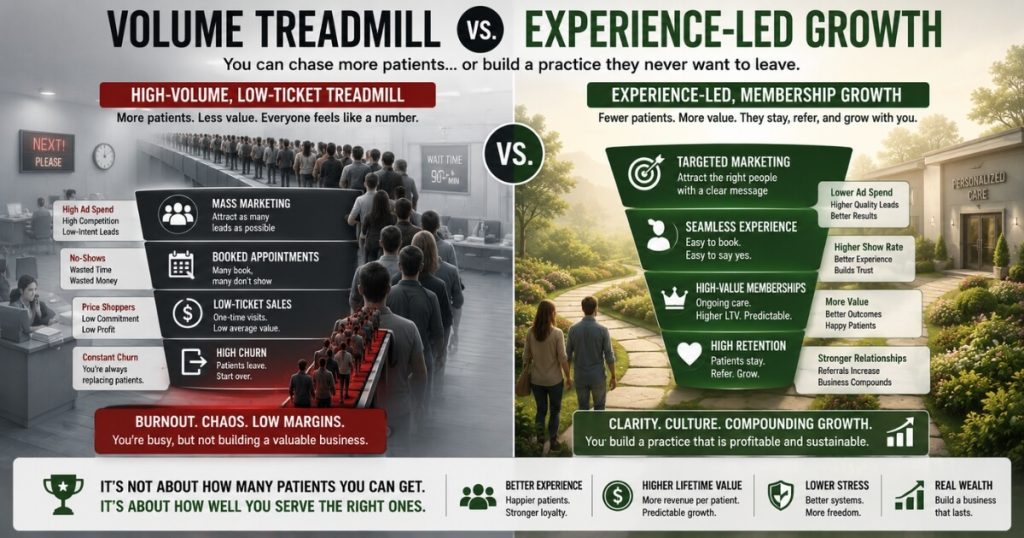
Should I grow with high volume and low ticket, or fewer, higher-value patients?
In most cases, fewer higher-value patients create a stronger business.
Membership models generally outperform high-volume, low-ticket growth.
The clinic that learned this lesson eventually asked itself one simple question:
“Is this really the business we want?”
The answer was no.
High-volume, low-ticket models create:
- More patients
- More transactions
- More customer-service demands
- Smaller margins
All of those place additional pressure on the patient experience.
Membership models reverse that equation.
Instead of chasing volume, they provide:
- Fewer patients
- Higher revenue per patient
- Predictable recurring income
- More time to deliver exceptional care
That does not mean rejecting growth.
It means choosing the right kind of growth.
Higher-value patient relationships scale much more smoothly than constant low-ticket transactions.
Each patient contributes more revenue.
Each patient requires proportionally less operational chaos.
Growth built on value compounds.
Growth built only on volume eventually overwhelms itself.
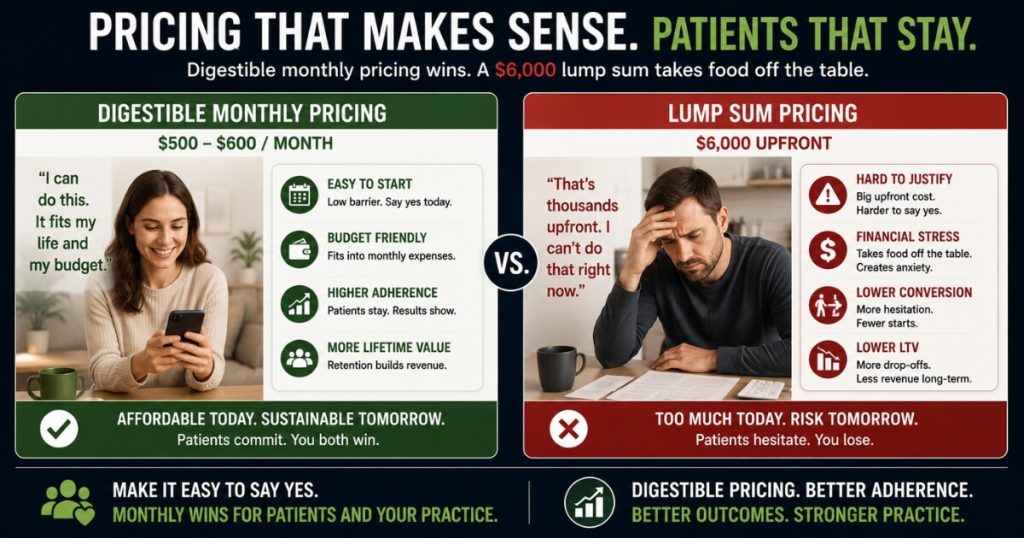
How do I make my pricing digestible so I can grow without scaring patients away?
Break large program costs into manageable monthly payments.
Patients often accept monthly memberships that they would reject as one large upfront payment.
One clinic explained it this way:
“Six thousand dollars may take food off the table for some families, but $500 to $600 per month feels much more manageable.”
The care never changed.
Only the way the pricing was presented changed.
Monthly memberships allow patients to say “yes” to programs they may have declined as one lump-sum expense.
That expands your potential patient base without reducing the value of your services.
Digestible pricing also creates another advantage.
Recurring monthly payments provide predictable revenue.
Predictable revenue makes sustainable growth much easier to manage.
When discussing pricing:
- Present the monthly investment.
- Structure the commitment clearly.
- Maintain the value of the program.
That combination improves conversion while supporting healthier long-term growth.
Should I market aggressively to grow, or grow through referrals and experience?
Build your patient experience first.
Allow referrals to grow naturally.
Then increase paid marketing once your operation can comfortably handle additional demand.
Many successful cash-pay clinics generate significant growth through referrals without relying heavily on paid advertising.
Outstanding patient experiences naturally create referral momentum.
Referral growth also has another advantage.
It tends to arrive at a pace that your team can actually support.
When aggressive advertising is added before your systems are ready, it accelerates the very problems that eventually damage the patient experience.
The order matters.
Build:
- Strong patient experiences.
- Reliable operational systems.
- Referral momentum.
Then add paid advertising.
Marketing simply amplifies whatever already exists.
If your systems are excellent, marketing multiplies growth.
If your systems are strained, marketing multiplies stress.
That readiness forms the foundation of every successful patient acquisition strategy.
How do I scale sustainably without losing what makes my clinic good?
Scale your systems before you scale your patient volume.
Sustainable growth is really a sequencing problem.
The clinics that grow successfully build infrastructure before increasing demand.
That infrastructure includes:
- Documented operating procedures
- Clearly defined team roles
- Predictable recurring revenue
- Capacity that matches projected growth
Only then do they accelerate patient acquisition.
Clinics that struggle usually reverse the order.
They:
- Chase more patients.
- Overload the team.
- Scramble to build systems afterward.
- Watch patient retention decline.
Across every successful clinic, one principle stayed consistent.
They protected the experience that made them successful in the first place.
They never sacrificed it simply to produce a larger revenue number.
That is how clinics can grow substantially while maintaining the standard of care patients expect.
Grow your operation alongside your ambition.
When those two stay aligned, sustainable growth becomes achievable instead of self-defeating.
FAQ’s About Scaling a Cash-Pay Clinic Sustainably
What’s a healthy pace of growth for a cash-pay clinic?
Steady, manageable growth is healthier than explosive spikes.
The goal is to add patients at a pace your team and systems can consistently support.
Healthy growth means:
- Your patient experience stays strong.
- Your team is not overwhelmed.
- Retention remains stable.
- Service quality does not decline.
Consistent month-over-month growth compounds far better than a sudden surge that overloads the operation.
Watch more than just revenue.
Pay attention to:
- Team stress
- Patient feedback
- Retention
- Overall experience
If those metrics begin declining while revenue rises, your clinic is probably growing faster than your operation can absorb.
How do I protect the patient experience while growing?
Build capacity before demand overwhelms your team.
Treat patient experience as one of your primary business metrics—not an afterthought.
Strong clinics prepare by:
- Documenting key processes.
- Defining team responsibilities clearly.
- Training staff before capacity becomes a problem.
- Monitoring patient feedback regularly.
Do not focus only on revenue.
Track experience just as carefully.
For example:
- Patient retention
- Reviews
- Referral volume
- Follow-up quality
Remember:
Patient experience creates revenue.
Protecting the experience means protecting long-term growth.
Is a membership model better for sustainable scaling?
Usually, yes.
Memberships support sustainable growth because they create:
- Higher-value patients
- Predictable recurring revenue
- More stable cash flow
Compared with high-volume, low-ticket transactions, memberships require fewer patients to generate the same revenue.
That gives your team more time to provide exceptional care.
Recurring revenue also improves planning.
It becomes much easier to:
- Forecast staffing needs.
- Invest in better systems.
- Improve the patient experience.
That combination is why many of the most durable cash-pay clinics rely on memberships as the foundation of their growth strategy.
When should I add staff or capacity as I scale?
Add capacity before patients begin feeling the strain.
Waiting until your team becomes overwhelmed is already too late.
Watch for early warning signs such as:
- Staff consistently rushing appointments.
- Less personal interaction with patients.
- Delayed follow-up.
- Increasing team stress.
If those patterns appear regularly, your clinic has probably outgrown its current capacity.
Adding staff one step ahead of demand helps preserve:
- Patient experience
- Team morale
- Long-term retention
That proactive approach prevents the slow erosion that often follows rapid growth.
What’s the next step?
If your revenue is increasing but your clinic feels strained, your growth may be outpacing your operation.
Common warning signs include:
- Patients feeling like numbers.
- A team constantly under pressure.
- Retention beginning to decline.
- The overall experience slipping.
The answer is not to stop growing.
The answer is to strengthen the operation so growth continues without sacrificing what made your clinic successful.
That means focusing on:
- Digestible membership pricing.
- Higher-value recurring patient relationships.
- Experience-driven referral growth.
- Systems that are built before demand arrives.
Those are the foundations of sustainable scaling.
During a strategy call, we’ll compare your current growth rate with your operational capacity.
We’ll identify where your systems need to expand so you can continue growing without sacrificing the patient experience.
It’s the same approach we used with clinics like an HRT clinic we grew from $1M to $4M per year, while protecting both the patient experience and the owners’ quality of life.